


Structure of genetic and environmental risk factors for dimensional representations of DSM-IV anxiety disorders
- PMID: 19794197
- PMCID: PMC3010208
- DOI: 10.1192/bjp.bp.108.059485
Structure of genetic and environmental risk factors for dimensional representations of DSM-IV anxiety disorders
Abstract
Background: Twin data permit decomposition of comorbidity into genetically and environmentally derived correlations. No previous twin study includes all major forms of anxiety disorder.
Aims: To estimate the degree to which genetic and environmental risk factors are shared rather than unique to dimensionally scored panic disorder, generalised anxiety disorder, phobias, obsessive-compulsive disorder and post-traumatic stress disorder.
Method: Data obtained from 2801 young-adult Norwegian twins by means of the Composite International Diagnostic Interview were analysed with the Mx program.
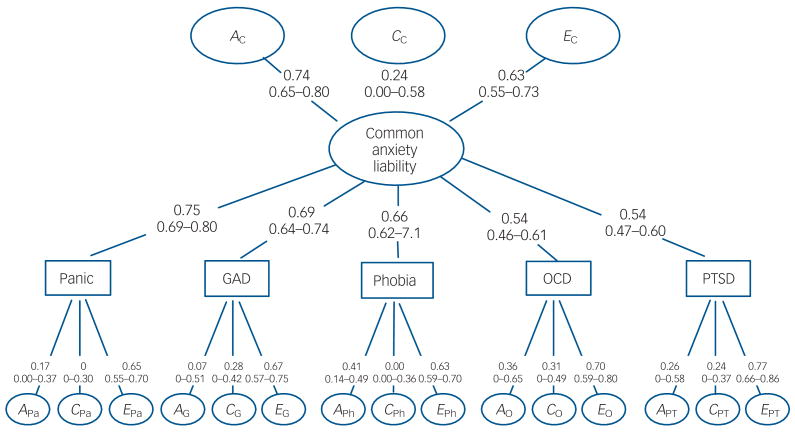
Results: A multivariate common factor model fitted best. The latent liability to all anxiety disorders was substantially more heritable (54%) than the individual disorders (23% to 40%). Most of the genetic effect was common to the disorders. Genes contributed just over 50% to the covariance between liabilities.
Conclusions: The five anxiety disorders all share genetic and environmental risk factors. This has implications for the revision of the anxiety disorder section in DSM-V.
Conflict of interest statement
Figures
References
-
- Middeldorp CM, Birley AJ, Cath DC, Gillespie NA, Willemsen G, Statham DJ, et al. Familial clustering of major depression and anxiety disorders in Australian and Dutch twins and siblings. Twin Res Hum Genet. 2005;8:609–15. - PubMed
-
- Hettema JM, Neale MC, Kendler KS. A review and meta-analysis of the genetic epidemiology of anxiety disorders. Am J Psychiatry. 2001;158:1568–78. - PubMed
-
- Chantarujikapong SI, Scherrer JF, Xian H, Eisen SA, Lyons MJ, Goldberg J, et al. A twin study of generalized anxiety disorder symptoms, panic disorder symptoms and post-traumatic stress disorder in men. Psychiatry Res. 2001;103:133–45. - PubMed
-
- Hettema JM, Prescott CA, Myers JM, Neale MC, Kendler KS. The structure of genetic and environmental risk factors for anxiety disorders in men and women. Arch Gen Psychiatry. 2005;62:182–9. - PubMed
-
- Kendler KS, Gardner CO, Prescott CA. Panic syndromes in a population-based sample of male and female twins. Psychol Med. 2001;31:989–1000. - PubMed
