


Type 2 Diabetes Mellitus: New Genetic Insights will Lead to New Therapeutics
- PMID: 19794883
- PMCID: PMC2699827
- DOI: 10.2174/138920209787847023
Type 2 Diabetes Mellitus: New Genetic Insights will Lead to New Therapeutics
Abstract
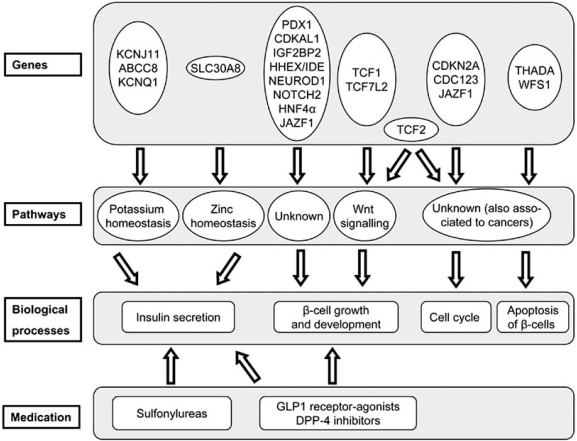
Type 2 diabetes is a disorder of dysregulated glucose homeostasis. Normal glucose homeostasis is a complex process involving several interacting mechanisms, such as insulin secretion, insulin sensitivity, glucose production, and glucose uptake. The dysregulation of one or more of these mechanisms due to environmental and/or genetic factors, can lead to a defective glucose homeostasis. Hyperglycemia is managed by augmenting insulin secretion and/or interaction with hepatic glucose production, as well as by decreasing dietary caloric intake and raising glucose metabolism through exercise. Although these interventions can delay disease progression and correct blood glucose levels, they are not able to cure the disease or stop its progression entirely. Better management of type 2 diabetes is sorely needed. Advances in genotyping techniques and the availability of large patient cohorts have made it possible to identify common genetic variants associated with type 2 diabetes through genome-wide association studies (GWAS). So far, genetic variants on 19 loci have been identified. Most of these loci contain or lie close to genes that were not previously linked to diabetes and they may thus harbor targets for new drugs. It is also hoped that further genetic studies will pave the way for predictive genetic screening. The newly discovered type 2 diabetes genes can be classified based on their presumed molecular function, and we discuss the relation between these gene classes and current treatments. We go on to consider whether the new genes provide opportunities for developing alternative drug therapies.
Keywords: Type 2 diabetes; drug targets; genetics; personalized medicine..
Figures
References
-
- Newman B, Selby JV, King MC, Slemenda C, Fabsitz R, Friedman GD. Concordance for type 2 (non-insulin-dependent) diabetes mellitus in male twins. Diabetologia. 1987;30:763–768. - PubMed
-
- van Haeften TW, Dubbeldam S, Zonderland ML, Erkelens DW. Insulin secretion in normal glucose-tolerant relatives of type 2 diabetic subjects. Assessments using hyperglycemic glucose clamps and oral glucose tolerance tests. Diabetes Care. 1998;21:278–282. - PubMed
-
- Pimenta W, Korytkowski M, Mitrakou A, Jenssen T, Yki-Jarvinen H, Evron W, Dailey G, Gerich J. Pancreatic beta-cell dysfunction as the primary genetic lesion in NIDDM. Evidence from studies in normal glucose-tolerant individuals with a first-degree NIDDM relative. Jama. 1995;273:1855–1861. - PubMed
-
- Vaxillaire M, Froguel P. Monogenic diabetes in the young, pharmacogenetics and relevance to multifactorial forms of type 2 diabetes. Endocr. Rev. 2008;29:254–264. - PubMed
-
- Horikawa Y, Iwasaki N, Hara M, Furuta H, Hinokio Y, Cockburn BN, Lindner T, Yamagata K, Ogata M, Tomonaga O, Kuroki H, Kasahara T, Iwamoto Y, Bell GI. Mutation in hepatocyte nuclear factor-1 beta gene (TCF2) associated with MODY. Nat. Genet. 1997;17:384–385. - PubMed
LinkOut - more resources
Full Text Sources