


Three-dimensional culture models of mammary gland
- PMID: 19794898
- PMCID: PMC2710524
- DOI: 10.4161/org.5.2.8321
Three-dimensional culture models of mammary gland
Abstract
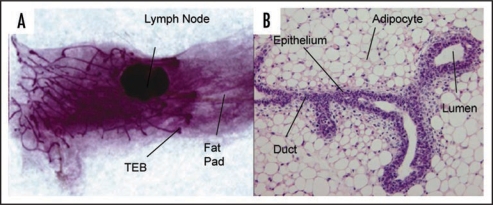
The mammary gland is a complex tissue comprised of a branching network of ducts embedded within an adipocyte-rich stroma. The ductal epithelium is a bi-layer of luminal and myoepithelial cells, the latter being in contact with a basement membrane. During pregnancy, tertiary branching occurs and lobuloalveolar structures, which produce milk during lactation, form in response to hormonal and cytokine signals. Postlactational regression is characterized by extensive cell death and tissue remodeling. These complex developmental events have been difficult to mimic in cell culture although many useful culture models exist. Recently, considerable advances in three-dimensional modelling of the mammary gland have been made with the use of collagen and other biomaterials for the study of branching morphogenesis and tumorigenesis, techniques which may enable rapid advances in our understanding of both basic biology and the study of cancer therapeutics.
Keywords: adipocytes; cell culture; cell-lines; epithelium; extracellular matrix; mammary gland; models; scaffolds; tissue engineering.
Figures
References
-
- Senger DR, Van de Water L, Brown LF, Nagy JA, Yeo KT, Yeo TK, et al. Vascular permeability factor (VPF, VEGF) in tumor biology. Cancer Metastasis Rev. 1993;12:303–324. - PubMed
-
- Brennan KR, Brown AMC. Wnt Proteins in Mammary development and cancer. J Mammary Gland Biol Neoplasia. 2004;9:119–131. - PubMed
-
- Trichopoulos D, Adami HO, Ekbom A. Early life events and conditions and breast cancer risk: From epidemiology to etiology. Int J Cancer. 2008;122:481–485. - PubMed
-
- Robinson GW. Cooperation of signalling pathways in embryonic mammary gland development. Nat Rev Genet. 2007;8:963–972. - PubMed
Grants and funding
LinkOut - more resources
Full Text Sources
