. 2010 May;11(2):185-91.
doi: 10.1007/s10048-009-0219-8. Epub 2009 Oct 1.

A Copine family member, Cpne8, is a candidate quantitative trait gene for prion disease incubation time in mouse

Affiliations

A Copine family member, Cpne8, is a candidate quantitative trait gene for prion disease incubation time in mouse

Sarah E Lloyd et al. Neurogenetics. 2010 May.

Abstract

Prion disease incubation time in mice is determined by many factors including genetic background. The prion gene itself plays a major role in incubation time; however, other genes are also known to be important. Whilst quantitative trait loci (QTL) studies have identified multiple loci across the genome, these regions are often large, and with the exception of Hectd2 on Mmu19, no quantitative trait genes or nucleotides for prion disease incubation time have been demonstrated. In this study, we use the Northport heterogeneous stock of mice to reduce the size of a previously identified QTL on Mmu15 from approximately 25 to 1.2 cM. We further characterised the genes in this region and identify Cpne8, a member of the copine family, as the most promising candidate gene. We also show that Cpne8 mRNA is upregulated at the terminal stage of disease, supporting a role in prion disease. Applying these techniques to other loci will facilitate the identification of key pathways in prion disease pathogenesis.


Figures
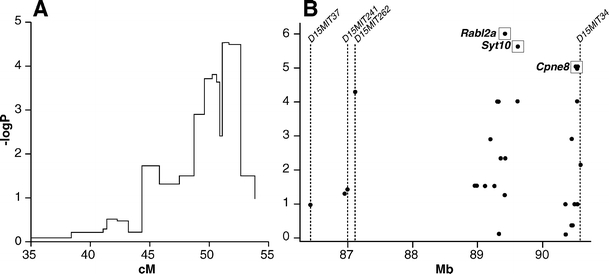
Fig. 1
Fig. 1
HAPPY multipoint linkage analysis for D15Mit234–D15Mit43. Results are displayed on the y-axis as −log of the P value with cM along Mmu15 on the x-axis (a) and Mb along Mmu15 on the x-axis for b. a Log probability plot (additive model). The peak of linkage is seen for the interval D15Mit241–D15Mit262 (−logP = 4.52) and the adjacent interval D15Mit262–D15Mit34 (−logP = 4.48). These data are generated by analysis of HS mice (n = 400) from both extremes of the incubation time distribution. For details of intervals, see Electronic supplementary material, Table 1. b HAPPY analysis (additive merged model) for all polymorphisms detected in the interval D15Mit37–D15Mit34. SNPs are derived from sequencing the HS parental lines and data are analysed according to the methods of Yalcin et al [22]. Details for individual SNPs are given in Electronic supplementary material, Table 3. Highly significant SNPs are boxed to illustrate the associated gene
Fig. 2
Fig. 2
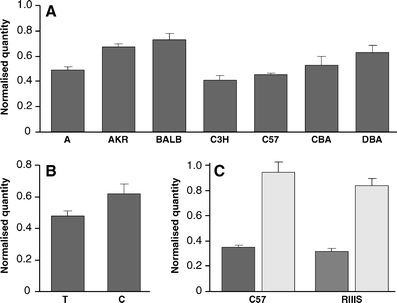
Cpne8 mRNA expression. cDNA was prepared from the whole brains of uninfected 6- to 8-week-old male mice or mice at the terminal stages of prion disease (Chandler/RML). All samples were duplexed for Cpne8 (Fam-label) and an endogenous control GAPDH, β-actin or Thy-1 (Vic-label). Samples were run in triplicate with n = 6 for each mouse strain/group (except CBA where n = 3). Mean ± SEM Cpne8 mRNA expression level is expressed in arbitrary units as normalised by the geometric mean of the quantity of the endogenous controls (y-axis). a Parental strains of the HS mice (except LP). b Mouse strains are grouped by the main significant strain distribution seen in Cpne8 as represented by the genotype at a 3′UTR SNP (CPNE3UB T/C; T = A, C3H, CBA; C = AKR, BALB, C57, DBA). c Comparison of Cpne8 mRNA expression in C57BL/6 and RIIIS/J mice in normal and RML infected mice. Dark grey and light grey bars represent uninfected and RML-infected mice, respectively. Significant differences are seen between normal and terminally sick mice (P = 2.7 × 10−5 and P = 7.9 × 10−6 for C57BL/6 and RIIIS/J, respectively)

References

    1. Carlson GA, Westaway D, Goodman PA, Peterson M, Marshall ST, et al. Genetic control of prion incubation period in mice. Ciba Found Symp. 1988;135:84–99. - PubMed
    1. Dickinson AG, Meikle VM, Fraser H. Identification of a gene which controls the incubation period of some strains of scrapie agent in mice. J Comp Pathol. 1968;78:293–299. doi: 10.1016/0021-9975(68)90005-4. - DOI - PubMed
    1. Kingsbury DT, Kasper KC, Stites DP, Watson JD, Hogan RN, et al. Genetic control of scrapie and Creutzfeldt–Jakob disease in mice. J Immunol. 1983;131:491–496. - PubMed
    1. Westaway D, Goodman PA, Mirenda CA, McKinley MP, Carlson GA, et al. Distinct prion proteins in short and long scrapie incubation period mice. Cell. 1987;51:651–662. doi: 10.1016/0092-8674(87)90134-6. - DOI - PubMed
    1. Moore RC, Hope J, McBride PA, McConnell I, Selfridge J, et al. Mice with gene targetted prion protein alterations show that Prnp, Sinc and Prni are congruent. Nat Genet. 1998;18:118–125. doi: 10.1038/ng0298-118. - DOI - PubMed

Publication types