


Novel trafficking routes for hematopoietic stem and progenitor cells
- PMID: 19796236
- PMCID: PMC2847888
- DOI: 10.1111/j.1749-6632.2009.04609.x
Novel trafficking routes for hematopoietic stem and progenitor cells
Abstract
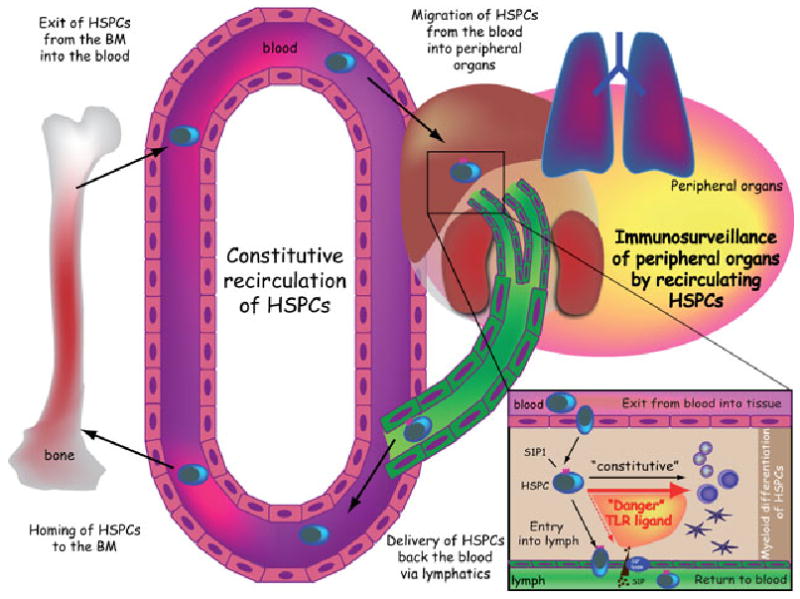
Bone marrow (BM)-resident hematopoietic stem and progenitor cells (HSPCs) are known to enter the blood and to home back to the BM. However, whether these migratory HSPCs also follow extramedullary traffic routes is unknown. Our group has recently shown that mouse thoracic duct (TD) lymph contains clonogenic HSPCs that possess short- and long-term multilineage reconstitution capacity in primary and secondary transplantation assays. Using BM transplantation, homing experiments, and parabiotic mice, we established that TD HSPCs originate in the BM and traffic constitutively to multiple extramedullary tissues, where they reside for several days until entering draining lymphatics to return to the blood. While these migratory properties of HSPCs resemble those of lymphocytes, circulating HSPCs access different target tissues because, unlike lymphocytes, they do not require secondary lymphoid organs to recirculate. The egress of HSPCs from extramedullary tissues into lymph depends on sphingosine-1-phosphate (S1P) receptors, particularly S1P(1). We have shown that under physiological conditions migratory HSPCs contribute to the continuous restoration of specialized hematopoietic cells that reside in peripheral tissues. Upon exposure to toll-like receptor (TLR) agonists, migratory HSPCs proliferate locally within extramedullary tissues and generate innate immune effector cells. Thus, HSPCs can survey peripheral organs to replenish tissue-resident hematopoietic cells and act as a source of mature leukocytes during host defense against pathogens.
Conflict of interest statement
Figures
References
-
- Wright DE, et al. Physiological migration of hematopoietic stem and progenitor cells. Science. 2001;294:1933–1936. - PubMed
-
- von Andrian UH, Mackay CR. T-cell function and migration. Two sides of the same coin. N Engl J Med. 2000;343:1020–1034. - PubMed
-
- Mazo IB, et al. Bone marrow is a major reservoir and site of recruitment for central memory CD8+ T cells. Immunity. 2005;22:259–270. - PubMed
Publication types
MeSH terms
Grants and funding
LinkOut - more resources
Full Text Sources
Other Literature Sources
Medical
