


Heightened endoplasmic reticulum stress in the lungs of patients with chronic obstructive pulmonary disease: the role of Nrf2-regulated proteasomal activity
- PMID: 19797762
- PMCID: PMC2796732
- DOI: 10.1164/rccm.200903-0324OC
Heightened endoplasmic reticulum stress in the lungs of patients with chronic obstructive pulmonary disease: the role of Nrf2-regulated proteasomal activity
Retraction in
-
Retraction: Decline in NRF2-regulated Antioxidants in Chronic Obstructive Pulmonary Disease Lungs Due to Loss of Its Positive Regulator, DJ-1; Heightened Endoplasmic Reticulum Stress in the Lungs of Patients with Chronic Obstructive Pulmonary Disease: The Role of Nrf2-Regulated Proteasomal Activity.Am J Respir Crit Care Med. 2016 Feb 1;193(3):344. doi: 10.1164/rccm.1933retraction. Am J Respir Crit Care Med. 2016. PMID: 26829430 Free PMC article. No abstract available.
Expression of concern in
-
Expression of concern: decline in NRF2-regulated antioxidants in COPD lungs due to loss of its positive regulator, and heightened endoplasmic reticulum stress in the lungs of patients with COPD.Am J Respir Crit Care Med. 2014 Nov 15;190(10):1200. doi: 10.1164/rccm.190101200. Am J Respir Crit Care Med. 2014. PMID: 25398118 Free PMC article. No abstract available.
Abstract
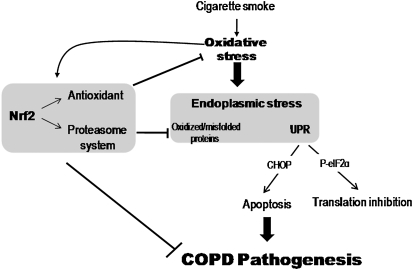
Rationale: Nuclear factor erythroid 2-related factor 2 (Nrf2), an important regulator of lung antioxidant defenses, declines in chronic obstructive pulmonary disease (COPD). However, Nrf2 also regulates the proteasome system that degrades damaged and misfolded proteins. Because accumulation of misfolded proteins in the endoplasmic reticulum (ER) causes ER stress and ER stress-induced apoptosis, Nrf2 may potentially prevent ER stress-mediated apoptosis in COPD.
Objectives: To determine whether Nrf2-regulated proteasome function affects ER stress-mediated apoptosis in COPD.
Methods: We assessed the expression of Nrf2, Nrf2-dependent proteasomal subunits, proteasomal activity, markers of ER stress, and apoptosis in emphysematous lungs of mice exposed to cigarette smoke (CS) as well as peripheral lung tissues from normal control subjects and patients with COPD.
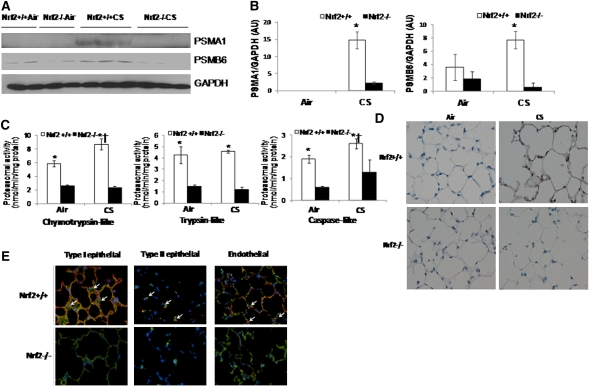
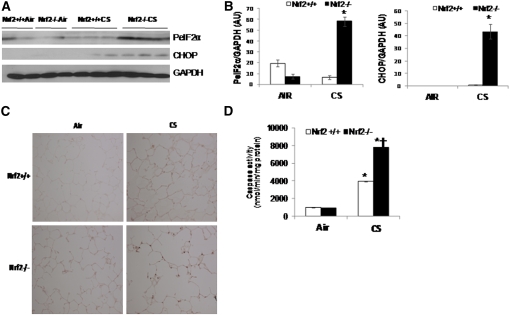
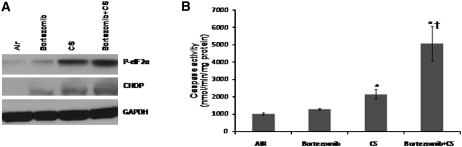
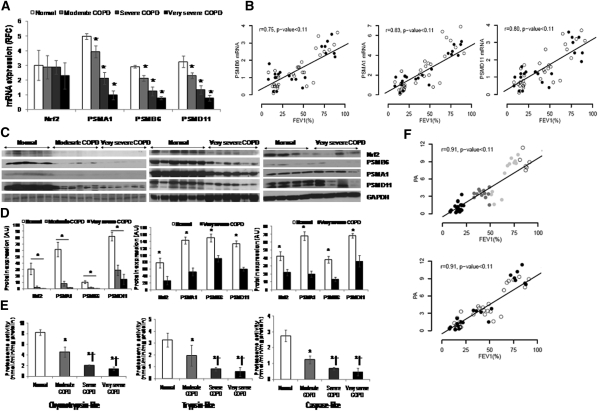
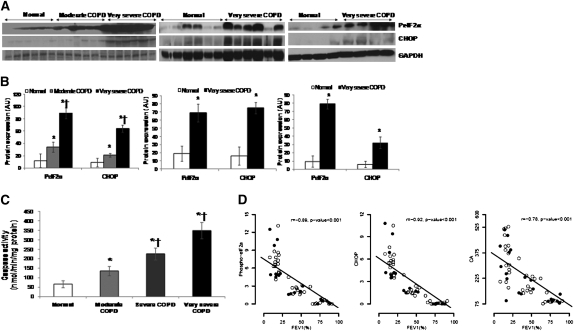
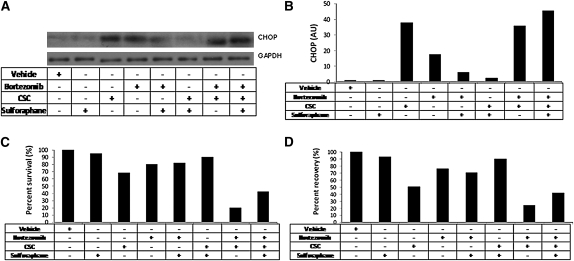
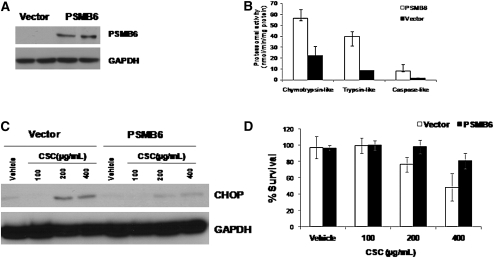
Measurements and main results: Compared with wild-type mice, emphysematous lungs of CS-exposed Nrf2-deficient mice exhibited markedly lower proteasomal activity and elevated markers of ER stress and apoptosis. Furthermore, compared with normal control subjects, lungs of patients with mild and advanced COPD showed a marked decrease in the expression of Nrf2-regulated proteasomal subunits and total proteasomal activity. However, they were associated with greater levels of ER stress and apoptosis markers. In vitro studies have demonstrated that enhancing proteasomal activity in Beas2B cells either by sulforaphane, an activator of Nrf2, or overexpression of Nrf2-regulated proteasomal subunit PSMB6, significantly inhibited cigarette smoke condensate (CSC)-induced ER stress and cell death.
Conclusions: Impaired Nrf2 signaling causes significant decline in proteasomal activity and heightens ER stress response in lungs of patients with COPD and CS-exposed mice. Accordingly, pharmacological approaches that augment Nrf2 activity may protect against COPD progression by both up-regulating antioxidant defenses and relieving ER stress.
Figures
References
-
- Buist AS, McBurnie MA, Vollmer WM, Gillespie S, Burney P, Mannino DM, Menezes AM, Sullivan SD, Lee TA, Weiss KB, et al. International variation in the prevalence of COPD (the BOLD Study): a population-based prevalence study. Lancet 2007;370:741–750. - PubMed
-
- Yoshida T, Tuder RM. Pathobiology of cigarette smoke-induced chronic obstructive pulmonary disease. Physiol Rev 2007;87:1047–1082. - PubMed
-
- Malhotra JD, Kaufman RJ. Endoplasmic reticulum stress and oxidative stress: a vicious cycle or a double-edged sword? Antioxid Redox Signal 2007;9:2277–2293. - PubMed
-
- Davenport EL, Morgan GJ, Davies FE. Untangling the unfolded protein response. Cell Cycle 2008;7:865–869. - PubMed
Publication types
MeSH terms
Substances
Grants and funding
LinkOut - more resources
Full Text Sources
Other Literature Sources
Medical
