


A randomized controlled trial on effects of the Transcendental Meditation program on blood pressure, psychological distress, and coping in young adults
- PMID: 19798037
- PMCID: PMC3128829
- DOI: 10.1038/ajh.2009.184
A randomized controlled trial on effects of the Transcendental Meditation program on blood pressure, psychological distress, and coping in young adults
Abstract
Background: Psychological distress contributes to the development of hypertension in young adults. This trial assessed the effects of a mind-body intervention on blood pressure (BP), psychological distress, and coping in college students.
Methods: This was a randomized controlled trial (RCT) of 298 university students randomly allocated to either the Transcendental Meditation (TM) program or wait-list control. At baseline and after 3 months, BP, psychological distress, and coping ability were assessed. A subgroup of 159 subjects at risk for hypertension was analyzed similarly.
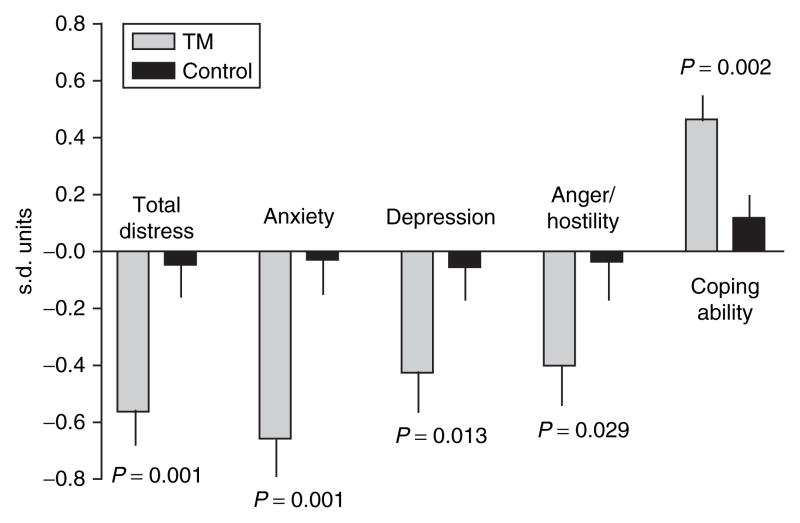
Results: Changes in systolic BP (SBP)/diastolic BP (DBP) for the overall sample were -2.0/-1.2 mm Hg for the TM group compared to +0.4/+0.5 mm Hg for controls (P = 0.15, P = 0.15, respectively). Changes in SBP/DBP for the hypertension risk subgroup were -5.0/-2.8 mm Hg for the TM group compared to +1.3/+1.2 mm Hg for controls (P = 0.014, P = 0.028, respectively). Significant improvements were found in total psychological distress, anxiety, depression, anger/hostility, and coping (P values < 0.05). Changes in psychological distress and coping correlated with changes in SBP (P values < 0.05) and DBP (P values < 0.08).
Conclusions: This is the first RCT to demonstrate that a selected mind-body intervention, the TM program, decreased BP in association with decreased psychological distress, and increased coping in young adults at risk for hypertension. This mind-body program may reduce the risk for future development of hypertension in young adults.
Figures
References
-
- Rosamond W, Flegal K, Furie K, Go A, Greenlund K, Haase N, Hailpern SM, Ho M, Howard V, Kissela B, Kittner S, Lloyd-Jones D, McDermott M, Meigs J, Moy C, Nichol G, O’Donnell C, Roger V, Sorlie P, Steinberger J, Thom T, Wilson M, Hong Y American Heart Association Statistics Committee and Stroke Statistics Subcommittee. Heart disease and stroke statistics—2008 update: a report from the American Heart Association Statistics Committee and Stroke Statistics Subcommittee. Circulation. 2008;117:e25–146. - PubMed
-
- Andersson OK, Lingman M, Himmelmann A, Sivertsson R, Widgren BR. Prediction of future hypertension by casual blood pressure or invasive hemodynamics? A 30-year follow-up study. Blood Press. 2004;13:350–354. - PubMed
-
- Rozanski A, Blumenthal JA, Davidson KW, Saab PG, Kubzansky L. The epidemiology, pathophysiology, and management of psychosocial risk factors in cardiac practice: the emerging field of behavioral cardiology. J Am Coll Cardiol. 2005;45:637–651. - PubMed
-
- Yan LL, Liu K, Matthews KA, Daviglus ML, Ferguson TF, Kiefe CI. Psychosocial factors and risk of hypertension: the Coronary Artery Risk Development in Young Adults (CARDIA) study. JAMA. 2003;290:2138–2148. - PubMed
-
- Rutledge T, Hogan BE. A quantitative review of prospective evidence linking psychological factors with hypertension development. Psychosom Med. 2002;64:758–766. - PubMed
