Review
. 2009 Dec 15;108(6):1233-43.
doi: 10.1002/jcb.22363.

Role of matrix metalloproteinases in epithelial migration

Affiliations
Review

Role of matrix metalloproteinases in epithelial migration

Peter Chen et al. J Cell Biochem. .

Abstract

In response to injury, epithelial cells migrate across the denuded tissue to rapidly close the wound and restore barrier, thereby preventing the entry of pathogens and leakage of fluids. Efficient, proper migration requires a range of processes, acting both inside and out of the cell. Among the extracellular responses is the expression of various matrix metalloproteinases (MMPs). Though long thought to ease cell migration simply by breaking down matrix barriers, findings from various models demonstrate that MMPs facilitate (and sometimes repress) cell movement by other means, such as affecting the state of cell-matrix interactions or proliferation. In this Prospect, we review some key data indicting how specific MMPs function via their activity as proteinases to control closure of epithelial wounds.


Figures

Fig. 1.
Fig. 1.
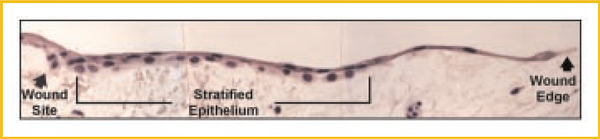
Morphology of the wound edge epithelium. Shown is the actively repairing epithelium at 5 days post-wounding of a human tracheal explant. Approaching the wound edge, the epithelial cells are squamated and stretched widely across the denuded lining. Behind the wound front, the epithelium is stratified over many cell diameters. However, the lining of intact airways is a simple (pseudostratified) epithelium; that is, basal surface of all cells lie on the basement membrane. In wounds, this normal histology is altered by reparative cells that “leap frog” over epithelial cells that had earlier moved over and covered the denuded tissue. These images suggest that much of the epithelial migration in wounds involves cell–cell interactions rather than cell–matrix interactions. Reproduced with permission from the American Society for Clinical Investigation [Dunsmore et al., 1998].
Fig. 2.
Fig. 2.
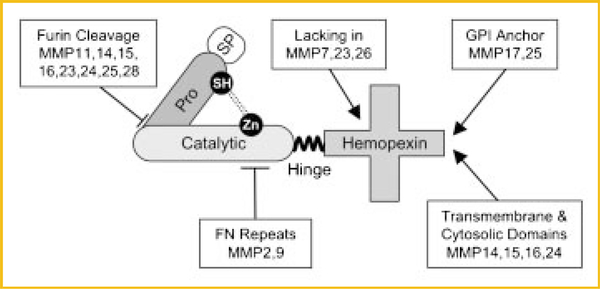
Domain structure of a typical MMP. The common motifs of MMPs are the pro- and catalytic domains. The prodomain of a typical MMP is about 80 amino acids and contains the consensus sequence PRCXXPD. The exception to this rule is MMP23, in which the critical cysteine is found within a distinct run of amino acids [Velasco et al., 1999]. The catalytic domain contains three conserved histidines in the sequence HEXXHXXGXXH, which ligate the active site Zn2+. Several MMPs have a furin recognition within the C-terminal half of the prodomain allowing activation of zymogen by proprotein convertases within the secretion pathway. For most other MMPs, the activation mechanism is unknown [Ra and Parks, 2007]. As MMPs function in the extracellular space, they each have a signal peptide (SP), the exception again being MMP23, which has an N-terminal signal anchor. With the exceptions of MMP7, 23, and 26, MMPs have a flexible proline-rich hinge region and a hemopexin-like C-terminal domain, which functions in substrate recognition. Other additions include transmembrane and cytosolic domains to the membrane-type MMPs, a glycosylphosphatidylinositol (GPI) anchoring signal to MMP17 and 25, and gelatin-binding domains that resemble similar motifs in fibronectin (FN) in MMP2 and 9.
Fig. 3.
Fig. 3.
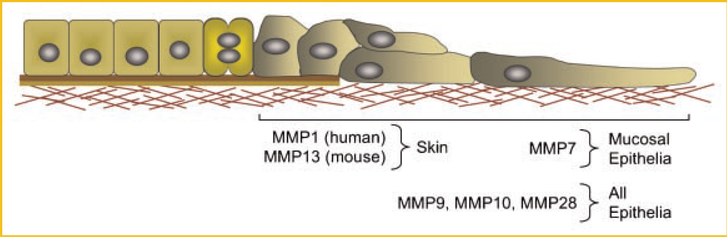
Patterns of MMP expression skin and mucosal wounds. The bi-color line under the intact and proliferating cells represents the basement membrane, and below that lies the interstitial matrix, which includes type I collagen. In skin, MMP1 is expressed by human keratinocytes and MMP13 is expressed by the analogous cell in mouse wounds. Although both collagenases promote re-epithelialization, it is not clear if they both function by an analogous mechanism. In mucosal epithelia, MMP7, which is not expressed in the wounded epidermis, is expressed at the wound front, and is required for efficient repair. In addition to these epithelial type-specific MMPs, other MMPs are expressed in all wounds.

References

    1. Atkinson J, Toennies HM, Holmbeck K, Senior RM. 2007. Membrane type 1 matrix metalloproteinase is necessary for distal airway epithelial repair and keratinocyte growth factor receptor expression after acute injury. Am J Physiol Lung Cell Mol Physiol 293:L600–L610. - PubMed
    1. Balbin M, Fueyo A, Knauper V, Lopez JM, Alvarez J, Sanchez LM, Quesada V, Bordallo J, Murphy G, Lopez-Otin C. 2001. Identification and enzymatic characterization of two diverging murine counterparts of human interstitial collagenase (MMP-1) expressed at sites of embryo implantation. J Biol Chem 276:10253–10262. - PubMed
    1. Baumann P, Zigrino P, Mauch C, Breitkreutz D, Nischt R. 2000. Membrane-type 1 matrix metalloproteinase-mediated progelatinase A activation in non-tumorigenic and tumorigenic human keratinocytes. Br J Cancer 83:1387–1393. - PMC - PubMed
    1. Betsuyaku T, Fukuda Y, Parks WC, Shipley JM, Senior RM. 2000. Gelatinase B is required for alveolar bronchiolization after intratracheal bleomycin. Am J Pathol 157:525–535. - PMC - PubMed
    1. Bister VO, Salmela MT, Karjalainen-Lindsberg ML, Uria J, Lohi J, Puolak-kainen P, Lopez-Otin C, Saarialho-Kere U. 2004. Differential expression of three matrix metalloproteinases, MMP-19, MMP-26, and MMP-28, in normal and inflamed intestine and colon cancer. Dig Dis Sci 49:653–661. - PubMed

Publication types

MeSH terms

Substances

LinkOut - more resources