. 2009 Dec;191(23):7315-22.
doi: 10.1128/JB.00425-09. Epub 2009 Oct 2.

Role of intracellular polysaccharide in persistence of Streptococcus mutans

Affiliations

Role of intracellular polysaccharide in persistence of Streptococcus mutans

Monica Busuioc et al. J Bacteriol. 2009 Dec.

Abstract

Intracellular polysaccharide (IPS) is accumulated by Streptococcus mutans when the bacteria are grown in excess sugar and can contribute toward the cariogenicity of S. mutans. Here we show that inactivation of the glgA gene (SMU1536), encoding a putative glycogen synthase, prevented accumulation of IPS. IPS is important for the persistence of S. mutans grown in batch culture with excess glucose and then starved of glucose. The IPS was largely used up within 1 day of glucose starvation, and yet survival of the parental strain was extended by at least 15 days beyond that of a glgA mutant; potentially, some feature of IPS metabolism distinct from providing nutrients is important for persistence. IPS was not needed for persistence when sucrose was the carbon source or when mucin was present.


Figures
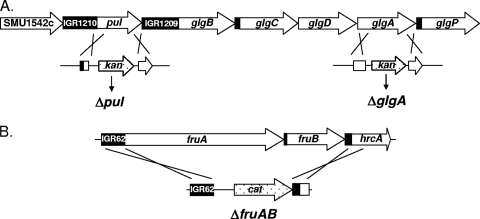
FIG. 1.
FIG. 1.
Schematic representation of genetic regions studied. (A) The pul and glg region of the S. mutans UA159 genome. The glg and pul genes are indicated by arrows. IGR indicates an intergenic region. The sites of gene replacement of pul and glgA by a kan cassette are shown below. The pul gene was inactivated by replacing an internal fragment of the gene (positions 1469911 to 1468763 of the S. mutans genome [http://www.oralgen.lanl.gov/], the deleted 1,148 bp corresponding to 383 codons of the ORF) with a kan cassette. Similarly, the glgA gene was inactivated by replacing an internal fragment (positions 1462665 to 1463113, the deleted 448 bp corresponding to 149 codons of the ORF) with a kan cassette. (B) The fru region. The fruA and fruB genes are indicated by arrows. The region of gene replacement by a cat cassette is shown below; the region replaced was between positions 77576 and 83477 and encompassed both ORFs (http://www.oralgen.lanl.gov/).
FIG. 2.
FIG. 2.
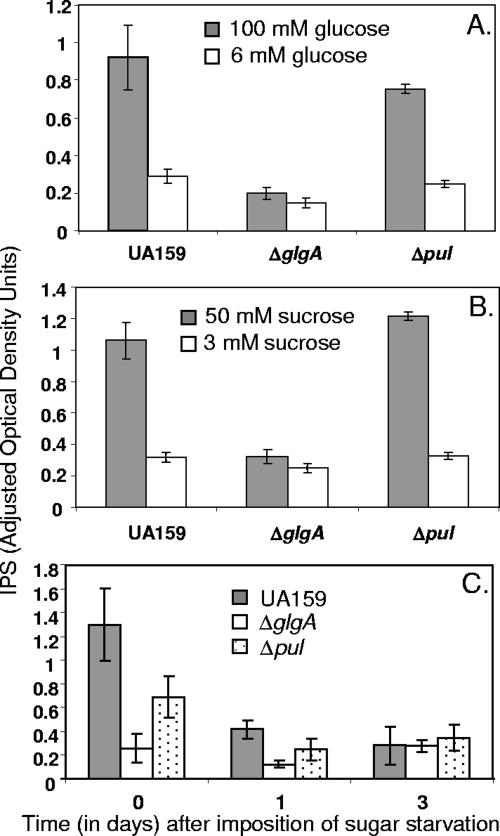
Comparison of IPSs formed by the parental strain S. mutans UA159 and glgA and pul mutants (SL13180 and SL13178, respectively) grown at different sugar concentrations. (A and B) Bacteria were grown in FMC containing glucose (A) or sucrose (B), and IPS was determined 8 h after the end of exponential growth. (C) Change in IPS content after transfer to spent medium of bacteria grown in FMC containing 100 mM glucose. Numbers are the averages of three experiments ± standard deviations.
FIG. 3.
FIG. 3.
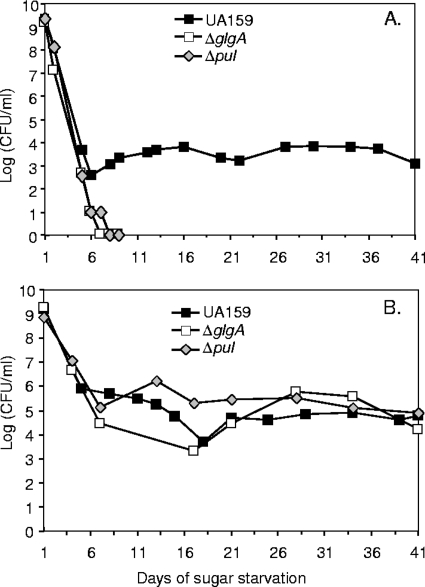
Effect of glgA and pul mutations on the persistence of S. mutans cultures grown in FMC containing 100 mM glucose. After overnight growth, bacteria were transferred to spent medium without (A) or with (B) 0.5% mucin. Survival was determined as CFU obtained from 1 ml of culture. Filled squares, S. mutans UA159; open squares, glgA mutant SL13180; diamonds, pul mutant SL13178. In each case, the results of an experiment representative of at least three experiments are shown.
FIG. 4.
FIG. 4.
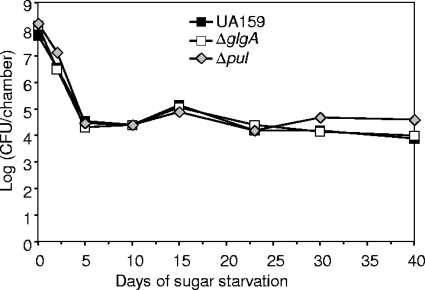
Persistence of S. mutans strains in static biofilms. Wells of microtiter plates were loaded with cultures in FMC containing 50 mM sucrose. After 14 h the supernatants and associated planktonic bacteria were removed and replaced with spent medium. Filled squares, S. mutans UA159; open squares, glgA mutant SL13180; diamonds, pul mutant SL13178. Results of an experiment representative of three experiments are shown.

References

    1. Ballicora, M. A., A. A. Iglesias, and J. Preiss. 2003. ADP-glucose pyrophosphorylase, a regulatory enzyme for bacterial glycogen synthesis. Microbiol. Mol. Biol. Rev. 67:213-225. - PMC - PubMed
    1. Burleigh, I. G., and E. A. Dawes. 1967. Studies on the endogenous metabolism and senescence of starved Sarcina lutea. Biochem. J. 102:236-250. - PMC - PubMed
    1. Burne, R. A., K. Schilling, W. H. Bowen, and R. E. Yasbin. 1987. Expression, purification, and characterization of an exo-β-d-fructosidase of Streptococcus mutans. J. Bacteriol. 169:4507-4517. - PMC - PubMed
    1. Carlsson, J. 1997. Bacterial metabolism in dental biofilms. Adv. Dent. Res. 11:75-80. - PubMed
    1. Chary, V. K., M. Busuioc, J. A. Renye, Jr., and P. J. Piggot. 2005. Vectors that facilitate the replacement of transcriptional lacZ fusions in Streptococcus mutans and Bacillus subtilis with fusions to gfp or gusA. FEMS Microbiol. Lett. 247:171-176. - PubMed

Publication types

MeSH terms

LinkOut - more resources