. 2009 Aug 11;106(32):13469-74.
doi: 10.1073/pnas.0906678106.

Experimental and clinical evidence of neuroprotection by nerve growth factor eye drops: Implications for glaucoma

Affiliations

Experimental and clinical evidence of neuroprotection by nerve growth factor eye drops: Implications for glaucoma

Alessandro Lambiase et al. Proc Natl Acad Sci U S A. .

Abstract

Elevated intraocular pressure (IOP) in glaucoma causes loss of retinal ganglion cells (RGCs) and damage to the optic nerve. Although IOP is controlled pharmacologically, no treatment is available to restore retinal and optic nerve function. We evaluated the effects of NGF eye drops in a rat model of glaucoma. We also treated 3 patients with progressive visual field defects despite IOP control. Glaucoma was induced in rats through injection of hypertonic saline into the episcleral vein. Initially, 2 doses of NGF (100 and 200 mug/mL) were tested on 24 rats, and the higher dose was found to be more effective. Glaucoma was then induced in an additional 36 rats: half untreated and half treated with 200 mug/mL NGF QID for 7 weeks. Apoptosis/survival of RGCs was evaluated by histological, biochemical, and molecular analysis. Three patients with advanced glaucoma underwent psychofunctional and electrofunctional tests at baseline, after 3 months of NGF eye drops, and after 3 months of follow-up. Seven weeks of elevated IOP caused RGC degeneration resulting in 40% cell death. Significantly less RGC loss was observed with NGF treatment (2,530 +/- 121 vs. 1,850 +/- 156 RGCs/mm(2)) associated with inhibition of cell death by apoptosis. Patients treated with NGF demonstrated long lasting improvements in visual field, optic nerve function, contrast sensitivity, and visual acuity. NGF exerted neuroprotective effects, inhibiting apoptosis of RGCs in animals with glaucoma. In 3 patients with advanced glaucoma, treatment with topical NGF improved all parameters of visual function. These results may open therapeutic perspectives for glaucoma and other neurodegenerative diseases.


Conflict of interest statement

The authors declare no conflict of interest.

Figures
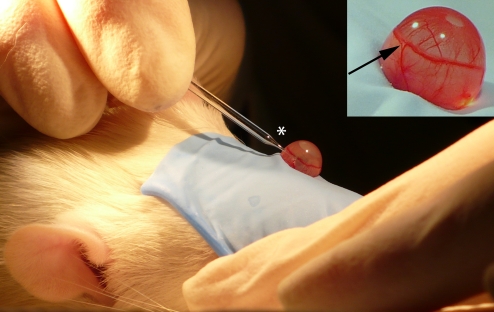
Fig. 1.
Fig. 1.
Glaucoma was induced in adult SD rats by single injection of 50 μL hypertonic saline solution (1.75M NaCl) into the superior episcleral vein. Once the rats were anesthetized, episcleral veins were isolated (arrow) under a led microscope and injections were performed using custom-made microneedle glass syringes (asterisk).
Fig. 2.
Fig. 2.
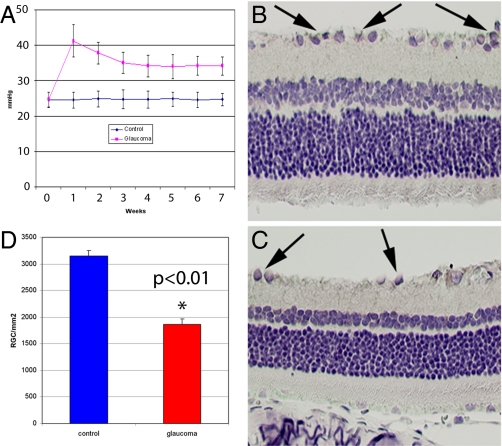
Measurement of intraocular pressure (IOP) demonstrated significant increases (P < 0.01) in rats that received episcleral injection with hypertonic saline solution (A). Hematoxylin/eosin staining of normal (B) and glaucomatous (C) retinas showed a significantly lower (P < 0.01) number of RGCs (arrows) in glaucomatous eyes (D).
Fig. 3.
Fig. 3.
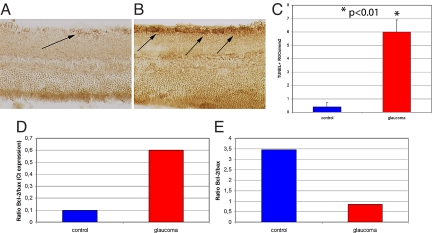
Anti-TUNEL immunostaining of RGCs (arrows) in normal (A) and glaucomatous (B) eyes showed a significantly greater (P < 0.01) number of apoptotic RGCs in glaucomatous eyes (C). Molecular analysis of glaucomatous compared to normal, healthy retinas showed greater mRNA expression of Bax (a biomarker of cell apoptosis) and lower expression of Bcl2 (a biomarker for cell survival), as illustrated by the Bcl-2/Bax ratio (D). The results of western blot protein analysis confirmed the significantly lower Bcl-2/Bax ratio in glaucomatous retinas (E).
Fig. 4.
Fig. 4.
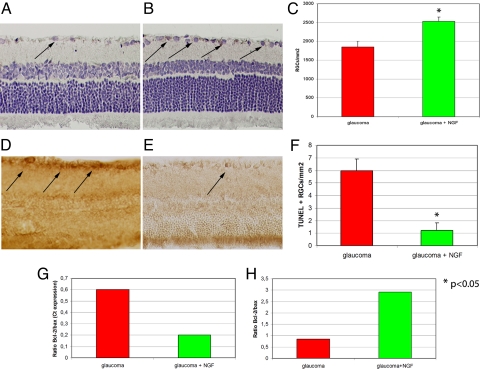
Hematoxylin/eosin staining of retinas from untreated (A) and NGF-treated (B) glaucomatous eyes showed significantly less (P < 0.05) loss of RGCs (arrows) in animals that received 200 μg/mL NGF eye drops (C). Anti-TUNEL immunostaining of retinas from untreated (D) and NGF-treated (E) glaucomatous eyes showed significantly less (P < 0.05) apoptotic RGCs (arrows) in animals that received NGF (F). Molecular analysis showed significantly lower mRNA expression of Bax (a biomarker of cell apoptosis) associated with greater expression of Bcl2 (a biomarker for cell survival), as illustrated by the Bcl-2/Bax ratio (G), in glaucomatous eyes treated with NGF compared to untreated glaucomatous eyes. Western blot analysis of Bcl and 2/Bax (H) confirmed this protective effect of NGF.
Fig. 5.
Fig. 5.
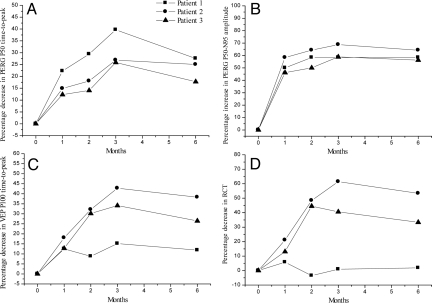
Results of NGF eye drop treatment in 3 glaucomatous patients. Presented are relative changes in the electrophysiological parameters that reflected function of the innermost retinal layer (Panels A and B: pattern electroretinogram: PERG P50 time-to-peak and P50-N95 amplitude), the bioelectric visual cortical response (Panel C: visual evoked potential: VEP P100 time-to-peak) and neural conduction along the postretinal visual pathways (Panel D: retinocortical time: RCT) observed after 30, 60, and 90 days of NGF treatment and after another 90 days of follow-up (time 1, 2, 3, and 6) with respect to the baseline condition (time 0). The relative changes are expressed as percentage increase in amplitude or percentage decrease in time-to-peak from baseline. Percentage increases in PERG P50-N95 amplitude and percentage decreases in PERG P50 time-to-peak indicated a reduction in ganglion cell dysfunction after NFG treatment. Percentage decreases in VEP P100 time-to-peak and percentage decreases in RCT indicated a reduction of the neural conduction delay along visual pathways after NFG treatment.
Fig. 6.
Fig. 6.
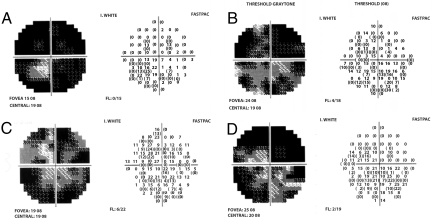
A representative visual field illustrate changes from baseline (A) to 1 month of NGF treatment (B), to 3 months of NGF treatment (C) and to 3 months after discontinuation of NGF (D) in a patient affected by advanced glaucoma.

References

    1. Kingman S. Glaucoma is second leading cause of blindness globally. Bull World Health Organ. 2004;82:887–888. - PMC - PubMed
    1. Quigley HA. Number of people with glaucoma worldwide. Br J Ophthalmol. 1996;80:389–393. - PMC - PubMed
    1. Kwon YH, Fingert JH, Kuehn MH, Alward WL. Primary open-angle glaucoma. N Engl J Med. 2009;360:1113–1124. - PMC - PubMed
    1. Weinreb RN, Khaw PT. Primary open-angle glaucoma. Lancet. 2004;363:1711–1720. - PubMed
    1. Whitcup SM. Clinical trials in neuroprotection. Prog Brain Res. 2008;173:323–335. - PubMed

Publication types

MeSH terms