


Polar firn air reveals large-scale impact of anthropogenic mercury emissions during the 1970s
- PMID: 19805267
- PMCID: PMC2752559
- DOI: 10.1073/pnas.0905117106
Polar firn air reveals large-scale impact of anthropogenic mercury emissions during the 1970s
Abstract
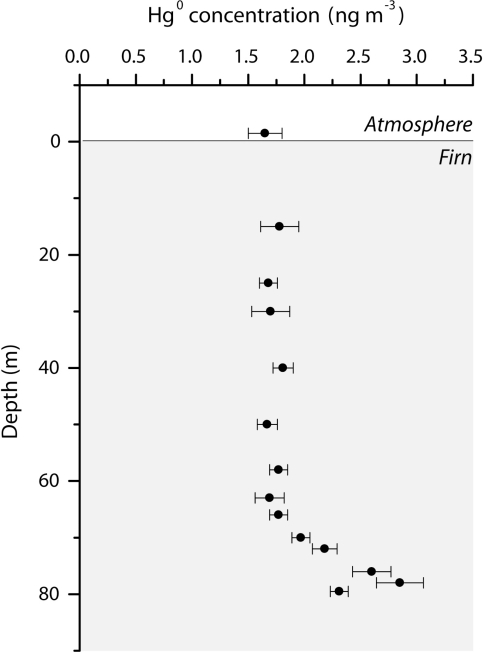
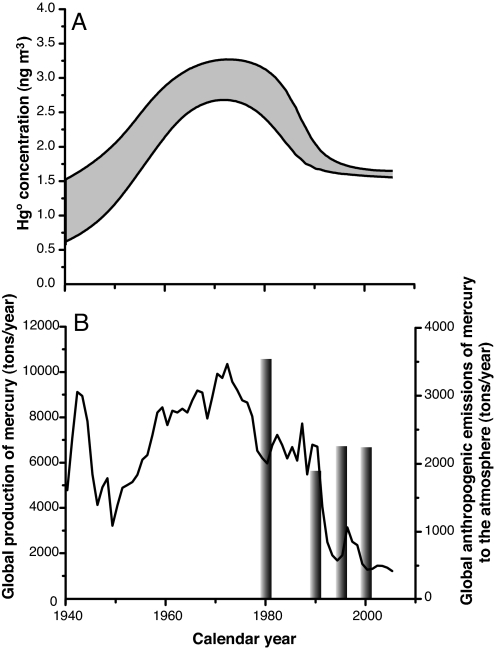
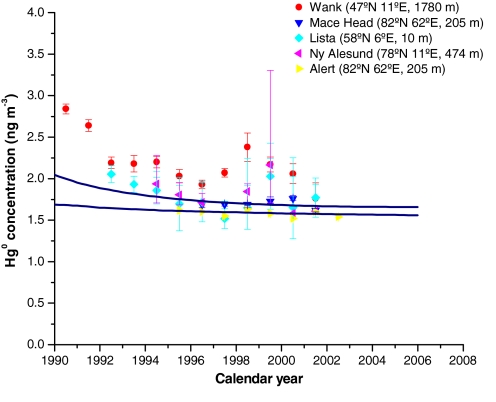
Mercury (Hg) is an extremely toxic pollutant, and its biogeochemical cycle has been perturbed by anthropogenic emissions during recent centuries. In the atmosphere, gaseous elemental mercury (GEM; Hg degrees ) is the predominant form of mercury (up to 95%). Here we report the evolution of atmospheric levels of GEM in mid- to high-northern latitudes inferred from the interstitial air of firn (perennial snowpack) at Summit, Greenland. GEM concentrations increased rapidly after World War II from approximately 1.5 ng m(-3) reaching a maximum of approximately 3 ng m(-3) around 1970 and decreased until stabilizing at approximately 1.7 ng m(-3) around 1995. This reconstruction reproduces real-time measurements available from the Arctic since 1995 and exhibits the same general trend observed in Europe since 1990. Anthropogenic emissions caused a two-fold rise in boreal atmospheric GEM concentrations before the 1970s, which likely contributed to higher deposition of mercury in both industrialized and remotes areas. Once deposited, this toxin becomes available for methylation and, subsequently, the contamination of ecosystems. Implementation of air pollution regulations, however, enabled a large-scale decline in atmospheric mercury levels during the 1980s. The results shown here suggest that potential increases in emissions in the coming decades could have a similar large-scale impact on atmospheric Hg levels.
Conflict of interest statement
The authors declare no conflict of interest.
Figures
References
-
- Lindberg S, et al. A synthesis of progress and uncertainties in attributing the sources of mercury in deposition. Ambio. 2007;36:19–32. - PubMed
-
- Mason RP, Sheu G-R. Role of the ocean in the global mercury cycle. Global Biogeochem Cycles. 2002;16:1093.
-
- Pacyna EG, Pacyna JM, Steenhuisen F, Wilson S. Global anthropogenic mercury emission inventory for 2000. Atmos Environ. 2006;40:4048–4063.
-
- Schroeder WH, Munthe J. Atmospheric mercury - An overview. Atmos Environ. 1998;32:809–822.
-
- Munthe J, et al. Recovery of mercury-contaminated fisheries. Ambio. 2007;36:33–44. - PubMed
Publication types
MeSH terms
Substances
LinkOut - more resources
Full Text Sources
Medical
Research Materials
