


Young adults with acute lymphoblastic leukemia have an excellent outcome with chemotherapy alone and benefit from intensive postinduction treatment: a report from the children's oncology group
- PMID: 19805689
- PMCID: PMC3053149
- DOI: 10.1200/JCO.2008.20.8959
Young adults with acute lymphoblastic leukemia have an excellent outcome with chemotherapy alone and benefit from intensive postinduction treatment: a report from the children's oncology group
Abstract
Purpose: Patients 16 to 21 years of age with acute lymphoblastic leukemia (ALL) have an inferior outcome compared with younger children, leading some medical oncologists to advocate allogeneic stem-cell transplantation in first remission for these patients. We examined outcome for young adults with ALL enrolled onto the Children's Cancer Group (CCG) 1961 study between 1996 and 2002.
Patients and methods: CCG 1961 entered patients with ALL 1 to 21 years of age with initial WBC count > or = 50,000/microL and/or age > or = 10 years. Randomly assigned therapies evaluated the impact of postinduction treatment intensification on outcome. We examined outcome and prognostic factors for 262 young adults with ALL.
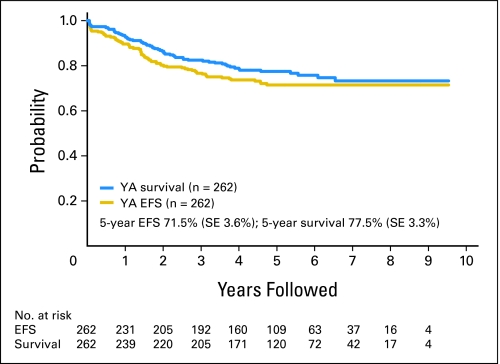
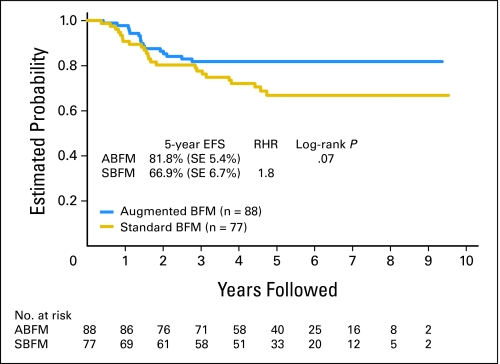
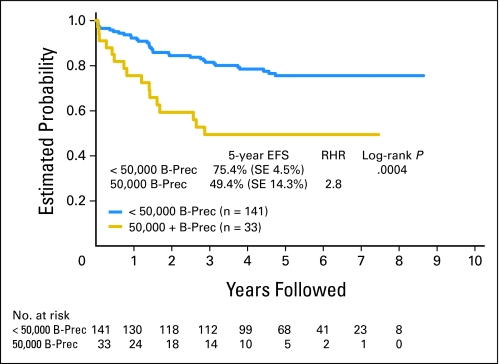
Results: Five-year event-free and overall survival rates for young adult patients are 71.5% (SE, 3.6%) and 77.5% (SE, 3.3%), respectively. Rapid responder patients (< 25% bone marrow blasts on day 7) randomly assigned to augmented therapy had 5-year event-free survival of 81.8% (SE, 7%), as compared with 66.8% (SE, 6.7%) for patients receiving standard therapy (P = .07). One versus two interim maintenance and delayed intensification courses had no significant impact on event-free survival. WBC count more than 50,000/microL was an adverse prognostic factor.
Conclusion: Young adult patients with ALL showing a rapid response to induction chemotherapy benefit from early intensive postinduction therapy but do not benefit from a second interim maintenance and delayed intensification phase. Given the excellent outcome with this chemotherapy, there seems to be no role for the routine use of allogeneic stem-cell transplantation in first remission for young adults with ALL.
Conflict of interest statement
Authors' disclosures of potential conflicts of interest and author contributions are found at the end of this article.
Figures
Comment in
-
Toward a total cure for acute lymphoblastic leukemia.J Clin Oncol. 2009 Nov 1;27(31):5121-3. doi: 10.1200/JCO.2009.24.8518. Epub 2009 Oct 5. J Clin Oncol. 2009. PMID: 19805663 No abstract available.
References
-
- Plasschaert L, Kamps W, Vellenga E, et al. Prognosis in childhood and adult acute lymphoblastic leukemia: A question of maturation? Cancer Treat Rev. 2004;30:37–51. - PubMed
-
- Nachman J. Clinical Characteristics, biologic features and outcome for young adult patients with acute lymphoblastic leukaemia. Br J Haematol. 2005;130:166–173. - PubMed
-
- Möricke A, Zimmermann M, Reiter A, et al. Prognostic impact of age in children and adolescents with acute lymphoblastic leukemia. Klin Padiatr. 2005;217:310–320. - PubMed
-
- Santana V, Dodge R, Crist W, et al. Presenting features and treatment outcome of adolescents with acute lymphoblastic leukemia. Leukemia. 1990;4:87–90. - PubMed
-
- Nachman JB, Sather HN, Sensel MG, et al. Augmented post-induction therapy for children with high-risk acute lymphoblastic leukemia and a slow response to initial therapy. N Engl J Med. 1998;338:1663–1671. - PubMed
Publication types
MeSH terms
Grants and funding
LinkOut - more resources
Full Text Sources
Medical
