


Controlling infectious disease outbreaks: Lessons from mathematical modelling
- PMID: 19806073
- PMCID: PMC7099230
- DOI: 10.1057/jphp.2009.13
Controlling infectious disease outbreaks: Lessons from mathematical modelling
Abstract
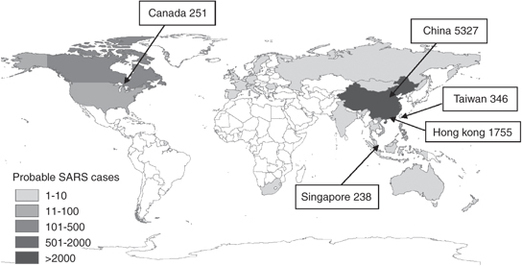
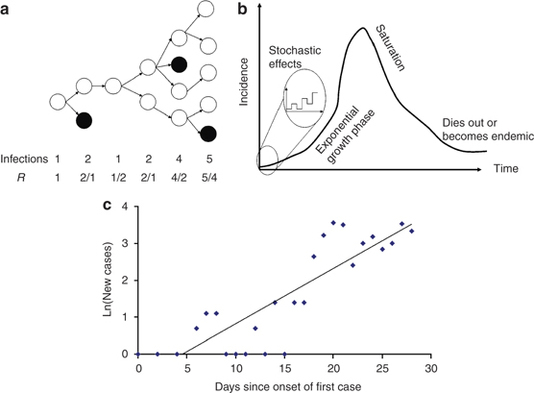
Epidemiological analysis and mathematical models are now essential tools in understanding the dynamics of infectious diseases and in designing public health strategies to contain them. They have provided fundamental concepts, such as the basic and effective reproduction number, generation times, epidemic growth rates, and the role of pre-symptomatic infectiousness, which are crucial in characterising infectious diseases. These concepts are outlined and their relevance in designing control policies for outbreaks is discussed. They are illustrated using examples from the 2003 severe acute respiratory syndrome outbreak, which was brought under control within a year, and from pandemic influenza planning, where mathematical models have been used extensively.
Figures
References
-
- Anderson RM, May RM. Infectious Diseases of Humans: Dynamics and Control. 1991.
-
- World Health Organisation. (2008) Epidemic and pandemic response pages, http://www.who.int/csr/disease/avian_influenza/en/, accessed 24 March 2009.
-
- World Health Organisation. (2003) Summary of probable SARS cases with onset of illness from 1 Novemer 2002 to 31 July 2003, http://www.who.int/csr/sars/country/table20040421/en/, accessed 24 March 2009.
Publication types
MeSH terms
LinkOut - more resources
Full Text Sources