. 2009 Oct 6:9:356.
doi: 10.1186/1471-2407-9-356.

The influence of P-glycoprotein expression and its inhibitors on the distribution of doxorubicin in breast tumors

Affiliations

The influence of P-glycoprotein expression and its inhibitors on the distribution of doxorubicin in breast tumors

Krupa J Patel et al. BMC Cancer. .

Abstract

Background: Anti-cancer drugs access solid tumors via blood vessels, and must penetrate tumor tissue to reach all cancer cells. Previous studies have demonstrated steep gradients of decreasing doxorubicin fluorescence with increasing distance from blood vessels, such that many tumor cells are not exposed to drug. Studies using multilayered cell cultures show that increased P-glycoprotein (PgP) is associated with better penetration of doxorubicin, while PgP inhibitors decrease drug penetration in tumor tissue. Here we evaluate the effect of PgP expression on doxorubicin distribution in vivo.

Methods: Mice bearing tumor sublines with either high or low expression of PgP were treated with doxorubicin, with or without pre-treatment with the PgP inhibitors verapamil or PSC 833. The distribution of doxorubicin in relation to tumor blood vessels was quantified using immunofluorescence.

Results: Our results indicate greater uptake of doxorubicin by cells near blood vessels in wild type as compared to PgP-overexpressing tumors, and pre-treatment with verapamil or PSC 833 increased uptake in PgP-overexpressing tumors. However, there were steeper gradients of decreasing doxorubicin fluorescence in wild-type tumors compared to PgP overexpressing tumors, and treatment of PgP overexpressing tumors with PgP inhibitors led to steeper gradients and greater heterogeneity in the distribution of doxorubicin.

Conclusion: PgP inhibitors increase uptake of doxorubicin in cells close to blood vessels, have little effect on drug uptake into cells at intermediate distances, and might have a paradoxical effect to decrease doxorubicin uptake into distal cells. This effect probably contributes to the limited success of PgP inhibitors in clinical trials.


Figures
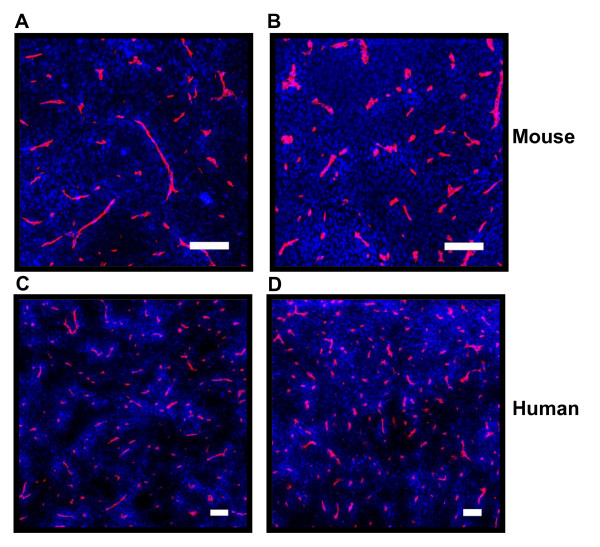
Figure 1
Figure 1
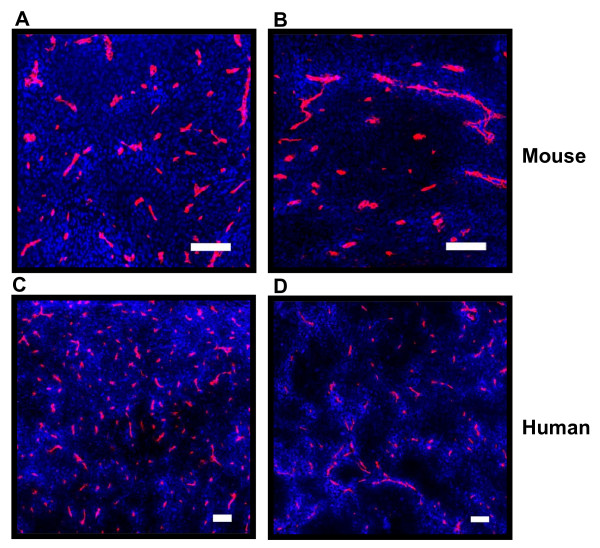
Distribution of doxorubicin in solid tumors. Murine tumors EMT6 (A) and its PgP overexpressing subline AR1 (B) and MCF-7 human breast cancer xenograft (C) and its PgP overexpressing subline BC19 (D) were resected from Balb/C and nude mice, respectively. Doxorubicin is shown in blue and blood vessels are shown in red. Note more uniform distribution of doxorubicin in the PgP overexpressing tumors. (Scale bars = 100 μm)
Figure 2
Figure 2
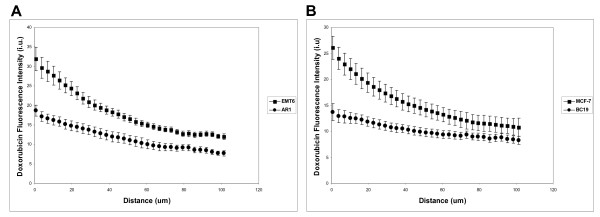
The gradient of doxorubicin fluorescence intensity in relation to distance from the nearest blood vessel. Mice-bearing either EMT6 or AR1 tumors (A) (n = 6 tumors each) or MCF-7 or BC19 xenografts (B) (n = 11 and 5 tumors, respectively) were treated with doxorubicin and their tumors were resected, sectioned and imaged. Image analysis was undertaken using customized algorithms. Values represent mean ± standard error.
Figure 3
Figure 3
Distribution of doxorubicin in solid tumors. Murine AR1 tumors were treated with either doxorubicin (A) or PSC 833 and doxorubicin (C). Similarly, BC19 xenografts were treated with either doxorubicin (B) or PSC 833 and doxorubicin (D). Doxorubicin is shown in blue and blood vessels are shown in red. (Scale bars = 100 μm)
Figure 4
Figure 4
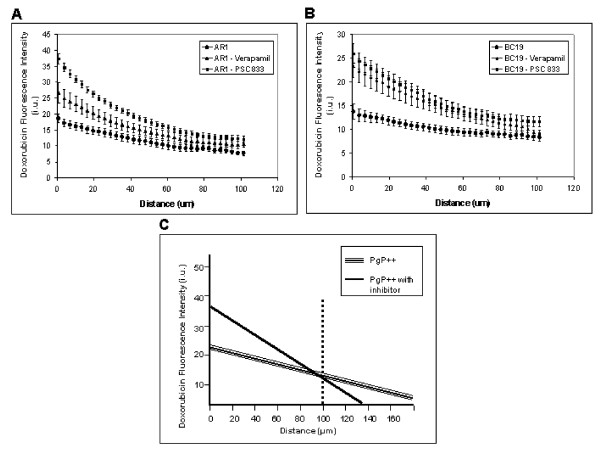
The gradient of doxorubicin fluorescence intensity in relation to distance from the nearest blood vessel and a model of doxorubicin distribution in solid tumours. Mice-bearing AR1 tumors (A) or BC19 xenografts (B) were treated with either doxorubicin alone, or pretreated with verapamil or PSC 833 and doxorubicin. Tumors were resected, sectioned and imaged. Image analysis was undertaken using customized algorithms. Values represent mean ± standard error. In panel A, 6, 10 and 9 tumors were analyzed, respectively. In panel B, 6, 7 and 6 tumors were analyzed, respectively. (C) represents a model of doxorubicin distribution without fluouresence interference from neighboring out-of-section blood vessels.
Figure 5
Figure 5
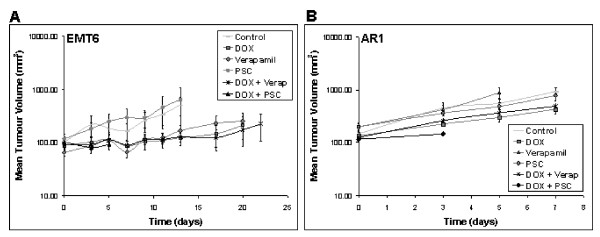
Tumor growth delay and toxicity studies. Mice-bearing EMT6 tumors (A) or AR1 tumors (B) were treated with either saline, doxorubicin alone, verapamil alone, PSC 833 alone or pretreated with verapamil or PSC 833 in combination with doxorubicin. Tumor volume and body weight was measured every 2-3 days. Values represent mean ± standard error (n = 5).

References

    1. Baguley BC, Finlay GJ. Pharmacokinetic/cytokinetic principles in the chemotherapy of solid tumours. Clinical and experimental pharmacology & physiology. 1995;22(11):825–828. doi: 10.1111/j.1440-1681.1995.tb01943.x. - DOI - PubMed
    1. Durand RE. Slow penetration of anthracyclines into spheroids and tumors: a therapeutic advantage? Cancer chemotherapy and pharmacology. 1990;26(3):198–204. doi: 10.1007/BF02897199. - DOI - PubMed
    1. Erlanson M, Daniel-Szolgay E, Carlsson J. Relations between the penetration, binding and average concentration of cytostatic drugs in human tumour spheroids. Cancer chemotherapy and pharmacology. 1992;29(5):343–353. doi: 10.1007/BF00686002. - DOI - PubMed
    1. Kerr DJ, Kaye SB. Aspects of cytotoxic drug penetration, with particular reference to anthracyclines. Cancer chemotherapy and pharmacology. 1987;19(1):1–5. doi: 10.1007/BF00296245. - DOI - PubMed
    1. Tunggal JK, Cowan DS, Shaikh H, Tannock IF. Penetration of anticancer drugs through solid tissue: a factor that limits the effectiveness of chemotherapy for solid tumors. Clin Cancer Res. 1999;5(6):1583–1586. - PubMed

Publication types

MeSH terms