


Surrogate mobility and orientation affect the early neurobehavioral development of infant rhesus macaques (Macaca mulatta)
- PMID: 19810188
- PMCID: PMC2762640
- DOI: 10.1002/dev.20296
Surrogate mobility and orientation affect the early neurobehavioral development of infant rhesus macaques (Macaca mulatta)
Abstract
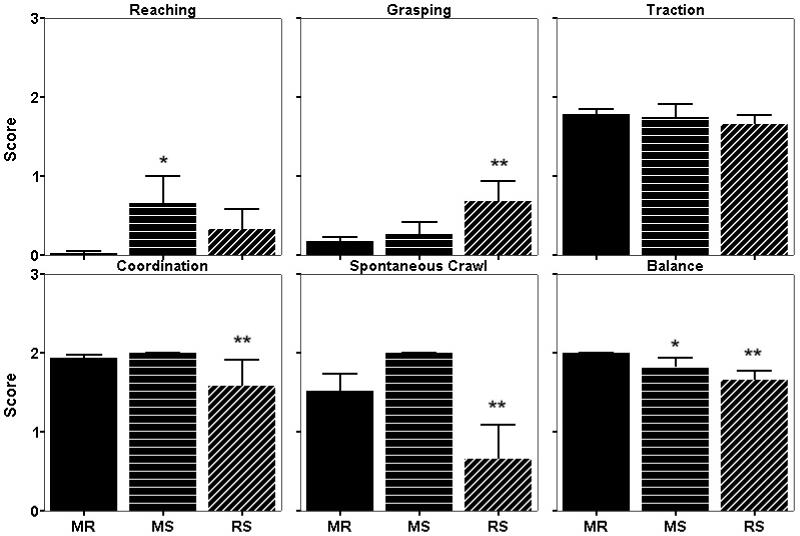
A biological mother's movement appears necessary for optimal development in infant monkeys. However, nursery-reared monkeys are typically provided with inanimate surrogate mothers that move very little. The purpose of this study was to evaluate the effects of a novel, highly mobile surrogate mother on motor development, exploration, and reactions to novelty. Six infant rhesus macaques (Macaca mulatta) were reared on mobile hanging surrogates (MS) and compared to six infants reared on standard stationary rocking surrogates (RS) and to 9-15 infants reared with their biological mothers (MR) for early developmental outcome. We predicted that MS infants would develop more similarly to MR infants than RS infants. In neonatal assessments conducted at Day 30, both MS and MR infants showed more highly developed motor activity than RS infants on measures of grasping (p = .009), coordination (p = .038), spontaneous crawl (p = .009), and balance (p = .003). At 2-3 months of age, both MS and MR infants displayed higher levels of exploration in the home cage than RS infants (p = .016). In a novel situation in which only MS and RS infants were tested, MS infants spent less time near their surrogates in the first five minutes of the test session than RS infants (p = .05), indicating a higher level of comfort. Collectively, these results suggest that when nursery-rearing of infant monkeys is necessary, a mobile hanging surrogate may encourage more normative development of gross motor skills and exploratory behavior and may serve as a useful alternative to stationary or rocking surrogates.
Figures
References
-
- Anderson CO, Kenney AM, Mason WA. Effects of maternal mobility, partner, and endocrine state on social responsiveness of adolescent rhesus monkeys. Developmental Psychobiology. 1977;10(5):421–434. - PubMed
-
- Blumstein DT, Daniel JC, Evans CS. JWatcher 1.0: An introductory user’s guide [Computer software] University of California; Los Angeles: 2006. Retrieved May 1, 2005 from. JWatcher Web site: http://www.jwatcher.ucla.edu.
-
- Capitanio JP, Mason WA. Cognitive style: problem solving by rhesus macaques (Macaca mulatta) reared with living or inanimate surrogate mothers. Journal of Comparative Psychology. 2000;114(2):115–225. - PubMed
-
- Capitanio JP, Mendoza SP, Mason WA, Maninger N. Rearing environment and hypothalamic-pituitary-adrenal regulation in young rhesus monkeys (Macaca mulatta) Developmental Psychobiology. 2005;46:318–330. - PubMed
-
- Duijghuisen JA, Timmermans PJ, Vochteloo JD, Vossen JM. Mobile surrogate mothers and the development of exploratory behavior and radius of action in infant long tailed macaques (Macaca fascicularis) Developmental Psychobiologoy. 1992;25(6):441–459. - PubMed
Publication types
MeSH terms
Grants and funding
LinkOut - more resources
Full Text Sources
