. 2009 Nov;26(11):1867-77.
doi: 10.1089/neu.2009.0882.

A panel of neuron-enriched proteins as markers for traumatic brain injury in humans

Affiliations

A panel of neuron-enriched proteins as markers for traumatic brain injury in humans

Robert Siman et al. J Neurotrauma. 2009 Nov.

Abstract

Surrogate markers have enormous potential for contributing to the diagnosis, prognosis, and therapeutic evaluation of acute brain damage, but extensive prior study of individual candidates has not yielded a biomarker in widespread clinical practice. We hypothesize that a panel of neuron-enriched proteins measurable in cerebrospinal fluid (CSF) and blood should vastly improve clinical evaluation and therapeutic management of acute brain injuries. Previously, we developed such a panel based initially on the study of protein release from degenerating cultured neurons, and subsequently on rodent models of traumatic brain injury (TBI) and ischemia, consisting of 14-3-3beta, 14-3-3zeta, three distinct phosphoforms of neurofilament H, ubiquitin hydrolase L1, neuron-specific enolase, alpha-spectrin, and three calpain- and caspase-derived fragments of alpha-spectrin. In the present study, this panel of 11 proteins was evaluated as CSF and serum biomarkers for severe TBI in humans. By quantitative Western blotting and sandwich immunoassays, the CSF protein levels were near or below the limit of detection in pre-surgical and most normal pressure hydrocephalus (NPH) controls, but following TBI nine of the 11 were routinely elevated in CSF. Whereas different markers peaked coordinately, the time to peak varied across TBI cases from 24-96 h post-injury. In serum, TBI increased all four members of the marker panel for which sandwich immunoassays are currently available: a calpain-derived NH(2)-terminal alpha-spectrin fragment and the three neurofilament H phosphoforms. Our results identify neuron-enriched proteins that may serve as a panel of CSF and blood surrogate markers for the minimally invasive detection, management, mechanistic, and therapeutic evaluation of human TBI.


Figures
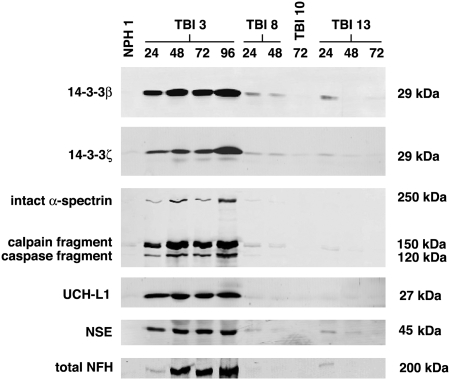
FIG. 1.
FIG. 1.
A panel of neuron-enriched proteins in human cerebrospinal fluid (CSF) following traumatic brain injury (TBI). By Western blot analysis, CSF levels of eight neuron-enriched proteins increased following severe human TBI. In comparison with CSF from cases of normal pressure hydrocephalus (NPH) or pre-surgical controls (not shown; see also Siman et al., 2008), TBI led to a marked rise in three of the four cases shown in CSF levels of the following members of our biomarker panel: the β and ζ isoforms of 14-3-3 protein, α-spectrin (∼250 kDa), a calpain-derived ∼150-kDa α-spectrin COOH-terminal fragment, a caspase-derived ∼120-kDa α-spectrin COOH-terminal fragment, ubiquitin C-terminal hydrolase L1 (UCH-L1), neuron-specific enolase (NSE), and neurofilament H (NFH). Immunodetection of the target polypeptides was confirmed by their appropriate apparent molecular weights (shown on the right). Note that levels of the calpain-derived fragment of α-spectrin always exceeded those of the caspase derivative, and the latter was not noticeably increased in a subset of TBI cases.
FIG. 2.
FIG. 2.
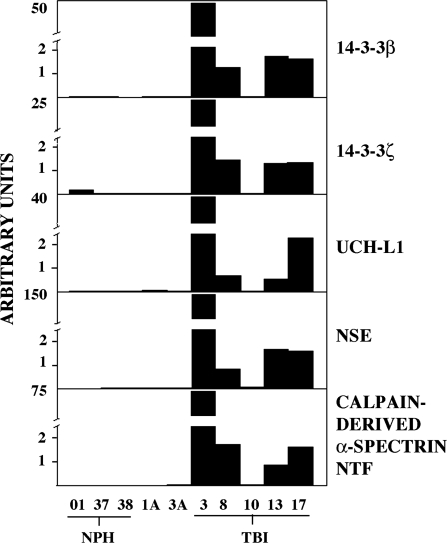
Quantitative analysis of biomarker elevations in human cerebrospinal fluid (CSF) following traumatic brain injury (TBI). Five biomarkers were quantified in human CSF by a near-infrared immunofluorescence labeling and image analysis approach, as described in Methods. The biomarkers were near or below the limit of detection in the three normal pressure hydrocephalus (NPH) cases and the two pre-surgical control cases (1A, 3A), but increased markedly at 24–96 h following severe TBI. For the five cases of TBI, peak biomarker levels are depicted. Note that only a single time point (72 h post-injury) was available for case TBI-10, which did not exhibit increased levels of any of the five biomarkers.
FIG. 3.
FIG. 3.
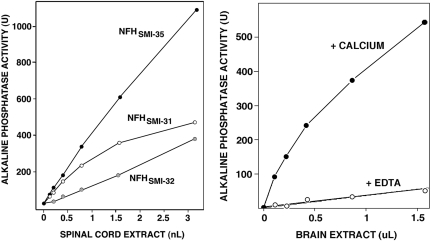
Enzyme-linked immunofluorescence sandwich assays for three distinct neurofilament H phosphoforms and a calpain-derived α-spectrin NH2-terminal fragment (NTF). Four sandwich immunoassays were validated and standardized using increasing amounts of spinal cord extract enriched in neurofilaments (left), or brain extract either treated with calcium to activate endogenous calpains, or maintained in EDTA (right). For distinguishing neurofilament H (NFH) phosphoforms, three distinct well-characterized capture antibodies were used: SMI-35, which preferentially reacts with hypophosphorylated NFH, SMI-32, which recognizes only nonphosphorylated NFH, and SMI-31, which binds specifically to highly phosphorylated NFH. The calpain-derived α-spectrin ∼150-kDa NTF was detected using Ab37, a cleavage site-specific antibody that only recognizes this calpain fragment (Roberts-Lewis et al., ; Siman et al., 2000).
FIG. 4.
FIG. 4.
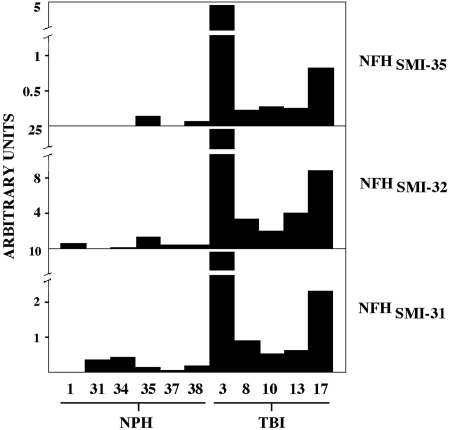
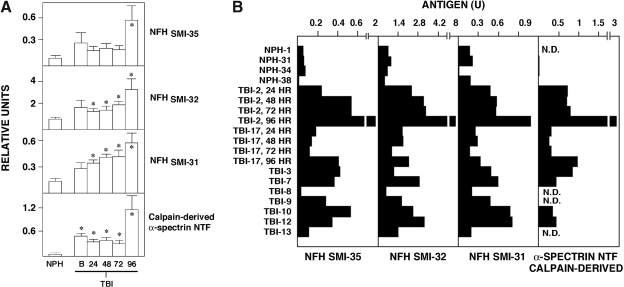
Increased cerebrospinal fluid (CSF) levels of three neurofilament H (NFH) phosphoforms following severe human traumatic brain injury (TBI). CSF levels of hypophosphorylated NFH (SMI-35 reactive), nonphosphorylated neurofilament H (SMI-32 reactive), and highly phosphorylated neurofilament H (SMI-31 reactive) were quantified by fluorescence immunoassay from six cases of normal pressure hydrocephalus (NPH) and five cases of TBI. The graph depicts peak CSF levels at 24–72 h post-injury, except in the case of TBI-10, from whom only a 72-h sample was available.
FIG. 5.
FIG. 5.
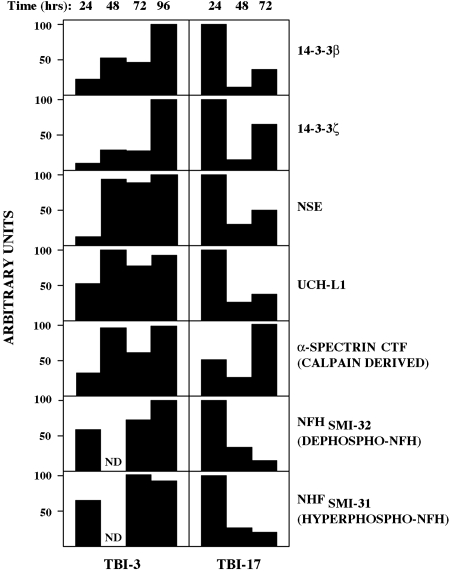
Biomarker elevations are coordinated over time and vary across traumatic brain injury (TBI) cases. The graph depicts time-dependent increases in seven members of the biomarker panel for two cases of TBI. For case TBI-3, marker elevations were detectable at 24 h and increased thereafter, reaching peak levels at 72–96 h post-injury. In sharp contrast, for case TBI-17, elevations in six of the seven biomarkers were highest at 24 h and declined thereafter, with only the calpain-cleaved α-spectrin NH2-terminal fragment (NTF) reaching maximal levels at the later time point.
FIG. 6.
FIG. 6.
Four members of the protein panel are blood biomarkers for human traumatic brain injury (TBI). (A) Fluorescence enzyme immunoassays for the three distinct neurofilament H (NFH) phosphoforms and a calpain-derived α-spectrin NH2-terminal fragment (NTF) were applied to sera taken from normal pressure hydrocephalus (NPH) and pre-surgical cases, four of which are depicted here, as well as the nine cases of severe TBI. The graph shows the mean biomarker levels (±SEM) at various times post-injury. Not all time points were available for all TBI cases, and the means are derived from three to nine determinations. Serum levels of the four neuron-enriched proteins were elevated by 24 h post-injury (*p < 0.05), but did not reach peak levels until 96 h post-injury, the longest time point examined. (B) Case-by-case serum biomarker elevations. In comparison with NPH cases, marker levels were consistently higher for eight of the nine cases of TBI. As illustrated for cases TBI-2 and TBI-17, peak serum levels of each of the four biomarkers was not reached until 96 h post-injury.

References

    1. Agren-Wilsson A. Lekman A. Sjöberg W. Rosengren L. Blennow K. Bergenheim A.T. Malm J. CSF biomarkers in the evaluation of idiopathic normal pressure hydrocephalus. Acta Neurol. Scand. 2007;116:333–339. - PubMed
    1. Aitken A. Jones D. Soneji Y. Howell S. 14-3-3 proteins: biological function and domain structure. Biochem. Soc. Trans. 2003;23:605–611. - PubMed
    1. Anderson K.J. Scheff S.W. Miller K.M. Roberts K.N. Gilmer L.K. Yang C. Shaw G. The phosphorylated axonal form of the neurofilament subunit NF-H (pNF-H) as a blood biomarker of traumatic brain injury. J. Neurotrauma. 2008;25:1079–1085. - PMC - PubMed
    1. Anderson R.E. Hansson L.O. Nilsson O. Dijlai-Merzoug R. Settergren G. High serum S100β levels for trauma patients without head injuries. Neurosurgery. 2001;48:1255–1258. - PubMed
    1. Begaz T. Kyriacou D.N. Segal J. Bazarian J.J. Serum biochemical markers for post-concussion syndrome in patients with mild traumatic brain injury. J. Neurotrauma. 2006;23:1201–1210. - PubMed

Publication types

LinkOut - more resources