


Heterogeneous vancomycin-intermediate susceptibility phenotype in bloodstream methicillin-resistant Staphylococcus aureus isolates from an international cohort of patients with infective endocarditis: prevalence, genotype, and clinical significance
- PMID: 19811099
- PMCID: PMC3600359
- DOI: 10.1086/606027
Heterogeneous vancomycin-intermediate susceptibility phenotype in bloodstream methicillin-resistant Staphylococcus aureus isolates from an international cohort of patients with infective endocarditis: prevalence, genotype, and clinical significance
Abstract
Background: The significance of heterogeneous vancomycin-intermediate Staphylococcus aureus (hVISA) is unknown. Using a multinational collection of isolates from methicillin-resistant S. aureus (MRSA) infective endocarditis (IE), we characterized patients with IE with and without hVISA, and we genotyped the infecting strains.
Methods: MRSA bloodstream isolates from 65 patients with definite IE from 8 countries underwent polymerase chain reaction (PCR) for 31 virulence genes, pulsed-field gel electrophoresis, and multilocus sequence typing. hVISA was defined using population analysis profiling.
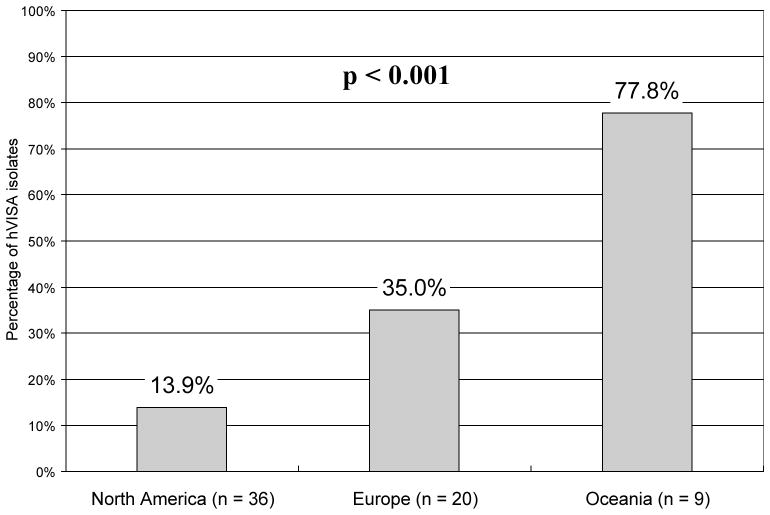
Results: Nineteen (29.2%) of 65 MRSA IE isolates exhibited the hVISA phenotype by population analysis profiling. Isolates from Oceania and Europe were more likely to exhibit the hVISA phenotype than isolates from the United States (77.8% and 35.0% vs 13.9%; P < .001). The prevalence of hVISA was higher among isolates with a vancomycin minimum inhibitory concentration of 2 mg/L (P = .026). hVISA-infected patients were more likely to have persistent bacteremia (68.4% vs 37.0%; P = .029) and heart failure (47.4% vs 19.6%; P = .033). Mortality did not differ between hVISA- and non-hVISA-infected patients (42.1% vs 34.8%, P = .586). hVISA and non-hVISA isolates were genotypically similar.
Conclusions: In these analyses, the hVISA phenotype occurred in more than one-quarter of MRSA IE isolates, was associated with certain IE complications, and varied in frequency by geographic region.
Conflict of interest statement
Dr. Bae, Rude, Newton, Park, Dr. Marco and Dr. Garcia-de-la-Maria did not have any conflict of interest.
Figures

References
-
- Deresinski S. Vancomycin heteroresistance and methicillin-resistant Staphylococcus aureus. J Infect Dis. 2009;199:605–9. - PubMed
-
- Tenover FC, Moellering RC., Jr The rationale for revising the Clinical and Laboratory Standards Institute vancomycin minimal inhibitory concentration interpretive criteria for Staphylococcus aureus. Clin Infect Dis. 2007;44:1208–15. - PubMed
-
- Fridkin SK, Hageman J, McDougal LK, et al. Epidemiological and microbiological characterization of infections caused by Staphylococcus aureus with reduced susceptibility to vancomycin, United States, 1997–2001. Clin Infect Dis. 2003;36:429–39. - PubMed
Publication types
MeSH terms
Grants and funding
LinkOut - more resources
Full Text Sources
Medical
Molecular Biology Databases
