


Apoptotic and necrotic cells as sentinels of local tissue stress and inflammation: response pathways initiated in nearby viable cells
- PMID: 19811288
- PMCID: PMC2840991
- DOI: 10.1080/08916930902832124
Apoptotic and necrotic cells as sentinels of local tissue stress and inflammation: response pathways initiated in nearby viable cells
Abstract
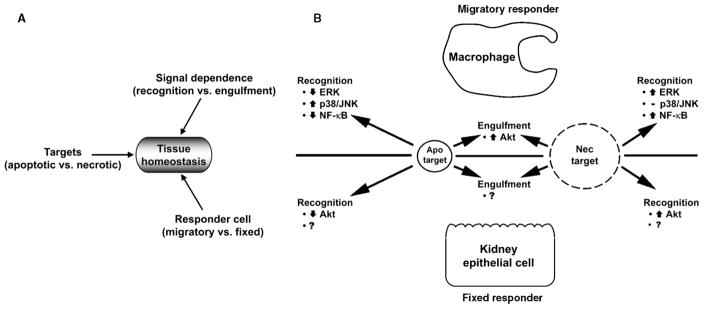
Virtually all cells in the body have the capacity to recognize and respond to dead cells. Viable cells discriminate apo from nec targets via distinct cell surface receptors. Engagement of these receptors induces "recognition-dependent" signaling events in viable responding cells that differ for apo vs. nec targets. Although "engulfment-dependent" signaling events also contribute to the response by viable cells, these events do not differ for apo vs. nec targets. While many signaling events are conserved across diverse cell lineages, other signaling events, especially those involving Akt, demonstrate lineage-specific variation. Whereas apo targets activate Akt in MPhi, they inhibit Akt in kidney epithelial cells. Differences in the responses to dead targets by viable migratory cells, such as MPhi, and viable fixed cells, such as kidney epithelial cells, permit cell-specific adaptations to local environmental change or stress. We propose that dead cells (apo and nec) act as sentinels to alert nearby viable cells to local environmental change or stress.
Figures
References
-
- Savill J, Dransfield I, Gregory C, Haslett C. A blast from the past: Clearance of apo cells regulates immune responses. Nat Rev Immunol. 2002;2:965–975. - PubMed
-
- Voll RE, Herrmann M, Roth EA, Stach C, Kalden JR, Girkontaite I. Immunosuppressive effects of apo cells. Nature. 1997;390:350–351. - PubMed
-
- Cvetanovic M, Ucker DS. Innate immune discrimination of apo cells: Repression of pro-inflammatory macrophage transcription is coupled directly to specific recognition. J Immunol. 2004;172:880–889. - PubMed
Publication types
MeSH terms
Grants and funding
LinkOut - more resources
Full Text Sources
