. 2009 Oct 8:8:82.
doi: 10.1186/1476-4598-8-82.

Limited copy number-high resolution melting (LCN-HRM) enables the detection and identification by sequencing of low level mutations in cancer biopsies

Affiliations

Limited copy number-high resolution melting (LCN-HRM) enables the detection and identification by sequencing of low level mutations in cancer biopsies

Hongdo Do et al. Mol Cancer. .

Abstract

Background: Mutation detection in clinical tumour samples is challenging when the proportion of tumour cells, and thus mutant alleles, is low. The limited sensitivity of conventional sequencing necessitates the adoption of more sensitive approaches. High resolution melting (HRM) is more sensitive than sequencing but identification of the mutation is desirable, particularly when it is important to discriminate false positives due to PCR errors or template degradation from true mutations.We thus developed limited copy number - high resolution melting (LCN-HRM) which applies limiting dilution to HRM. Multiple replicate reactions with a limited number of target sequences per reaction allow low level mutations to be detected. The dilutions used (based on Ct values) are chosen such that mutations, if present, can be detected by the direct sequencing of amplicons with aberrant melting patterns.

Results: Using cell lines heterozygous for mutations, we found that the mutations were not readily detected when they comprised 10% of total alleles (20% tumour cells) by sequencing, whereas they were readily detectable at 5% total alleles by standard HRM. LCN-HRM allowed these mutations to be identified by direct sequencing of those positive reactions.LCN-HRM was then used to review formalin-fixed paraffin-embedded (FFPE) clinical samples showing discordant findings between sequencing and HRM for KRAS exon 2 and EGFR exons 19 and 21. Both true mutations present at low levels and sequence changes due to artefacts were detected by LCN-HRM. The use of high fidelity polymerases showed that the majority of the artefacts were derived from the damaged template rather than replication errors during amplification.

Conclusion: LCN-HRM bridges the sensitivity gap between HRM and sequencing and is effective in distinguishing between artefacts and true mutations.


Figures
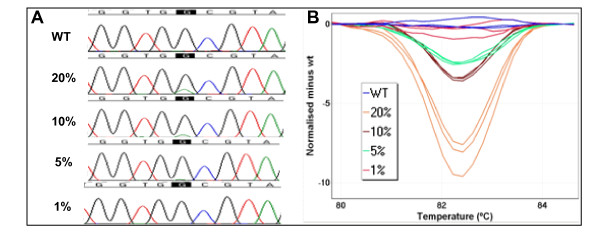
Figure 1
Figure 1
Comparison of the mutation detection sensitivity of high resolution melting (HRM) and sequencing. The sensitivity of KRAS HRM and dideoxynucleotide sequencing was tested using four HCT116 DNA dilutions. Based on qPCR data, the HCT116 DNA was mixed with wild-type DNA to dilute the mutant allele to 20%, 10%, 5%, and 1% of the total alleles. Sequencing was only sensitive to 10-20% whereas HRM readily detected 5% mutant sequence. Panel A: Sequencing traces of four HCT116 DNA dilutions. The mutant A allele was readily detectable at a 20% mutant frequency. However, when the mutant allele was present at 10%, it was barely distinguishable from the sequencing background. When the frequency of the mutant was below 10%, the mutation was not detectable by dideoxynucleotide sequencing. Panel B: Using HRM, the mutation was readily detectable down at 5% mutation frequency. The 1% dilution was not distinct from the normal DNA. The melting curves of each dilution are shown in orange (20%), brown (10%), green (5%), red (1%) and blue (wild-type control).
Figure 2
Figure 2
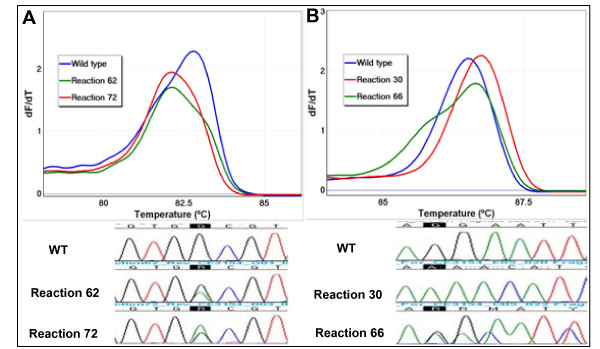
Detection of low levels of mutations by LCN-HRM and characterisation by subsequent sequencing. HCT116 and NCI-H1650 cell line DNA were mixed with normal DNA to a 5% mutant allele frequency based on the previous qPCR data. Each of the DNA mixtures were then tested by LCN-HRM in 65 replicates. An estimated average of three copies per reaction were added into the individual reaction. LCN-HRM using the diluted 5% HCT116 and 5% NCI-H1650 was performed for KRAS exon 2 and EGFR exon 19 respectively. LCN-HRM positive reactions, which were detected by melting curve analysis, were directly sequenced. The first derivative melting plots and sequencing traces of two of the representative LCN-HRM positive reactions are shown. (Panel A for 5% HCT116 and Panel B for 5% NCI-H1650). The identical KRAS mutation to the HCT116, c.38G>A, was detected by sequencing of reactions 62 and 72, which displayed aberrant melting pattern compared with wild type. The EGFR delE746_A750 was detected heterozygously in reaction 66 and a homozygously in reaction 30 by sequencing.
Figure 3
Figure 3
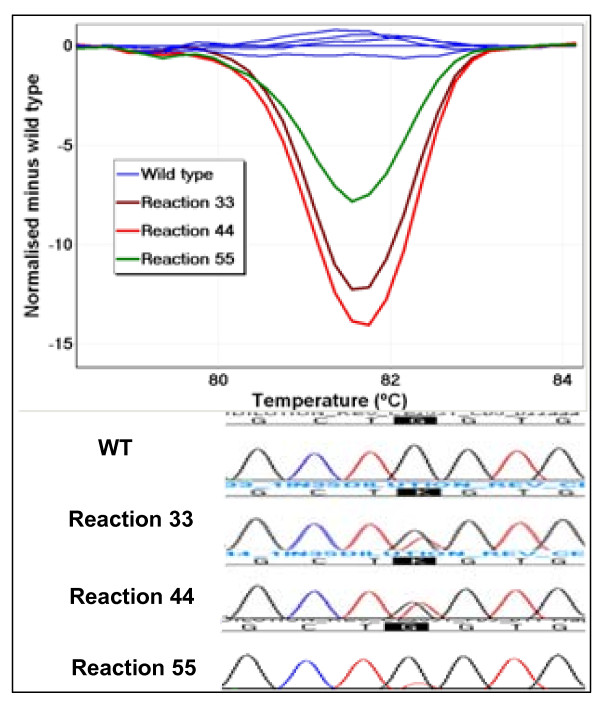
Detection of a KRAS mutations by LCN-HRM in a sequencing negative clinical sample. Testing of a clinical non-small cell lung cancer sample, TX450, for KRAS exon 2 by sequencing gave a negative result whereas the sample was positive by HRM. LCN-HRM was thus performed in 64 replicates using an estimate of average four copies per reaction. The difference graph plot and sequencing traces of three representatives of LCN-HRM positive reactions are shown. A KRAS c.34G>T was detected in all three reactions by subsequent sequencing.
Figure 4
Figure 4
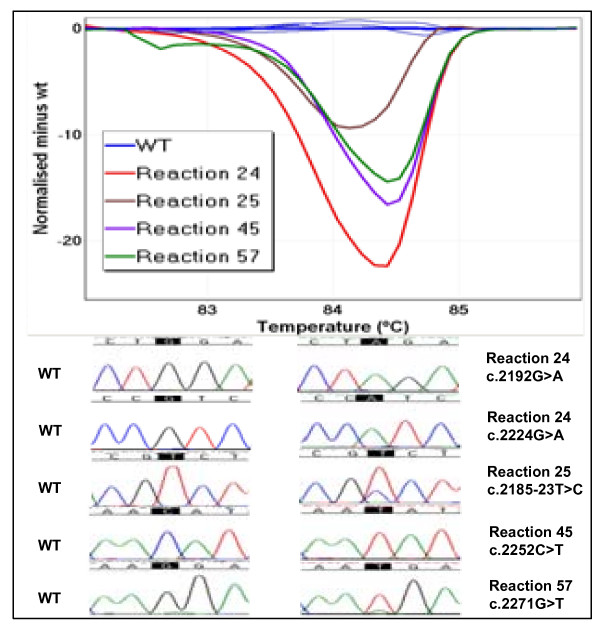
PCR artefacts detected in in a clinical FFPE sample (TX13). A total of 8 out of 31 LCN-HRM reactions were positive by melting curve analysis. Five non-identical sequence variants were detected from 4 of the 8 LCN-HRM positive reactions sequenced. In reaction 24, two transitional G>A changes were detected at positions c.2192 and c.2224. Two other exonic (c.2252C>T and c.2271G>T) and one intronic (c.2185-23T>C) variants were also detected in reactions 45, 57 and 25 respectively.

References

    1. Sharma SV, Bell DW, Settleman J, Haber DA. Epidermal growth factor receptor mutations in lung cancer. Nat Rev Cancer. 2007;7:169–181. doi: 10.1038/nrc2088. - DOI - PubMed
    1. Ludwig JA, Weinstein JN. Biomarkers in cancer staging, prognosis and treatment selection. Nat Rev Cancer. 2005;5:845–856. doi: 10.1038/nrc1739. - DOI - PubMed
    1. Taniguchi K, Okami J, Kodama K, Higashiyama M, Kato K. Intratumor heterogeneity of epidermal growth factor receptor mutations in lung cancer and its correlation to the response to gefitinib. Cancer Sci. 2008;99:929–935. doi: 10.1111/j.1349-7006.2008.00782.x. - DOI - PMC - PubMed
    1. Kobelt DJ, Hees SM, Hildebrandt RD, Wnendt S. Validation of a Method for Automated Nucleotide Sequence Analysis and Estimation of the Limits of Detection of Variant Sequences in a Heterogenic DNA Sample. Analytical Letters. 1998;31:41–54.
    1. Marchetti A, Martella C, Felicioni L, Barassi F, Salvatore S, Chella A, Camplese PP, Iarussi T, Mucilli F, Mezzetti A, et al. EGFR mutations in non-small-cell lung cancer: analysis of a large series of cases and development of a rapid and sensitive method for diagnostic screening with potential implications on pharmacologic treatment. J Clin Oncol. 2005;23:857–865. doi: 10.1200/JCO.2005.08.043. - DOI - PubMed

Publication types

MeSH terms