


How do physicians conduct medication reviews?
- PMID: 19813063
- PMCID: PMC2787945
- DOI: 10.1007/s11606-009-1132-4
How do physicians conduct medication reviews?
Abstract
Background: Medication reviews are recommended annually for older patients. A medication review is a discussion of a patient's complete set of medications, but the actual content of a review is not well specified. The medical literature suggests that it is an exhaustive evaluation, but what physicians actually ask about their patients' medication regimens has been little studied.
Objective: To describe what physicians do when they review medications in the office setting.
Methods: Qualitative content analysis of audio-taped encounters between 100 patients aged 65 and older and 28 primary care physicians in two health care systems in Sacramento, California.
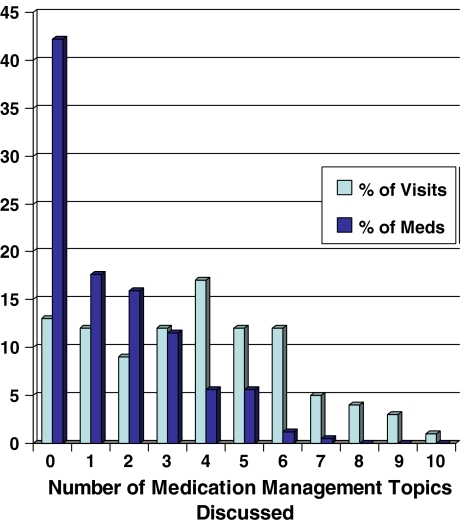
Results: Physicians use a combination of non-mutually exclusive strategies when reviewing chronic medications that include: (1) efforts to obtain a complete list of patient medications (36% of visits), (2) discussion of a topic related to the management of each of a patient's chronic medications (47% of visits), and (3) sequential discussion of the majority of a patient's medications without intervening discussion (45% of visits). Of 10 medication management topics that were discussed in medication reviews, a mean of 1.5 topics (SD = 1.7, range 0-7) were mentioned for each medication, with efficacy and directions being most common. Physicians conducted a sequential discussion that included discussion of each of a patient's medications in only 32% of visits.
Conclusions: Comprehensive discussions about chronic medications are uncommon in routine practice. Practical conceptualization of what constitutes a physician-conducted medication review is needed.
Figures
References
-
- Prescription Drug Trends Fact Sheet: May 2007 Update: Kaiser Family Foundation; 2007.
-
- Cost Overdose: Growth in Drug Spending for the Elderly, 199220132010. Publication No. 00-107. Washington, DC: Families USA Foundation; 2000.
-
- {'text': '', 'ref_index': 1, 'ids': [{'type': 'DOI', 'value': '10.1007/s11920-008-0008-3', 'is_inner': False, 'url': 'https://doi.org/10.1007/s11920-008-0008-3'}, {'type': 'PubMed', 'value': '18269893', 'is_inner': True, 'url': 'https://pubmed.ncbi.nlm.nih.gov/18269893/'}]}
- Barry PJ, Gallagher P, Ryan C. Inappropriate prescribing in geriatric patients. Curr Psychiatry Rep. 2008;10:37–43. - PubMed
-
- {'text': '', 'ref_index': 1, 'ids': [{'type': 'DOI', 'value': '10.1001/archinte.160.14.2129', 'is_inner': False, 'url': 'https://doi.org/10.1001/archinte.160.14.2129'}, {'type': 'PubMed', 'value': '10904455', 'is_inner': True, 'url': 'https://pubmed.ncbi.nlm.nih.gov/10904455/'}]}
- Bedell SE, Jabbour S, Goldberg R, et al. Discrepancies in the use of medications: their extent and predictors in an outpatient practice. Arch Intern Med. 2000;160:2129–34. - PubMed
-
- {'text': '', 'ref_index': 1, 'ids': [{'type': 'DOI', 'value': '10.1046/j.1532-5415.2001.49265.x', 'is_inner': False, 'url': 'https://doi.org/10.1046/j.1532-5415.2001.49265.x'}, {'type': 'PubMed', 'value': '11890495', 'is_inner': True, 'url': 'https://pubmed.ncbi.nlm.nih.gov/11890495/'}]}
- Bikowski RM, Ripsin CM, Lorraine VL. Physician-patient congruence regarding medication regimens. J Am Geriatr Soc. 2001;49:1353–7. - PubMed
