Review
. 2010 Feb 16:1314:74-90.
doi: 10.1016/j.brainres.2009.09.106. Epub 2009 Oct 6.

Lateral hypothalamic orexin/hypocretin neurons: A role in reward-seeking and addiction

Affiliations
Review

Lateral hypothalamic orexin/hypocretin neurons: A role in reward-seeking and addiction

Gary Aston-Jones et al. Brain Res. .

Abstract

Orexins (synonymous with hypocretins) are recently discovered neuropeptides made exclusively in hypothalamus. Behavioral, anatomical, and neurophysiological studies show that a subset of these cells, specifically those in lateral hypothalamus (LH), are involved in reward processing and addictive behaviors. Fos expression in LH orexin neurons varied in proportion to conditioned place preference (CPP) for morphine, cocaine, or food. This relationship occurred both in drug-naïve rats and in animals during protracted morphine withdrawal, when drug preference was elevated but food preference was decreased. Inputs to the LH orexin cell field from lateral septum and bed nucleus of the stria terminalis were Fos-activated during cocaine CPP in proportion to the preference expressed in each animal. This implies that these inputs may be involved in driving the conditioned responses in LH orexin neurons. Related studies showed that LH orexin neurons that project to ventral tegmental area (VTA) had greater Fos induction in association with elevated morphine preference during protracted withdrawal than non-VTA-projecting orexin neurons, indicating that the VTA is an important site of action for orexin's role in reward processing. In addition, stimulation of LH orexin neurons, or microinjection of orexin into VTA, reinstated an extinguished morphine preference. In self-administration studies, the orexin 1 receptor antagonist SB-334867 (SB) blocked cocaine-seeking induced by discrete or contextual cues previously associated with cocaine, but not by a priming injection of cocaine. There was no effect of SB on cocaine self-administration itself, indicating that it did not interfere with the drug's reinforcing properties. Neurophysiological studies revealed that locally applied orexin often augmented responses of VTA dopamine (DA) neurons to activation of the medial prefrontal cortex (mPFC), consistent with the view that orexin facilitates activation of VTA DA neurons by stimulus-reward associations. This LH-to-VTA orexin pathway was found to be necessary for learning a morphine place preference. These findings are consistent with results showing that orexin facilitates glutamate-mediated responses, and is necessary for glutamate-dependent long-term potentiation in VTA DA neurons. We surmise from these studies that LH orexin neurons play an important role in reward processing and addiction and that LH orexin cells are an important input to VTA for behavioral effects associated with reward-paired stimuli.


Figures

Figure 1
Figure 1
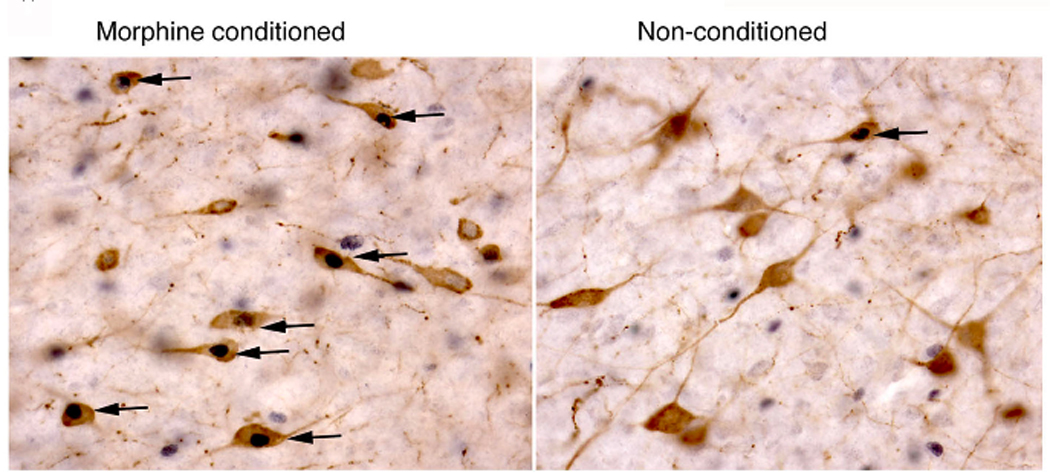
High-power photomicrograph of the LH showing the double labeling of orexin (brown cytoplasm) and Fos protein (black nuclei) in morphine-conditioned and non-conditioned animals, as indicated. Black arrows indicate double-labeled cells. Taken from (Harris et al., 2005).
Figure 2
Figure 2
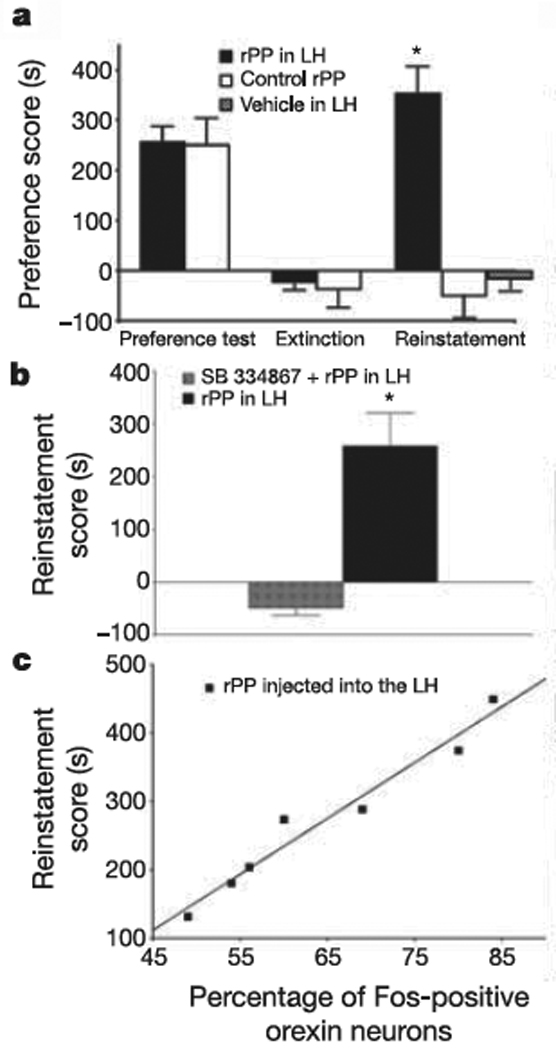
Activation of LH orexin neurons by rPP reinstated an extinguished preference for morphine. a, Preference scores are shown for both rPP- (150 nM) and vehicle-injected groups (mean ± s.e.m. in morphine-paired side minus saline-paired side) during the initial conditioning test, after extinction and during the reinstatement test. b, The selective OxR1 antagonist, SB 334867 (20–30 mg kg), blocked reinstatement by rPP (n = 8). Data were included only if rPP injection into LH on the following day (without the antagonist pretreatment) produced reinstatement of preference. c, Plot of correlation between reinstatement scores and percentages of LH orexin neurons that were Fos activated in rPP reinstated animals. Taken from (Harris et al., 2005).
Figure 3
Figure 3
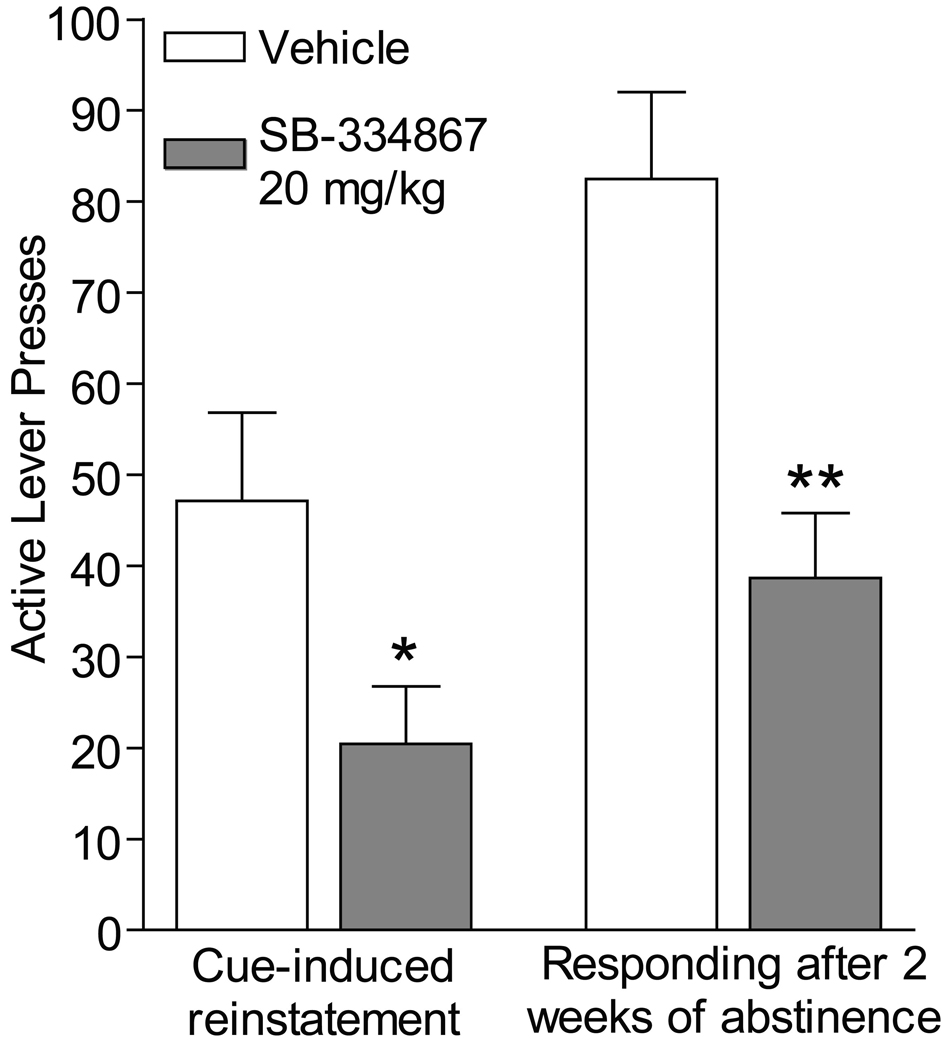
SB-334867 attenuated cocaine-seeking elicited by cues or following abstinence. Pretreatment with SB-334867 (20 mg/kg, ip) significantly reduced cue-induced reinstatement of extinguished lever-pressing as compared to vehicle pretreatment in the same animals (*p < 0.01). Pretreatment with SB-334867 also significantly reduced lever-pressing (cocaine-seeking) following 2 weeks of abstinence from cocaine self-administration as compared to animals given vehicle (**p < 0.005).
Figure 4
Figure 4
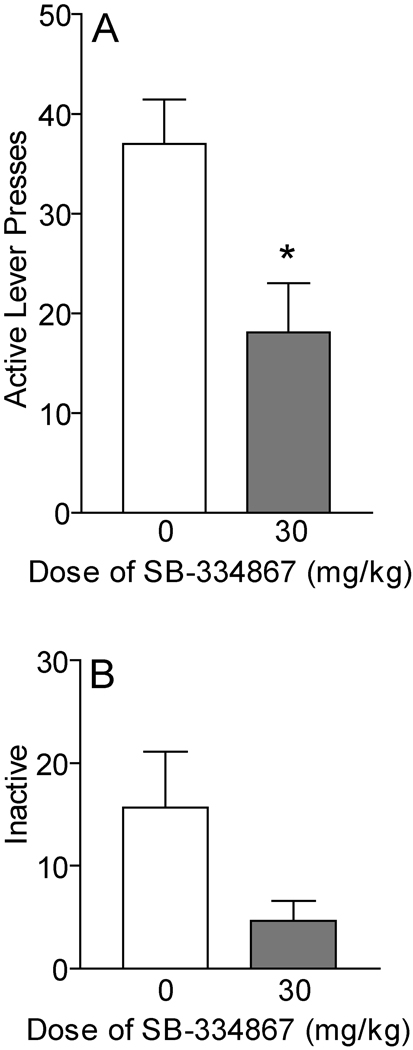
SB-334867 (30 mg/kg, ip) attenuated reinstatement elicited by contextual stimuli in an ABA (renewal) design. Animals were trained to self-administer cocaine in a distinct context and then given extinction training in an alternate environment. In a within-subjects design, rats were pretreated with SB (30 mg/kg, i.p.) or vehicle prior to re-exposure to the original self-administration context. Mean (± SEM) number of presses on the active and inactive lever in a 2-hour reinstatement session in the self-administration chamber is shown. a, Active lever responding during context-induced reinstatement of extinguished cocaine-seeking was significantly attenuated by SB (n = 9), as compared to vehicle (*p < 0.001). b, Inactive lever responding was not significantly affected by SB pretreatment. The apparent decrease in responding on the inactive lever is expected if SB attenuates drug-seeking.
Figure 5
Figure 5
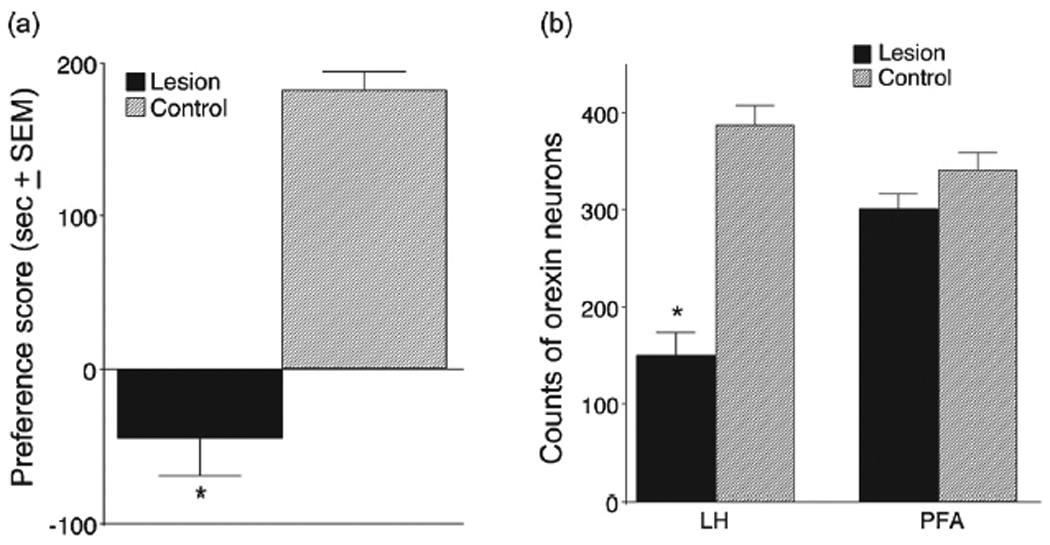
(a) Conditioned place preference (CPP) scores and (b) orexin neuronal cell counts for animals given unilateral NMDA injections in the LH and microinjections of SB-334867 in the contralateral VTA during CPP training. (a) Preference scores were calculated by subtracting the time spent in the morphine-paired chamber during the preconditioning day from the time spent in that chamber on the test day (i.e., post-conditioning). Control animals received vehicle instead of NMDA in the LH and received the same SB injections in the contralateral VTA. Scores represent group mean ± SEM. (b) Neuronal cell counts of surviving orexin neurons in LH or neighboring PFA (aka PeF) from six adjacent 40 um-thick sections at the level of the neurotoxin injection from animals with effective lesions. Control refers to the number of orexin neurons found on the non-lesioned side in the same slices (*P < .01, n = 9). Taken from (Harris et al., 2007a).
Figure 6
Figure 6
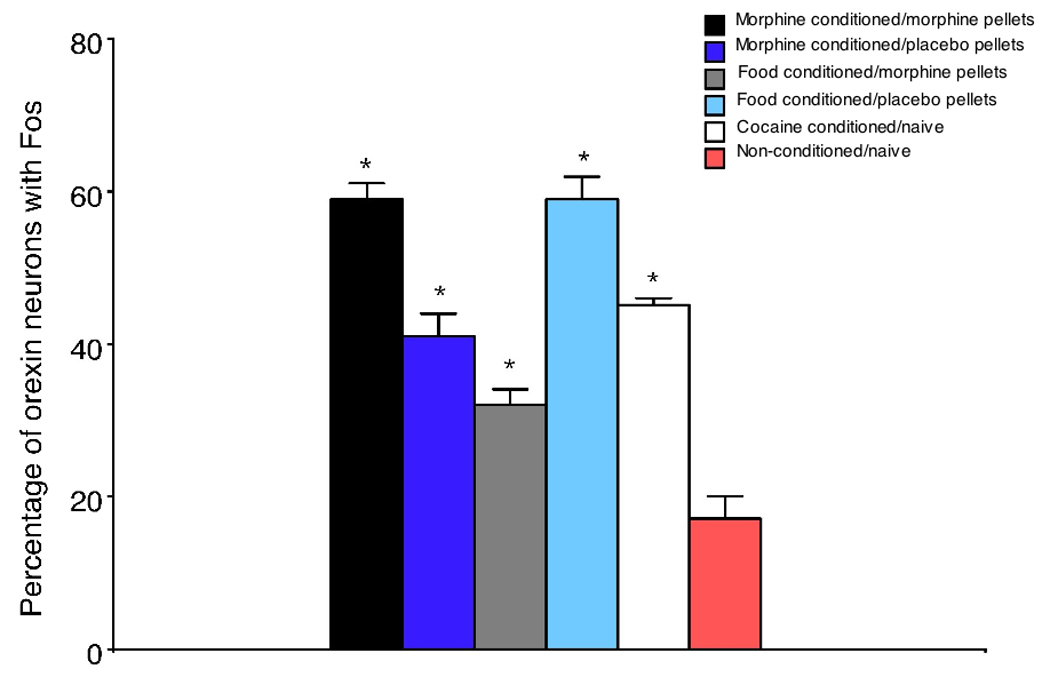
Fos expression in LH orexin neurons as a function of treatments, as indicated. Morphine- and food-conditioned animals were given morphine or placebo pellets for 2 weeks, and pellets were removed and animals remained in their home cages for 5 weeks before CPP conditioning, as in our previous publications (Aston-Jones and Harris, 2004a; Harris and Aston-Jones, 2003d). Note that a higher percentage of LH orexin neurons exhibited Fos in withdrawn animals than in placebo-pelleted animals subjected to morphine CPP. Conversely, a lower percentage of LH orexin neurons exhibited Fos in withdrawn animals than in placebo pelleted animals subjected to food CPP. Cocaine CPP in naïve rats (no prior drug treatment) also increased Fos expression in LH orexin neurons. Taken from (Aston-Jones et al., 2009).
Figure 7
Figure 7
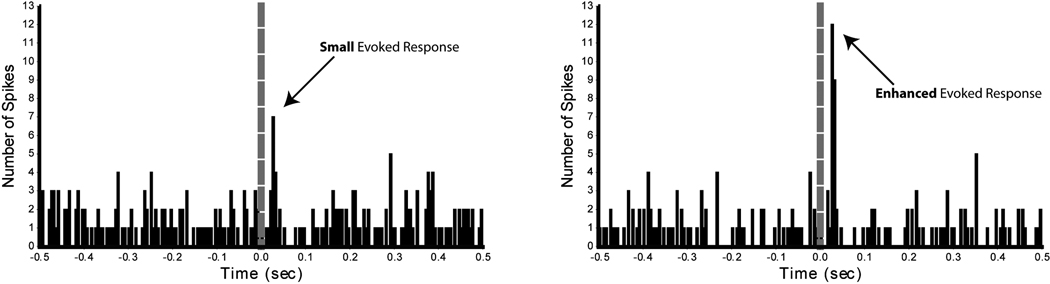
Responses of a single DA neuron evoked with mPFC stimulation before and after application of orexin A to the recorded neuron. Left panel shows the responses of a DA neuron evoked with 1 mA stimulation of the mPFC. Right panel shows the responses of the same neuron to the same stimulation approximately 5 min following delivery of 60 nl of 1.4 µM orexin A locally onto the recorded neuron. Dashed line is the onset of stimulation. Taken from (Aston-Jones et al., 2009).

References

    1. Akanmu MA, Honda K. Selective stimulation of orexin receptor type 2 promotes wakefulness in freely behaving rats. Brain Res. 2005;1048:138–145. - PubMed
    1. Akaoka H, Saunier CF, Chergui K, Charlety P, Buda M, Chouvet G. Combining in vivo volume-controlled pressure microejection with extracellular unit recording. J. Neurosci. Meth. 1992;42:119–128. - PubMed
    1. Aston-Jones G, Delfs JM, Druhan J, Zhu Y. The bed nucleus of the stria terminalis. A target site for noradrenergic actions in opiate withdrawal. Ann N Y Acad Sci. 1999;877:486–498. - PubMed
    1. Aston-Jones G, Harris GC. Brain substrates for increased drug seeking during protracted withdrawal. Neuropharmacology. 2004a;47S1:167–179. - PubMed
    1. Aston-Jones G, Harris GC. Brain substrates for increased drug seeking during protracted withdrawal. Neuropharmacology. 2004b;47 Suppl 1:167–179. - PubMed

Publication types

MeSH terms