Review
. 2010 Jan;51(1):27-36.
doi: 10.1111/j.1528-1167.2009.02341.x. Epub 2009 Oct 8.

Mammalian target of rapamycin (mTOR) inhibition as a potential antiepileptogenic therapy: From tuberous sclerosis to common acquired epilepsies

Affiliations
Review

Mammalian target of rapamycin (mTOR) inhibition as a potential antiepileptogenic therapy: From tuberous sclerosis to common acquired epilepsies

Michael Wong. Epilepsia. 2010 Jan.

Abstract

Most current treatments for epilepsy are symptomatic therapies that suppress seizures but do not affect the underlying course or prognosis of epilepsy. The need for disease-modifying or "antiepileptogenic" treatments for epilepsy is widely recognized, but no such preventive therapies have yet been established for clinical use. A rational strategy for preventing epilepsy is to target primary signaling pathways that initially trigger the numerous downstream mechanisms mediating epileptogenesis. The mammalian target of rapamycin (mTOR) pathway represents a logical candidate, because mTOR regulates multiple cellular functions that may contribute to epileptogenesis, including protein synthesis, cell growth and proliferation, and synaptic plasticity. The importance of the mTOR pathway in epileptogenesis is best illustrated by tuberous sclerosis complex (TSC), one of the most common genetic causes of epilepsy. In mouse models of TSC, mTOR inhibitors prevent the development of epilepsy and underlying brain abnormalities associated with epileptogenesis. Accumulating evidence suggests that mTOR also participates in epileptogenesis due to a variety of other causes, including focal cortical dysplasia and acquired brain injuries, such as in animal models following status epilepticus or traumatic brain injury. Therefore, mTOR inhibition may represent a potential antiepileptogenic therapy for diverse types of epilepsy, including both genetic and acquired epilepsies.


Figures
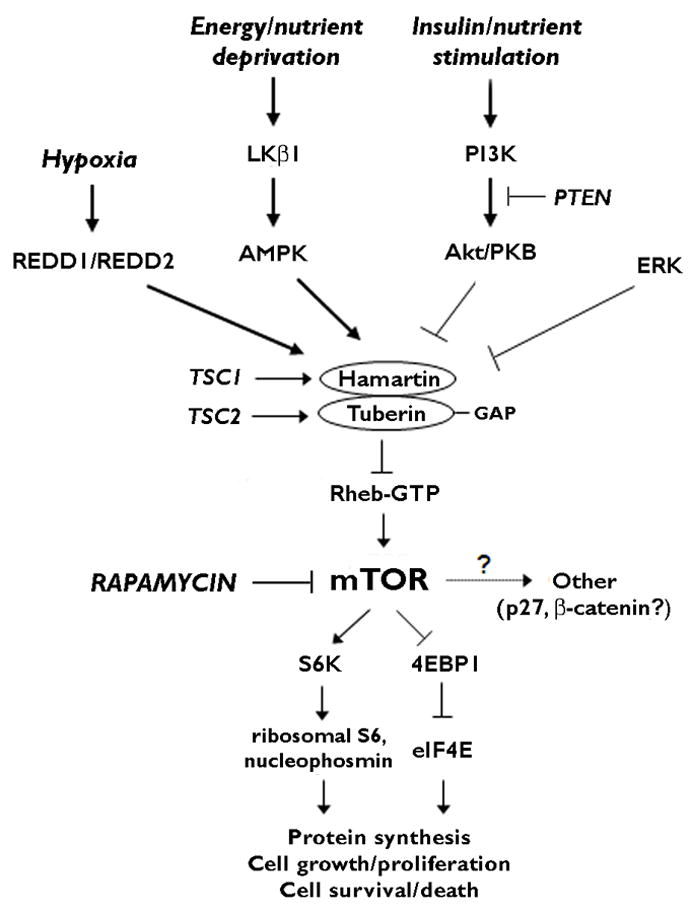
Figure 1
Figure 1
Physiological regulation of the mTOR signaling pathway. mTOR controls multiple downstream effectors, such as S6K/S6/nucleophosmin and 4EBP1/eIF4E, which regulate protein synthesis and other processes related to cellular growth, proliferation, metabolism, and survival. In response to environmental or physiological stimuli, multiple upstream pathways, primarily involving cascades of protein kinases, may either activate (PI3K/Akt, ERK) or inhibit (REDD1/REDD2, LKβ1/AMPK) mTOR via modulation of the tuberin-hamartin complex and Rheb GTPase. In anabolic states, such as with insulin, growth factor, or nutrient stimulation, PI3K/Akt and ERK activate the mTOR pathway and induce protein synthesis, cell growth and proliferation. Conversely, in catabolic states, the REDD1/REDD2 and LKβ1/AMPK pathways respond to hypoxia or energy/nutrient deprivation by inhibiting the mTOR pathway and thus slowing protein synthesis, cell growth, and metabolism. In the disease of TSC, mutation of one of the TSC genes leads to disinhibition or hyperactivation of the mTOR pathway, causing dysregulated growth and proliferation and predisposing to tumor formation. In addition to genetic mutations, acquired brain injuries may cause abnormal activation of mTOR and related pathways, which may lead to cellular and molecular changes promoting epileptogenesis (See Fig. 2). Note that this schematic figure is oversimplified for clarity, as upstream regulators, feedback loops, intermediary steps, and alternative pathways (e.g. mTORC1 vs. mTORC2) are not shown. Abbreviations: 4EBP1 – elongation factor 4E binding protein 1; AMPK – AMP-activated protein kinase; eIF4E – elongation initiation factor 4E; ERK – extracellular signal-regulated protein kinase; GAP – GTPase activating protein; mTOR – mammalian target of rapamycin; PI3K – phosphatidylinositide-3 kinase; PKB – protein kinase B (a.k.a Akt); PTEN - phosphatase and tensin homolog deleted on chromosome ten; Rheb – Ras homolog expressed in brain; S6K – ribosomal S6 kinase.
Figure 2
Figure 2
mTOR may be a central signaling pathway for coordinating multiple mechanisms of epileptogenesis due to diverse causes of epilepsy. The mTOR signaling pathway may be abnormally activated by a variety of genetic defects or acquired injuries, including upstream TSC or PTEN gene mutations, status epilepticus, or traumatic brain injury. In turn, mTOR hyperactivation may trigger multiple downstream mechanisms of epileptogenesis via regulation of protein synthesis and other cellular processes, such as expression of ion channels, apoptosis, autophagy, axonal sprouting, and neurogenesis. Inhibition of mTOR by rapamycin may represent an effective treatment for preventing epileptogenesis in many types of epilepsy involving abnormal mTOR activation.

References

    1. Asnaghi L, Bruno P, Priulla M, Nicolin A. mTOR: a protein kinase switching between life and death. Pharmacol Res. 2004;50:545–549. - PubMed
    1. Baehrecke EH. Autophagy: dual roles in life and death? Nat Rev Mol Cell Biol. 2005;6:505–510. - PubMed
    1. Baybis M, Yu J, Lee A, Golden JA, Weiner H, McKhann G, Aronica E, Crino PB. mTOR cascade activation distinguishes tubers from focal cortical dysplasia. Ann Neurol. 2004;56:478–487. - PubMed
    1. Beevers CS, Chen L, Liu L, Luo Y, Webster NJG, Huang S. Curcumin disrupts the mammalian target of rapamycin-raptor complex. Cancer Res. 2009;69:1000–1008. - PMC - PubMed
    1. Bissler JJ, McCormack FX, Young LR, Elwing JM, Chuck G, Leonard JM, Schmithorst VJ, Laor T, Brody AS, Bean J, Salibury S, Franz DN. Sirolimus for angiomyolipoma in tuberous sclerosis complex or lymphangioleiomyomatosis. N Engl J Med. 2008;358:140–151. - PMC - PubMed

Publication types

MeSH terms

Substances
