


Utilization of surveillance colonoscopy in community practice
- PMID: 19818779
- PMCID: PMC2813330
- DOI: 10.1053/j.gastro.2009.09.062
Utilization of surveillance colonoscopy in community practice
Abstract
Background & aims: The recommended timing of surveillance colonoscopy for individuals with adenomatous polyps is based on adenoma histology, size, and number. The burden and cost of surveillance colonoscopy are significant. The aim of this study was to examine the use of surveillance colonoscopy on a community-wide basis.
Methods: We retrospectively queried participants in the Prostate, Lung, Colorectal, and Ovarian Cancer screening trial in 9 US communities about use of surveillance colonoscopy. Subjects whose initial colonoscopy showed advanced adenoma (AA), nonadvanced adenoma (NAA), or no adenoma (NA) findings were included. Colonoscopy examinations were confirmed by reviewing colonoscopy reports.
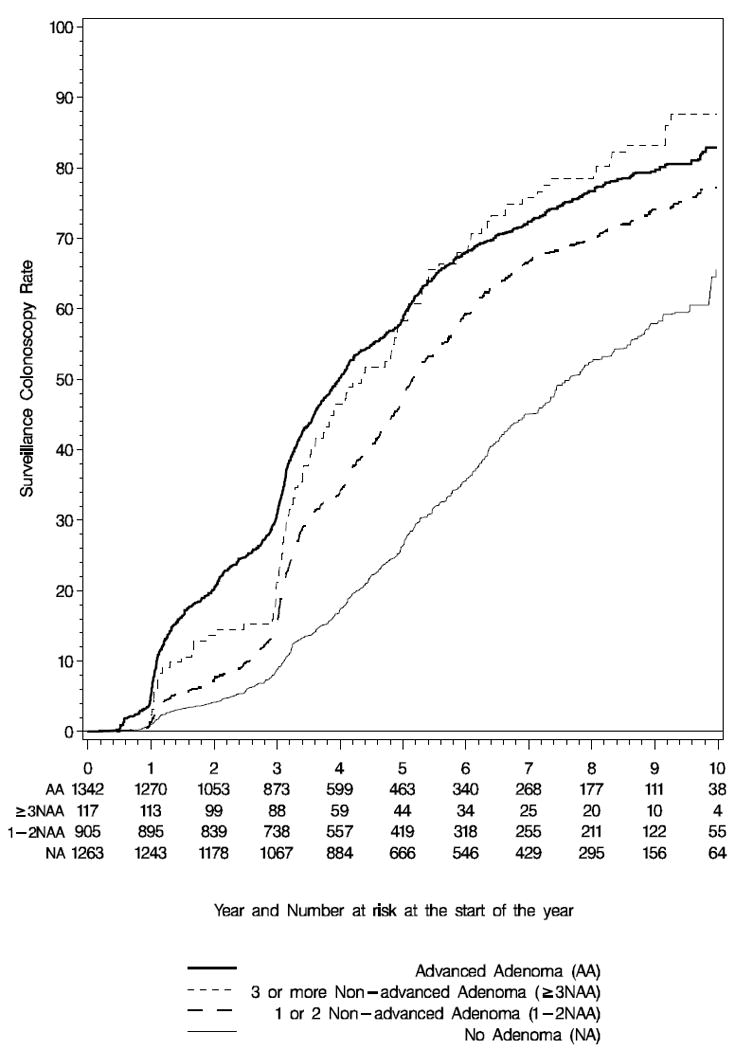
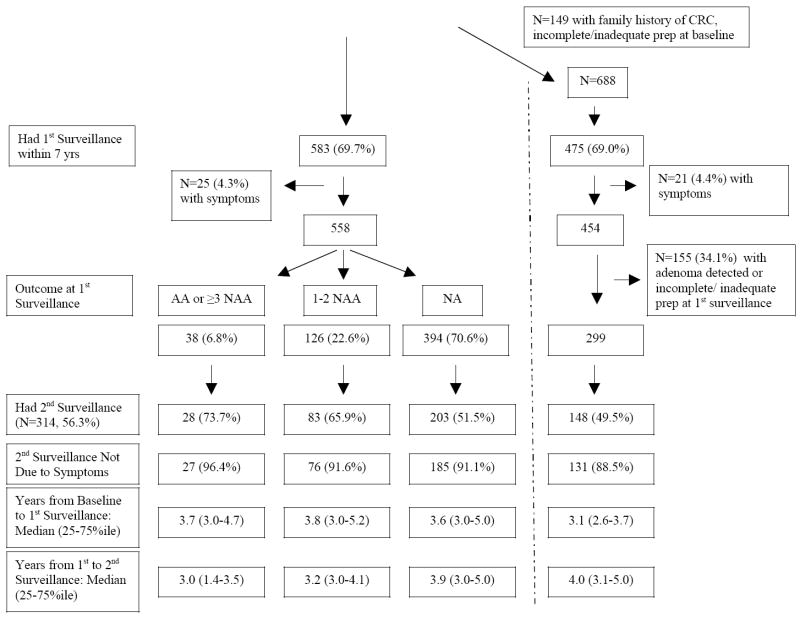
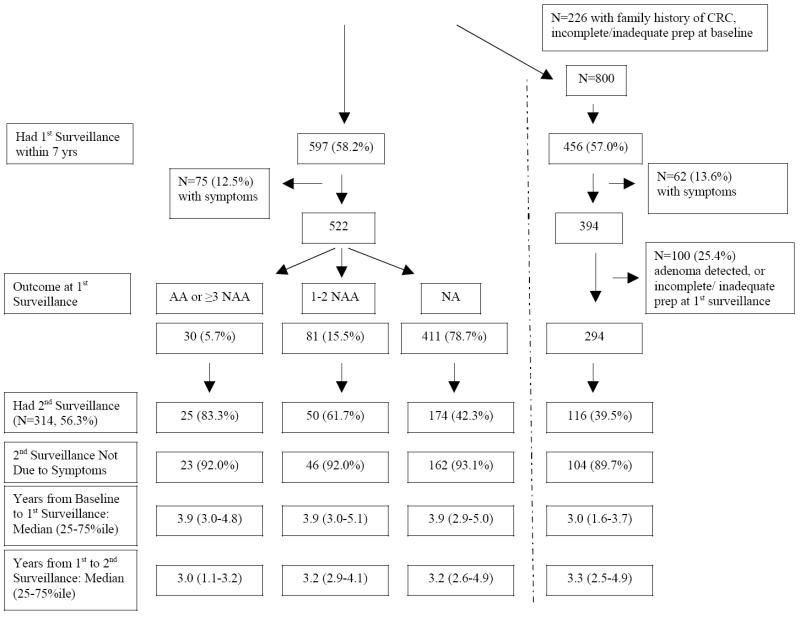
Results: Of 3876 subjects selected for inquiry, 3627 (93.6%) responded. The cumulative probability of a surveillance colonoscopy within 5 years was 58.4% (n = 1342) in the AA group, 57.5% in those with >or=3 NAAs (n = 117), 46.7% in those with 1-2 NAAs (n = 905), and 26.5% (n = 1263) in subjects with NAs. Within 7 years, 33.2% of subjects with AAs received >or=2 surveillance examinations versus 26.9% for those with >or=3 NAAs, 18.2% for those with 1 or 2 NAAs, and 10.4% for those with NAs. Incomplete colonoscopy, family history of colorectal cancer, or interval adenomatous findings could explain only a minority of surveillance colonoscopy in low-risk subjects.
Conclusions: In community practice, there is substantial overuse of surveillance colonoscopy among low-risk subjects and underuse among subjects with AAs. Interventions to better align use of surveillance colonoscopy with risk for advanced lesions are needed.
Copyright 2010 AGA Institute. Published by Elsevier Inc. All rights reserved.
Conflict of interest statement
There are no conflicts of interest reported by the authors relevant to this manuscript. The investigators had full access to all of the data and take responsibility for the integrity of the data and the accuracy of the data analysis.
Figures
Comment in
-
Community colonoscopy: a gordian knot?Gastroenterology. 2010 Jan;138(1):27-30. doi: 10.1053/j.gastro.2009.11.035. Epub 2009 Nov 21. Gastroenterology. 2010. PMID: 19932659 No abstract available.
References
-
- U.S.Preventive Services Task Force. Screening for colorectal cancer: recommendation and rationale. Annals of Internal Medicine. 2002;137:129–131. - PubMed
-
- Winawer S, Fletcher R, Rex D, Bond J, Burt R, Ferrucci J, Ganiats T, Levin T, Woolf S, Johnson D, Kirk L, Litin S, Simmang C Gastrointestinal Consortium. Colorectal cancer screening and surveillance: clinical guidelines and rationale-Update based on new evidence. Gastroenterology. 2003;124:544–560. - PubMed
-
- Winawer SJ, Zauber AG, Ho MN, O’Brien MJ, Gottlieb LS, Sternberg SS, Waye JD, Schapiro M, Bond JH, Panish JF. Prevention of colorectal cancer by colonoscopic polypectomy. The National Polyp Study Workgroup. New England Journal of Medicine. 1993;329(27):1977–81. see comment. - PubMed
-
- Mandel JS, Church TR, Bond JH, Ederer F, Geisser MS, Mongin SJ, Snover DC, Schuman LM. The effect of fecal occult-blood screening on the incidence of colorectal cancer. New England Journal of Medicine. 2000;343:1603–1607. [letter; comment]. [see comments] - PubMed
Publication types
MeSH terms
Grants and funding
LinkOut - more resources
Full Text Sources
Medical
