


doi: 10.1016/j.tig.2009.09.008.
Epub 2009 Oct 12.
Detecting new neurodegenerative disease genes: does phenotype accuracy limit the horizon?
- PMID: 19819581
- PMCID: PMC2824109
- DOI: 10.1016/j.tig.2009.09.008
Item in Clipboard
Detecting new neurodegenerative disease genes: does phenotype accuracy limit the horizon?
Trends Genet.
2009 Nov.
No abstract available
Figures
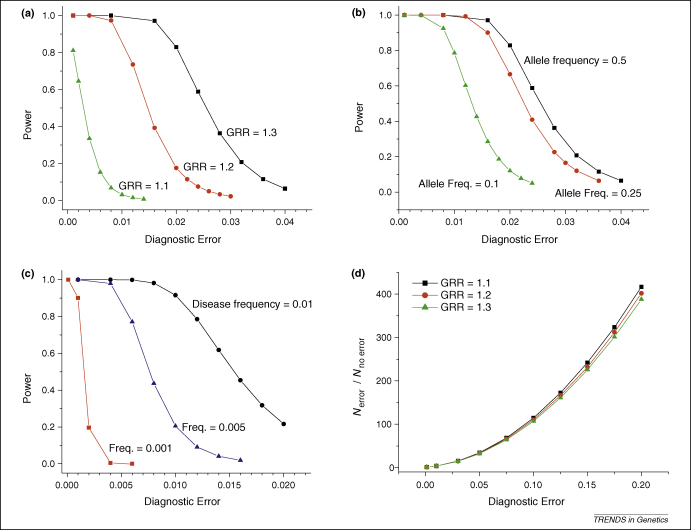
Power to detect a genetic association in the context of diagnostic errors. In each example, the probability of affected individuals being classified as controls is 1 × 10⁻⁵. Varying this parameter has negligible impact on power and/or optimal sample size for diseases that are present in <10% of the population . (a) Power to detect an association between a common allele (allele frequency = 0.5; GRR = 1.1– 1.3 under a multiplicative model) and disease in 20 000 cases and 20 000 controls with varying degrees of diagnostic error at P < 5 × 10⁻⁷. Disease frequency = 0.01. (b) Power to detect an association between alleles of different frequency (0.5, 0.25, 0.1) and disease in 20 000 cases and 20 000 controls with varying degrees of diagnostic error at P < 5 × 10⁻⁷. GRR = 1.3, disease frequency = 0.01. (c) Power to detect an association between an allele (frequency = 0.125, GRR = 1.3) and diseases of different prevalence (0.01, 0.001, 0.0001) in 20 000 cases and 20 000 controls with varying degrees of diagnostic error at P < 5 × 10⁻⁷. (d) Ratio of the number of inaccurately phenotyped cases (nerror) to the number of accurately phenotyped cases (nnoerror) required to detect an association between an allele (frequency = 0.1, varying GRR from 1.1 to 1.3) and a disease (frequency = 0.01) with 95% power at varying degrees of diagnostic error at P < 5 × 10⁻⁷. All calculations used PAWE-PH Phenotype Edition .
Comment in
-
Detecting genes in complex disease: does phenotype accuracy limit the horizon?Trends Genet. 2010 Jun;26(6):241-2; author reply 242-3. doi: 10.1016/j.tig.2010.03.003. Epub 2010 Apr 22. Trends Genet. 2010. PMID: 20417577 Free PMC article. No abstract available.
References
-
- Lansbury P.T., Jr Back to the future: the ‘old-fashioned’ way to new medications for neurodegeneration. Nat. Med. 2004;10(Suppl.):S51–S57. - PubMed
-
- Hughes A.J. The accuracy of diagnosis of parkinsonian syndromes in a specialist movement disorder service. Brain. 2002;125:861–870. - PubMed
-
- Caslake R. Changes in diagnosis with follow-up in an incident cohort of patients with parkinsonism. J. Neurol. Neurosurg. Psychiatry. 2008;79:1202–1207. - PubMed
Publication types
MeSH terms
Grants and funding
LinkOut - more resources
Full Text Sources
Medical
