Topical mupirocin/sodium hypochlorite reduces peritonitis and exit-site infection rates in children
- PMID: 19820132
- PMCID: PMC2798867
- DOI: 10.2215/CJN.02770409
Topical mupirocin/sodium hypochlorite reduces peritonitis and exit-site infection rates in children
Abstract
Background and objectives: Peritoneal dialysis (PD) is a common maintenance renal replacement modality for children with ESRD frequently compromised by infectious peritonitis and catheter exit site and tunnel infections (ESI/TI). The effect of topical mupirocin (Mup) and sodium hypochlorite (NaOCl) solution was evaluated as part of routine daily exit site care on peritonitis and ESI/TI rates, causative microorganisms, and catheter survival rates.
Design, setting, participants, & measurements: Retrospective chart review of children on home continuous cycling PD between April 1, 2001 and June 30, 2007 was performed. Infection rates were examined based on exit site protocol used in two different periods: Mup alone, April 1, 2001 to November 17, 2004; and Mup and NaOCl (Mup+NaOCl), November 18, 2004 to June 30, 2007.
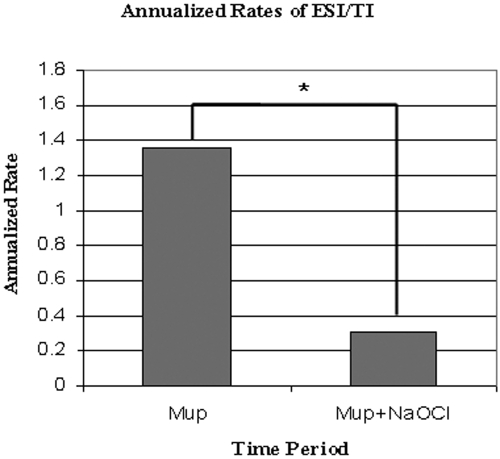
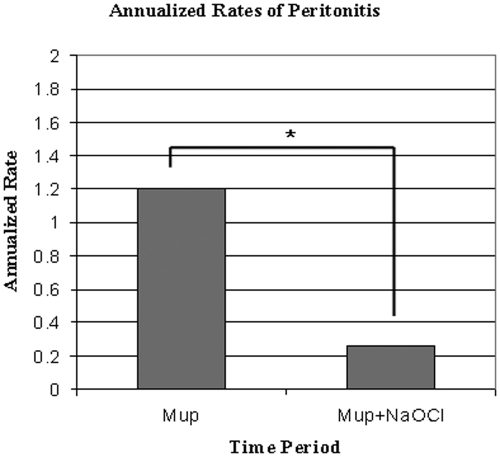
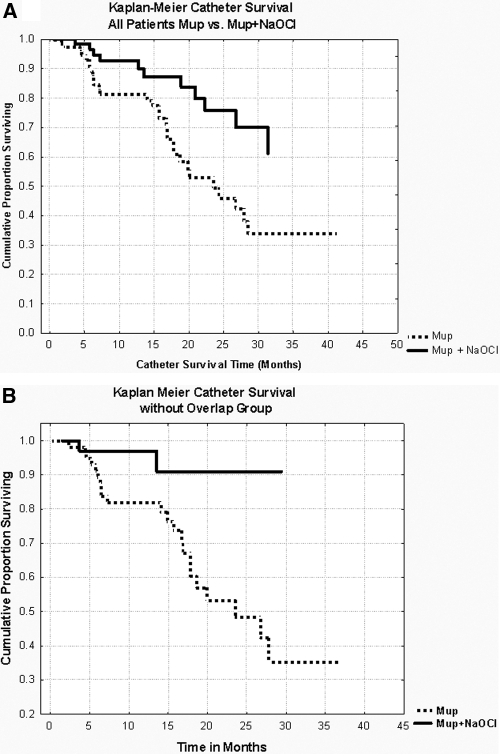
Results: Eighty-three patients (mean PD initiation age: 12.1 +/- 5.8 yr) received home PD over 2009 patient months. Annualized rates (ARs) for peritonitis decreased from 1.2 in the Mup period to 0.26 in the Mup+NaOCl period (P < 0.0001). ARs for ESI/TI decreased from 1.36 in the Mup period to 0.33 in the Mup+NaOCl period (P < 0.0001). No infections with Mup-resistant organisms were observed when either Mup or Mup+NaOCl was used for prophylaxis. Gram-negative-organism associated peritonitis decreased from an AR of 0.31 in the Mup period to 0.07 in the Mup+NaOCl period (P < 0.001). Infection-related catheter removal rates decreased from 1 in 38.9 catheter-months in the Mup period to 1 in 94.2 in the Mup+NaOCl period (P = 0.01). Catheter survival rates were longer in the Mup+NaOCl period (Kaplan-Meier, P < 0.009).
Conclusions: The combination Mup+NaOCl in daily exit site care was very effective to reduce PD catheter-associated infections and prolong catheter survival in pediatric patients.
Figures
Comment in
-
Concerns regarding routine use of sodium hypochlorite for exit-site care--what about the risks of encapsulating peritoneal sclerosis?Perit Dial Int. 2010 Jul-Aug;30(4):480. doi: 10.3747/pdi.2009.00261. Perit Dial Int. 2010. PMID: 20628114 No abstract available.
References
-
- Collins AJ, Kasiske B, Herzog C, Chavers B, Foley R, Gilbertson D, Grimm R, Liu J, Louis T, Manning W, McBean M, Murray A, St Peter W, Xue J, Fan Q, Guo H, Li Q, Li S, Qiu Y, Li S, Roberts T, Skeans M, Snyder J, Solid C, Wang C, Weinhandl E, Zhang R, Arko C, Chen SC, Dalleska F, Daniels F, Dunning S, Ebben J, Frazier E, Hanzlik C, Johnson R, Sheets D, Wang X, Forrest B, Berrini D, Constantini E, Everson S, Eggers P, Agodoa L: Excerpts from the United States Renal Data System 2006 Annual Data Report. Am J Kidney Dis 49[Suppl 2]: S1–S296, 2007 - PubMed
-
- Furth SL, Donaldson LA, Sullivan EK, Watkins SL: Peritoneal dialysis catheter infections and peritonitis in children: a report of the North American Pediatric Renal Transplant Cooperative Study. Pediatr Nephrol 15: 179–182, 2000 - PubMed
-
- Honda M: The 1997 Report of the Japanese National Registry data on pediatric peritoneal dialysis patients. Perit Dial Int 19[Suppl 2]: S473–S478, 1999 - PubMed
-
- Yinnon AM, Gabay D, Raveh D, Schlesinger Y, Slotki I, Attias D, Rudensky B: Comparison of peritoneal fluid culture results from adults and children undergoing CAPD. Perit Dial Int 19: 51–55, 1999 - PubMed
-
- Lerner GR, Warady BA, Sullivan EK, Alexander SR: Chronic dialysis in children and adolescents. The 1996 annual report of the North American Pediatric Renal Transplant Cooperative Study. Pediatr Nephrol 13: 404–417, 1999 - PubMed
MeSH terms
Substances
LinkOut - more resources
Full Text Sources
Medical
Research Materials
Miscellaneous