Alternative pathway of complement in children with diarrhea-associated hemolytic uremic syndrome
- PMID: 19820137
- PMCID: PMC2798880
- DOI: 10.2215/CJN.02730409
Alternative pathway of complement in children with diarrhea-associated hemolytic uremic syndrome
Abstract
Background and objectives: Diarrhea-associated hemolytic uremic syndrome (D+HUS) is a common cause of acute kidney injury in children. Mutations in alternative pathway (AP) complement regulatory proteins have been identified in severe cases of thrombotic microangiopathy, but the role of the AP in D+HUS has not been studied. Therefore, we determined whether plasma levels of markers of activation of the AP are increased in D+HUS and are biomarkers of the severity of renal injury that predict the need for dialysis.
Design, setting, participants, & measurements: Patients were randomly selected from among participants in the HUS-SYNSORB Pk trial. Plasma samples were collected on days 1, 4, 7, and 10 after enrollment and day 28 after discharge from the hospital. Levels of two complement pathway products, Bb and SC5b-9, were determined by ELISA.
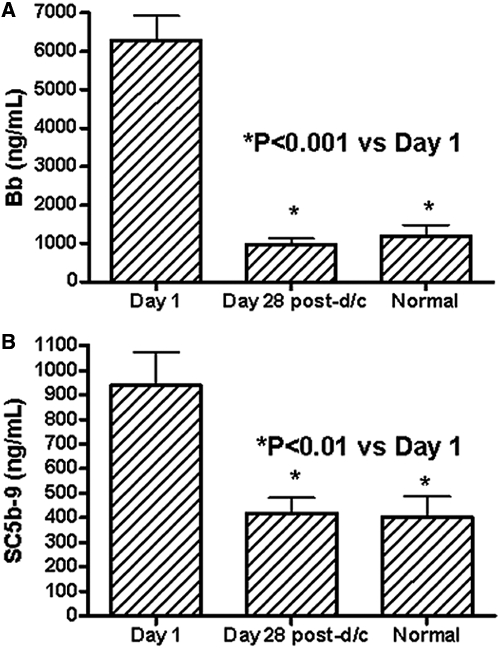
Results: Seventeen children (6 boys and 11 girls; age, 5.4 +/- 3.5 yr) were studied. Eight (47%) required dialysis support, and two had serious extrarenal events. On the day of enrollment, plasma levels of Bb and SC5b-9 were significantly increased in all patients compared with healthy controls (P < 0.01). The elevated concentrations normalized by day 28 after discharge. Circulating levels of complement pathway fragments did not correlate with severity of renal injury or occurrence of complications.
Conclusions: Patients with acute-onset D+HUS manifest activation of the AP of complement that is temporally related to the onset of disease and that resolves within 1 mo. Therapies to inhibit the AP of complement may be useful in attenuating the severity of renal injury and extrarenal complications.
Figures


References
-
- Tarr PI, Gordon CA, Chandler WL: Shiga-toxin-producing Escherichia coli and haemolytic uraemic syndrome. Lancet 365: 1073–1086, 2005 - PubMed
-
- Hughes AK, Ergonul Z, Stricklett PK, Kohan DE: Molecular basis for high renal cell sensitivity to the cytotoxic effects of Shigatoxin-1: Upregulation of globotriaosylceramide expression. J Am Soc Nephrol 13: 2239–2245, 2002 - PubMed
-
- Proulx F, Toledano B, Phan V, Clermont MJ, Mariscalco MM, Seidman EG: Circulating granulocyte colony-stimulating factor, C-X-C, and C-C chemokines with Escherichia coli O157:H7 associated with hemolytic uremic syndrome. Pediatr Res 52: 928–934, 2002 - PubMed
-
- Besbas N, Karpman D, Landau D, Loirat C, Proesmans W, Remuzzi G, Rizzoni G, Taylor CM, Van de Kar N, Zimmerhackl LB: A classification of hemolytic uremic syndrome and thrombotic thrombocytopenic purpura and related disorders. Kidney Int 70: 423–431, 2006 - PubMed
-
- Robson WL, Leung AK, Fick GHG, McKenna AI: Hypocomplementemia and leukocytosis in diarrhea-associated hemolytic uremic syndrome. Nephron 62: 296–298, 1992 - PubMed
Publication types
MeSH terms
Substances
Grants and funding
LinkOut - more resources
Full Text Sources
Other Literature Sources
Medical