Comparative Study
. 2010 Mar;201(2):209-20.
doi: 10.1007/s00221-009-2026-8. Epub 2009 Oct 10.

The effect of haptic guidance, aging, and initial skill level on motor learning of a steering task

Affiliations
Comparative Study

The effect of haptic guidance, aging, and initial skill level on motor learning of a steering task

Laura Marchal-Crespo et al. Exp Brain Res. 2010 Mar.

Abstract

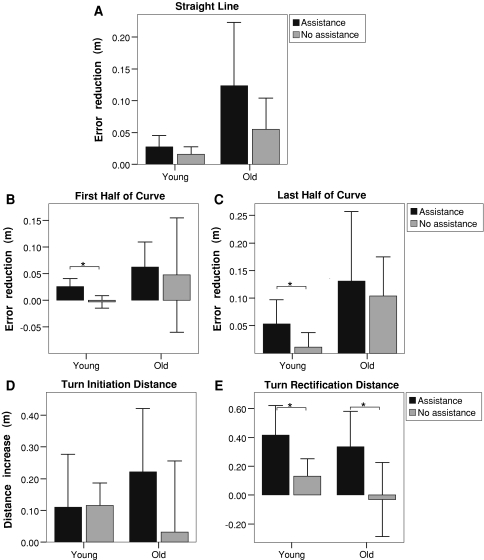
In a previous study, we found that haptic guidance from a robotic steering wheel can improve short-term learning of steering of a simulated vehicle, in contrast to several studies of other tasks that had found that the guidance either impairs or does not aid motor learning. In this study, we examined whether haptic guidance-as-needed can improve long-term retention (across 1 week) of the steering task, with age and initial skill level as independent variables. Training with guidance-as-needed allowed all participants to learn to steer without experiencing large errors. For young participants (age 18-30), training with guidance-as-needed produced better long-term retention of driving skill than did training without guidance. For older participants (age 65-92), training with guidance-as-needed improved long-term retention in tracking error, but not significantly. However, for a subset of less skilled, older subjects, training with guidance-as-needed significantly improved long-term retention. The benefits of guidance-based training were most evident as an improved ability to straighten the vehicle direction when coming out of turns. In general, older participants not only systematically performed worse at the task than younger subjects (errors approximately 3 times greater), but also apparently learned more slowly, forgetting a greater percentage of the learned task during the 1 week layoffs between the experimental sessions. This study demonstrates that training with haptic guidance can benefit long-term retention of a driving skill for young and for some old drivers. Training with haptic guidance is more useful for people with less initial skill.


Figures
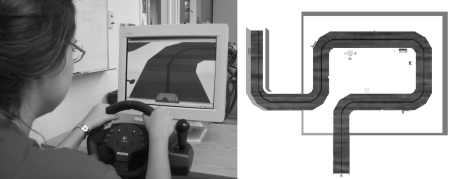
Fig. 1
Fig. 1
Left participant driving the wheelchair simulator. Right top view of the pathway the participants were required to complete
Fig. 2
Fig. 2
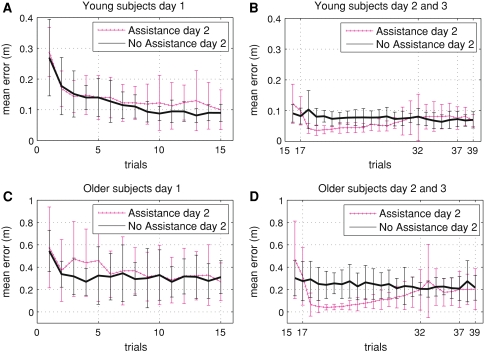
Tracking errors during the three training and testing days. a Young subjects on day 1. Note that neither the assistance or no assistance group received guidance on day 1. b Young subjects on days 2 and 3. The assistance group received gradually reducing assistance from trials 18 to 31. Trials 38 and 39 were a retention test without assistance on day 3. c Old subjects on day 1 d Older subjects on days 2 and 3. Error bars in all plots show ±1 SD
Fig. 3
Fig. 3
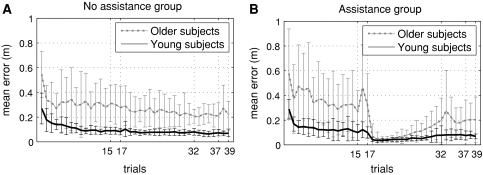
Tracking errors during the three training and testing days. a Comparison of tracking error between old and young subjects in the no assistance group, across all 3 days. b Comparison of tracking error between old and young subjects in the assistance group, across all 3 days. Error bars in all plots show ±1 SD
Fig. 4
Fig. 4
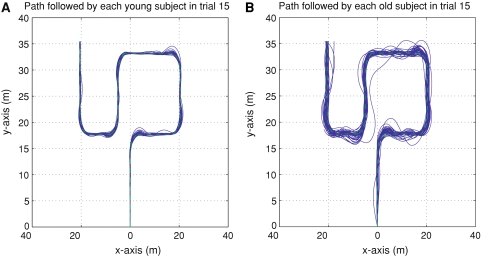
a Trajectories followed for each of the young participants at the end of training day 1 (trial 15). b Trajectories performed by each of the old participants in trial 15. Old participants created significantly larger tracking errors than young participants, and showed large oscillations when leaving the curves producing poor performance during straight lines
Fig. 5
Fig. 5
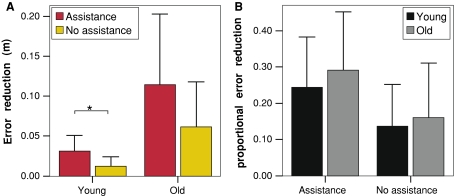
a Long-term reduction in steering performance with and without haptic training. The plots compare the change in steering performance from trials 17 to 39. Trial 17 was the last initial practice trial on Day 2 before training with guidance. Trial 39 was the final retention test trial on Day 3, 1 week later. b Proportional long-term reduction in steering performance with and without haptic training for the young and old groups. The proportion of error reduction was calculated as the change in steering performance from trials 17 to 39 over performance in trial 17
Fig. 6
Fig. 6
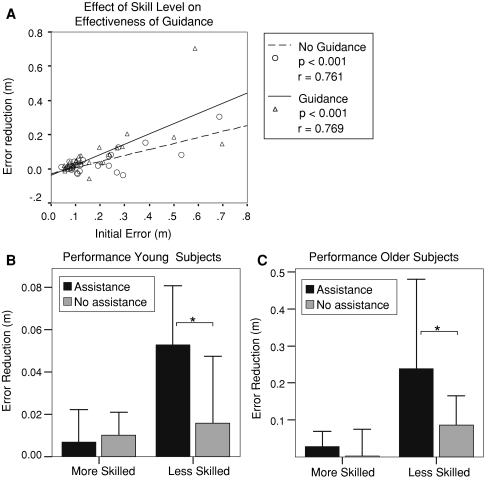
Effect of initial skill level on the benefits of training with haptic guidance. All plots compare the change in steering performance from trials 17 to 39. Trial 17 was the last initial practice trial on Day 2 before training with guidance. Trial 39 was the final retention test trial on Day 3, 1 week later. a Effect of haptic guidance based on initial skill level for all participants. The guidance-trained group showed a significantly greater long-term error reduction for initially less skilled participants, when compared with the error reduction for the no guidance group. b Long-term reduction in steering performance in younger subjects with and without haptic training. c Long-term reduction in steering performance in older subjects with and without haptic training
Fig. 7
Fig. 7
Long-term reduction in steering performance with and without haptic training. All plots compare the change in steering performance from trials 17 to 39. Trial 17 was the last initial practice trial on Day 2 before training with guidance. Trial 39 was the final retention test trial on Day 3, 1 week later. a Error during straight line portions of the driving course. b Error during the first half of turns. c Error in second half of turns. a Mean increase in turn-initiation distance. e Reduction in turn rectification distance
Fig. 8
Fig. 8
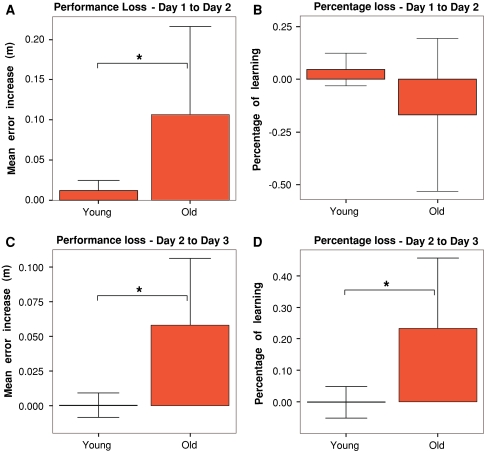
Retention of skill between testing sessions. a Mean tracking error increase from last trial on first day (trial 15), and first trial on second day (trial 16). b Percentage of learning loss in the first learning period. b Mean tracking error increase from last trial on second day (trial 37), and first trial on long-term retention on third day (trial 38). d Percentage of performance loss on Day 3 compared with Day 2

References

    1. Armstrong T (1970) Training for the production of memorized movement patterns. Technical report 26, University of Michigan, Human Performance Center, Ann Arbor
    1. Bayart B, Pocheville A, Kheddar A (2005) An adaptive haptic guidance software module for i-touch: example through a handwriting teaching simulation and a 3d maze. In: IEEE international workshop on haptic audio visual environments and their applications
    1. Bluteau J, Coquillart S, Payan Y, Gentaz E. Haptic guidance improves the visuo-manual tracking of trajectories. PLoS ONE. 2008;3(3):e1775. doi: 10.1371/journal.pone.0001775. - DOI - PMC - PubMed
    1. Brosseau J, Potvin M-J, Rouleau I. Aging affects motor skill learning when the task requires inhibitory control. Dev Neuropsychol. 2007;32(1):597–613. - PubMed
    1. Carnahan H, Vandervoort A, Swanson L. The influence of summary knowledge of results and aging on motor learning. Res Q Exerc Sport. 1996;67:280–287. - PubMed

Publication types