Review
. 2009 Dec;37(22):7349-59.
doi: 10.1093/nar/gkp819.

More than a decade of developmental gene expression atlases: where are we now?

Affiliations
Review

More than a decade of developmental gene expression atlases: where are we now?

Bouke A de Boer et al. Nucleic Acids Res. 2009 Dec.

Erratum in

  • Nucleic Acids Res. 2010 May;38(9):3147

Abstract

To unravel regulatory networks of genes functioning during embryonic development, information on in situ gene expression is required. Enormous amounts of such data are available in literature, where each paper reports on a limited number of genes and developmental stages. The best way to make these data accessible is via spatio-temporal gene expression atlases. Eleven atlases, describing developing vertebrates and covering at least 100 genes, were reviewed. This review focuses on: (i) the used anatomical framework, (ii) the handling of input data and (iii) the retrieval of information. Our aim is to provide insights into both the possibilities of the atlases, as well as to describe what more than a decade of developmental gene expression atlases can teach us about the requirements of the design of the 'ideal atlas'. This review shows that most ingredients needed to develop the ideal atlas are already applied to some extent in at least one of the discussed atlases. A review of these atlases shows that the ideal atlas should be based on a spatial framework, i.e. a series of 3D reference models, which is anatomically annotated using an ontology with sufficient resolution, both for relations as well as for anatomical terms.


Figures
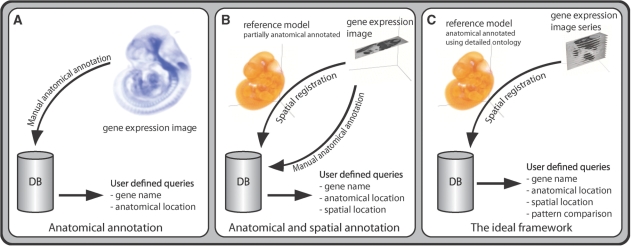
Figure 1.
Figure 1.
Frameworks. Panels A and B show the different frameworks used in the discussed atlases. All atlases except for EMAGE use a purely text-based annotation (A). In EMAGE the gene expression images are mapped into reference models (B). The ideal framework is shown in (C). Basically, this framework is used by the Allen Brain Atlas (except for the detailed ontology). The approach involves the mapping of sets of in situ gene expression images to a spatial framework. Enabling automated textual annotation and analysis based on the spatial location of the expression of a gene.
Figure 2.
Figure 2.
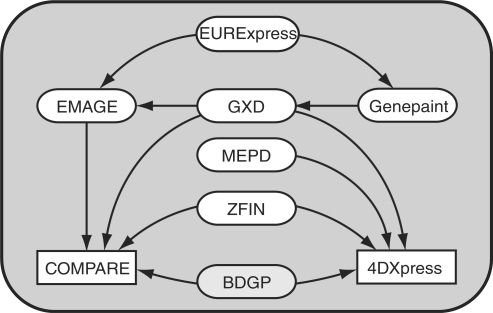
Data exchange. The arrows indicate the direction of data exchange between the different reviewed vertebrate atlases (rounded white cells). Only atlases that exchange data are included. The BDGP gene expression atlas (grey cell) holds expression data for Drosophila (http://www.fruitfly.org/cgi-bin/ex/insitu.pl). The rectangular cells are websites that combine the expression information of more than one species by importing data from the discussed atlases.

References

    1. Parkinson H, Kapushesky M, Shojatalab M, Abeygunawardena N, Coulson R, Farne A, Holloway E, Kolesnykov N, Lilja P, Lukk M, et al. ArrayExpress – a public database of microarray experiments and gene expression profiles. Nucleic Acids Res. 2007;35:D747–D750. - PMC - PubMed
    1. Barrett T, Troup DB, Wilhite SE, Ledoux P, Rudnev D, Evangelista C, Kim IF, Soboleva A, Tomashevsky M, Marshall KA, et al. NCBI GEO: archive for high-throughput functional genomic data. Nucleic Acids Res. 2009;37:D885–D890. - PMC - PubMed
    1. Bell GW, Yatskievych TA, Antin PB. GEISHA, a whole-mount in situ hybridization gene expression screen in chicken embryos. Dev. Dyn. 2004;229:677–687. - PubMed
    1. Antin PB, Kaur S, Stanislaw S, Davey S, Konieczka JH, Yatskievych TA, Darnell DK. Gallus expression in situ hybridization analysis: a chicken embryo gene expression database. Poult. Sci. 2007;86:1472–1477. - PubMed

    1. Sprague J, Bayraktaroglu L, Clements D, Conlin T, Fashena D, Frazer K, Haendel M, Howe DG, Mani P, Ramachandran S, et al. The zebrafish information network: the zebrafish model organism database. Nucleic Acids Res. 2006;34:D581–D585. - PMC - PubMed

Publication types

MeSH terms