


Infant neurobehavioral dysregulation: behavior problems in children with prenatal substance exposure
- PMID: 19822596
- PMCID: PMC2874881
- DOI: 10.1542/peds.2008-2898
Infant neurobehavioral dysregulation: behavior problems in children with prenatal substance exposure
Abstract
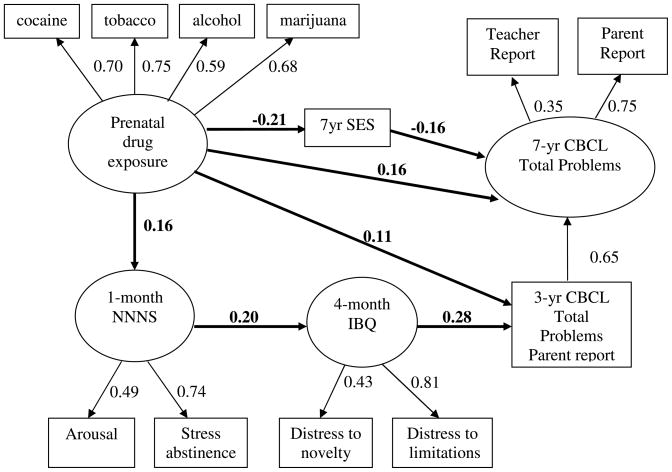
Objective: The objective of this study was to test a developmental model of neurobehavioral dysregulation relating prenatal substance exposure to behavior problems at age 7.
Methods: The sample included 360 cocaine-exposed and 480 unexposed children from lower to lower middle class families of which 78% were black. Structural equation modeling was used to test models whereby prenatal exposure to cocaine and other substances would result in neurobehavioral dysregulation in infancy, which would predict externalizing and internalizing behavior problems in early childhood. Structural equation models were developed for individual and combined parent and teacher report for externalizing, internalizing, and total problem scores on the Child Behavior Checklist.
Results: The goodness-of-fit statistics indicated that all of the models met criteria for adequate fit with 7 of the 9 models explaining 18% to 60% of the variance in behavior problems at age 7. The paths in the models indicate that there are direct effects of prenatal substance exposure on 7-year behavior problems as well as indirect effects, including neurobehavioral dysregulation.
Conclusions: Prenatal substance exposure affects behavior problems at age 7 through 2 mechanisms. The direct pathway is consistent with a teratogenic effect. Indirect pathways suggest cascading effects whereby prenatal substance exposure results in neurobehavioral dysregulation manifesting as deviations in later behavioral expression. Developmental models provide an understanding of pathways that describe how prenatal substance exposure affects child outcome and have significant implications for early identification and prevention.
Conflict of interest statement
The authors have indicated they have no financial disclosures or conflicts of interest relevant to this article to disclose.
Figures
References
-
- Lester BM, LaGasse LL, Seifer R. Cocaine exposure and children: the meaning of subtle effects. Science. 1998 Oct 23;282(5389):633–634. - PubMed
-
- Tronick EZ, Messinger DS, Weinberg MK, et al. Cocaine exposure is associated with subtle compromises of infants’ and mothers’ social-emotional behavior and dyadic features of their interaction in the face-to-face still-face paradigm. Dev Psychol. 2005 Sep;41(5):711–722. - PubMed
-
- Schiller C, Allen PJ. Follow-up of infants prenatally exposed to cocaine. Pediatr Nurs. 2005 Sep-Oct;31(5):427–436. - PubMed
-
- Seifer R, LaGasse LL, Lester B, et al. Attachment status in children prenatally exposed to cocaine and other substances. Child Dev. 2004 May-Jun;75(3):850–868. - PubMed
-
- Bada HS, Das A, Bauer CR, et al. Impact of prenatal cocaine exposure on child behavior problems through school age. Pediatrics. 2007 Feb;119(2):348–359. - PubMed
Publication types
MeSH terms
Grants and funding
- U10 DA024117/DA/NIDA NIH HHS/United States
- U01 HD036790/HD/NICHD NIH HHS/United States
- U10 DA024118/DA/NIDA NIH HHS/United States
- U10 HD 21415/HD/NICHD NIH HHS/United States
- U10 DA024119/DA/NIDA NIH HHS/United States
- U10HD 21397/HD/NICHD NIH HHS/United States
- U10 HD021385/HD/NICHD NIH HHS/United States
- U10 DA024128/DA/NIDA NIH HHS/United States
- U01 HD 36790/HD/NICHD NIH HHS/United States
- U10 HD 27904/HD/NICHD NIH HHS/United States
- U10 HD027904/HD/NICHD NIH HHS/United States
- U10 HD021397/HD/NICHD NIH HHS/United States
- N01-HD-2-3159/HD/NICHD NIH HHS/United States
- U10 HD 21385/HD/NICHD NIH HHS/United States
LinkOut - more resources
Full Text Sources
Medical
Miscellaneous
