


Review
doi: 10.1186/1465-9921-10-95.
Endothelial cells and pulmonary arterial hypertension: apoptosis, proliferation, interaction and transdifferentiation
Affiliations
- PMID: 19825167
- PMCID: PMC2768704
- DOI: 10.1186/1465-9921-10-95
Item in Clipboard
Review
Endothelial cells and pulmonary arterial hypertension: apoptosis, proliferation, interaction and transdifferentiation
Respir Res.
.
Abstract
Severe pulmonary arterial hypertension, whether idiopathic or secondary, is characterized by structural alterations of microscopically small pulmonary arterioles. The vascular lesions in this group of pulmonary hypertensive diseases show actively proliferating endothelial cells without evidence of apoptosis. In this article, we review pathogenetic concepts of severe pulmonary arterial hypertension and explain the term "complex vascular lesion ", commonly named "plexiform lesion", with endothelial cell dysfunction, i.e., apoptosis, proliferation, interaction with smooth muscle cells and transdifferentiation.
Figures
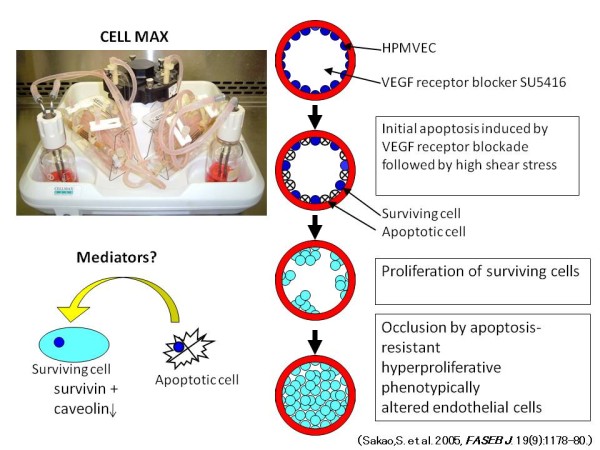
The CELLMAX artificial capillary modules and sequence of events that leads from initial apoptosis to proliferation of apoptosis-resistant endothelial cells. The combination of initial apoptosis induced by VEGF receptor blockade and high fluid shear stress generates apoptosis-resistant proliferative endothelial cells. Definition of abbreviations: HPMVEC = human pulmonary microvascular endothelial cell; VEGF = vascular endothelial growth factor; SU5416 = a combined VEGF I and II receptor blocker.
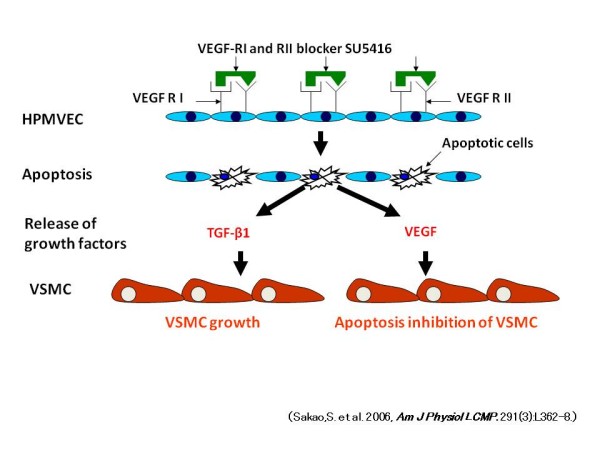
Sequence of events that leads from SU-5416-induced VEGF blockade to the increased growth of VSMC. VEGF receptor blockade induces apoptosis of vascular endothelial cells. Apoptotic endothelial cells release growth factors such as VEGF and TGF-β1, and, whereas VEGF inhibits apoptosis, TGF-β1 promotes VSMC proliferation. Definition of abbreviations: HPMVEC = human pulmonary microvascular endothelial cell; VSMC = vascular smooth muscle cell; TGF-β1 = transforming growth factor-β1; VEGF = vascular endothelial growth factor; SU5416 = a combined VEGF I and II receptor blocker.
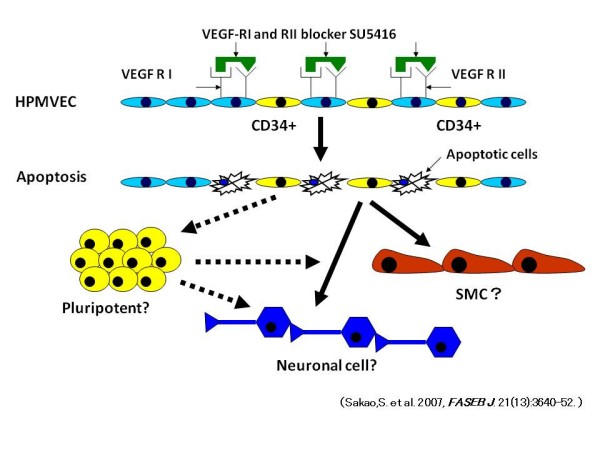
Sequence of events in HPMVEC that lead from VEGF blockade by SU5416 to transdifferentiation to smooth muscle-like cells. Endothelial cell death induced by VEGF receptor blockade and subsequent selection of progenitor-like cells leads to transdifferentiation to smooth muscle-like cells and neuronal cell. Dotted arrows mean hypothetical sequences of events. Definition of abbreviations: HPMVEC = human pulmonary microvascular endothelial cell; VSMC = vascular smooth muscle cell; SU5416 = a combined VEGF I and II receptor blocker.
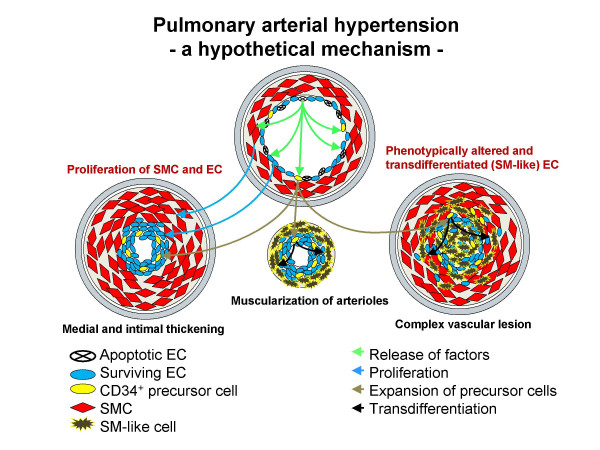
A hypothetical mechanism of pulmonary arterial hypertension. Sequence of events that leads from endothelial cell initial apoptosis to proliferation of apoptosis-resistant endothelial cells and vascular smooth muscle cells and endothlial-mesenchymal (SM-like) transdifferentiation. Apoptotic endothelial cells may release some kinds of factors that generate apoptosis-resistant proliferative endothelial cells, promote vascular smooth muscle cell proliferation and result in subsequent selection of progenitor-like cells leads to endothlial-mesenchymal (SM-like) transdifferentiation. These events may be a general mechanism for intimal and medial hypertrophy, muscularization of arterioles and complex vascular lesions. Definition of abbreviations: EC = endothelial cell; SMC = smooth muscle cell; SM-like = smooth muscle-like
References
-
- Sitbon O, Humbert M, Nunes H, Parent F, Garcia G, Herve P, Rainisio M, Simonneau G. Long-term intravenous epoprostenol infusion in primary pulmonary hypertension: prognostic factors and survival. J Am Coll Cardiol. 2002;40:780–788. - PubMed
-
- Rimensberger PC, Spahr-Schopfer I, Berner M, Jaeggi E, Kalangos A, Friedli B, Beghetti M. Inhaled nitric oxide versus aerosolized iloprost in secondary pulmonary hypertension in children with congenital heart disease: vasodilator capacity and cellular mechanisms. Circulation. 2001;103:544–548. - PubMed
-
- Hirose S, Hosoda Y, Furuya S, Otsuki T, Ikeda E. Expression of vascular endothelial growth factor and its receptors correlates closely with formation of the plexiform lesion in human pulmonary hypertension. Pathol Int. 2000;50:472–479. - PubMed
-
- Nicolls MR, Taraseviciene-Stewart L, Rai PR, Badesch DB, Voelkel NF. Autoimmunity and pulmonary hypertension: a perspective. Eur Respir J. 2005;26:1110–1118. - PubMed
Publication types
MeSH terms
Grants and funding
LinkOut - more resources
Full Text Sources
Other Literature Sources
Medical
