The transmembrane protein CBP plays a role in transiently anchoring small clusters of Thy-1, a GPI-anchored protein, to the cytoskeleton
- PMID: 19825940
- PMCID: PMC2773195
- DOI: 10.1242/jcs.049346
The transmembrane protein CBP plays a role in transiently anchoring small clusters of Thy-1, a GPI-anchored protein, to the cytoskeleton
Abstract
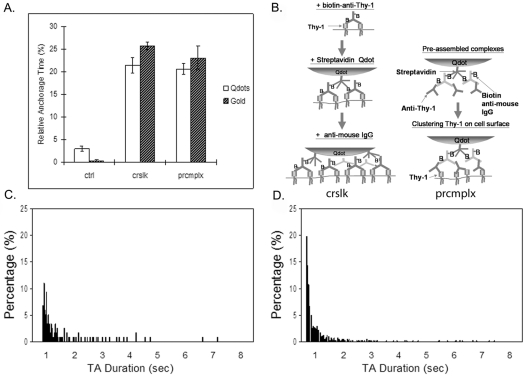
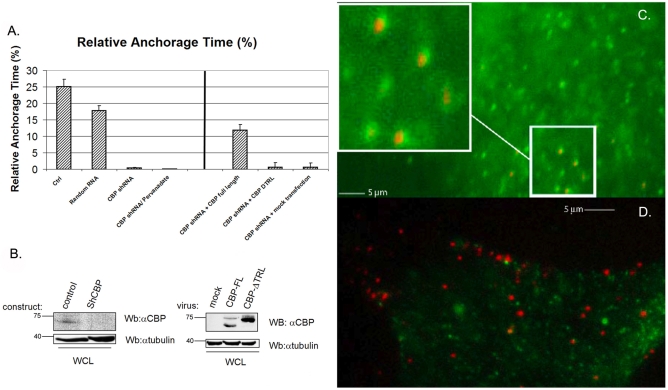
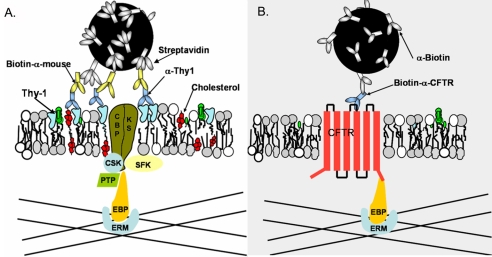
It remains unclear how GPI-anchored proteins (GPIAPs), which lack cytoplasmic domains, transduce signals triggered by specific ligation. Such signal transduction has been speculated to require the ligated GPIAP to associate with membrane-spanning proteins that communicate with obligate cytoplasmic proteins. Transient anchorage of crosslinked proteins on the cell surface was previously characterized by single-particle tracking, and temporary association with the actin cytoskeleton was hypothesized to cause regulated anchorage. GPIAPs, such as Thy-1, require clustering, cholesterol and Src-family kinase (SFK) activity to become transiently anchored. By contrast, a transmembrane protein, the cystic fibrosis transmembrane conductance regulator (CFTR), which has a PDZ-binding motif in its cytoplasmic C-terminus that binds the ERM adaptor EBP50, exhibits anchorage that strictly requires EBP50 but has little dependence on cholesterol or SFK. We hypothesized that a transmembrane protein would be required to mediate the linkage between Thy-1 and the cytoskeleton. Here, we present evidence, obtained by shRNA knockdown, that the transmembrane protein Csk-binding protein (CBP) plays an obligatory role in the transient anchorage of Thy1. Furthermore, either a dominant-negative form of CBP that did not bind EBP50 or a dominant-negative EBP50 drastically reduced transient anchorage of Thy-1, indicating the involvement of this adaptor. Finally, we speculate on the role of phosphorylation in the regulation of transient anchorage.
Figures

References
-
- Brdickova, N., Brdicka, T., Andera, L., Spicka, J., Angelisov, P., Milgram, S. L. and Horejsi, V. (2001). Interaction between two adapter proteins, PAG and EBP50: a possible link between membrane rafts and actin cytoskeleton. FEBS Letters 507, 133-136. - PubMed
-
- Brdicka, T., Pavlitova, D., Leo, A., Bruyns, E., Koinek, V., Angelisova, P., Scherer, J., Shevchenko, A., Shevchenko, A., Hilgert, I. et al. (2000). Phosphoprotein associated with glycosphingolipid-enriched microdomains (PAG), a novel ubiquitously expressed transmembrane adaptor protein, binds the protein tyrosine kinase Csk and is involved in regulation of T cell activation. J. Exp. Med. 191, 1591-1604. - PMC - PubMed
-
- Coyne, C. B. and Bergelson, J. M. (2006). Virus-induced Abl and Fyn kinase signals permit coxsackievirus entry through epithelial tight junctions. Cell 124, 119-131. - PubMed
Publication types
MeSH terms
Substances
Grants and funding
LinkOut - more resources
Full Text Sources
Molecular Biology Databases
Miscellaneous