. 2009 Oct 27;106(43):18109-13.
doi: 10.1073/pnas.0905890106. Epub 2009 Oct 13.

Bacillus subtilis spreads by surfing on waves of surfactant

Affiliations

Bacillus subtilis spreads by surfing on waves of surfactant

Thomas E Angelini et al. Proc Natl Acad Sci U S A. .

Abstract

The bacterium Bacillus subtilis produces the molecule surfactin, which is known to enhance the spreading of multicellular colonies on nutrient substrates by lowering the surface tension of the surrounding fluid, and to aid in the formation of aerial structures. Here we present experiments and a mathematical model that demonstrate how the differential accumulation rates induced by the geometry of the bacterial film give rise to surfactant waves. The spreading flux increases with increasing biofilm viscosity. Community associations are known to protect bacterial populations from environmental challenges such as predation, heat, or chemical stresses, and enable digestion of a broader range of nutritive sources. This study provides evidence of enhanced dispersal through cooperative motility, and points to nonintuitive methods for controlling the spread of biofilms.


Conflict of interest statement

The authors declare no conflict of interest.

Figures
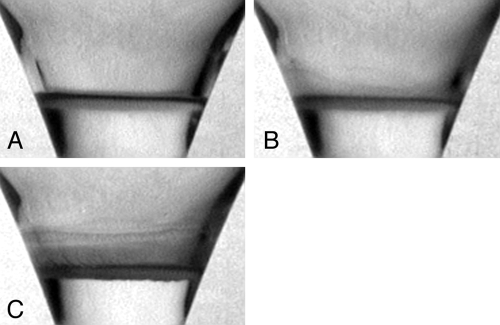
Fig. 1.
Fig. 1.
Wall climbing at the edges of B. subtilis pellicles. Sequence of images: (A) Development of biofilm pellicle at an air–liquid interface. (B) The biofilm after the onset of wall-climbing. (C) The advancing film reaches a plateau length of approximately 8 mm in this example.
Fig. 2.
Fig. 2.
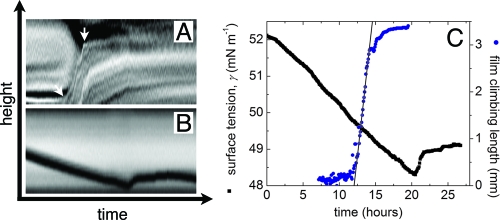
Dynamics of climbing film and surfactin excretion. (A) Height versus time of the wall-climbing biofilm. To create this intensity map, raw transmission images were inverted to make the edge of the film look bright, and the difference of successive inverted images were taken to reduce static background and accentuating moving edges. At each time point, a region of 20 pixels was averaged horizontally, creating a map of the vertical height versus time. The arrows point to the beginning and end of the “linear” climbing region. (B) Height versus time of the meniscus in the capillary. The strip of pixels across the center of the capillary was averaged to create the time-lapse image. The meniscus is seen as the dark trace in the figure. The drop in meniscus height during wall climbing signals a decrease in the surface tension, consistent with surfactant production. (C) Plot comparing the decrease in surface tension with time (black symbols) with the increase in the wall-climbing height with time (blue symbols). Surface-tension values are extracted from the meniscus height as described in the text. The linear fit shows that the biofilm climbs at a rate 1.39 ± 0.05 mm/hr.
Fig. 3.
Fig. 3.
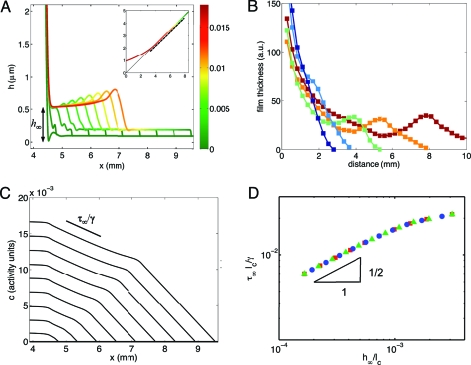
A model for surfactant production in the pellicle reproduces the dynamics of the spreading bacterial film. (A) Simulated film thickness profiles at 40 min intervals, from 0 (left-most, blue), to 6 hours (right-most, red) after onset of wall climbing. Color coding of interface gives the surfactant concentration. x = 0 is the equilibrium height of the flat interface. Note the different scalings of the film thickness and rise-height axes. The Inset shows the entire interface and spreading front, with the magnified region indicated by the dashed reference line. (B) Thickness profiles (arbitrary units) from the experimental measurements of the wall climbing film at times t = 900 min (dark blue), 940 min (light blue), 980 min (green), 1,020 min (orange), and 1,060 min (red) after innoculation. Note the presence of the capillary ridge at the edge of the film, in striking similarity to simulations in A. (C) Simulated surfactant concentrations show a pair of Marangoni waves, one with almost constant shear τ, advancing with the bacterial film, and the other advancing with the precursor film. (D) Film thickness and h and shear τ satisfy a compatibility condition h /ℓc = 3.57ℓc 2τ 20 2 independently of the length scale h min: We show collapse for h min = 0.25 μm (red squares), 2 μm (green triangles), and 20 μm (blue circles).
Fig. 4.
Fig. 4.
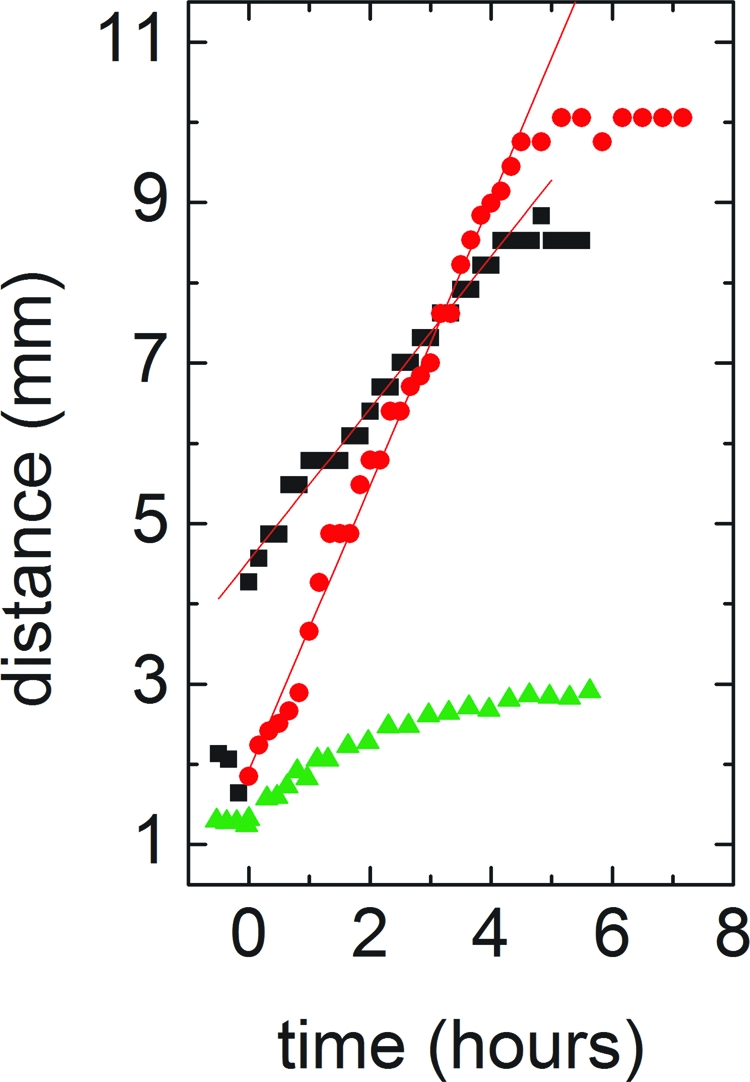
Bacterial spreading rate in WT (black squares), srfAA (surfactin knockout, green triangles) and hag (flagellum knockout, red circles) bacteria. Both WT and mobility mutant bacteria exhibit wall climbing. Knocking out surfactin destroys the ability of the bacterial pellicle to collectively climb the wall, confirming that Marangoni stresses drive pellicle expansion, and that surfactin gradients are responsible for these stresses.

References

    1. Heilmann C, et al. Molecular basis of intercellular adhesion in the biofilm-forming Staphylococcus epidermidis. Mol Microbiol. 1996;20:1083–1091. - PubMed
    1. Klapper I, Dockery J. Role of cohesion in the material description of biofilms. Phys Rev E. 2006;74:031902. - PubMed
    1. Wang X, Preston J, Romeo T. The pgaABCD locus of Escherichia coli promotes the synthesis of a polysaccharide adhesin required for biofilm formation. J Bacteriol. 2004;186:2724–2734. - PMC - PubMed
    1. O'Toole G, Kolter R. Initiation of biofilm formation in Pseudomonas fluorescens wcs365 proceeds via multiple, convergent signalling pathways: A genetic analysis. Mol Microbiol. 1998;28:449–461. - PubMed
    1. Koutsoudis M, Tsaltas D, Minogue T, von Bodman S. Quorum-sensing regulation governs bacterial adhesion, biofilm development, and host colonization in Pantoea stewartii subspecies stewartii. Proc Natl Acad Sci USA. 2006;103:5983–5988. - PMC - PubMed

Publication types