Comparative Study
. 2010 Mar;18(3):385-9.
doi: 10.1038/ejhg.2009.178. Epub 2009 Oct 14.

Large-scale parent-child comparison confirms a strong paternal influence on telomere length

Affiliations
Comparative Study

Large-scale parent-child comparison confirms a strong paternal influence on telomere length

Katarina Nordfjäll et al. Eur J Hum Genet. 2010 Mar.

Abstract

Telomere length is documented to have a hereditary component, and both paternal and X-linked inheritance have been proposed. We investigated blood cell telomere length in 962 individuals with an age range between 0 and 102 years. Telomere length correlations were analyzed between parent-child pairs in different age groups and between grandparent-grandchild pairs. A highly significant correlation between the father's and the child's telomere length was observed (r=0.454, P<0.001), independent of the sex of the offspring (father-son: r=0.465, P<0.001; father-daughter: r=0.484, P<0.001). For mothers, the correlations were weaker (mother-child: r=0.148, P=0.098; mother-son: r=0.080, P=0.561; mother-daughter: r=0.297, P=0.013). A positive telomere length correlation was also observed for grandparent-grandchild pairs (r=0.272, P=0.013). Our findings indicate that fathers contribute significantly stronger to the telomere length of the offspring compared with mothers (P=0.012), but we cannot exclude a maternal influence on the daughter's telomeres. Interestingly, the father-child correlations diminished with increasing age (P=0.022), suggesting that nonheritable factors have an impact on telomere length dynamics during life.


Figures

Figure 1
Figure 1
Hypothetical pedigree illustrating the selection of duos and trios. (I) Trio selected using father, mother (in-law parent) and son (oldest child). (II) Duo not allowed as, in order to avoid confounders, only one parent born within the family tree could be used to select a duo/trio. (III) Duo selected using father (in-law parent) and son (oldest child). (IV) Duo selected using mother (in-law parent) and daughter (oldest child).
Figure 2
Figure 2
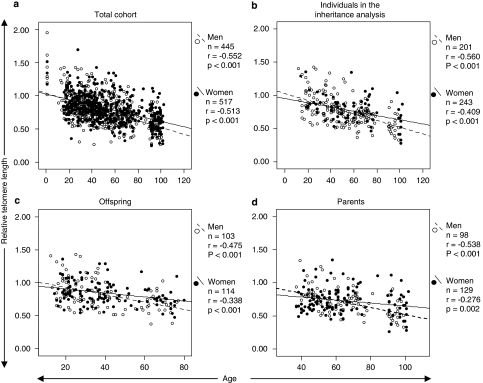
Age-associated telomere shortening stratified by gender. (a) Linear regression analysis including the whole cohort of 962 individuals. (bd) Linear regression analysis restricted to individuals included in the inheritance analysis (n=444). TL shortening with age in (b) all individuals, (c) offspring, (d) parents.
Figure 3
Figure 3
(af) Telomere length correlations between parents and offspring. The statistics given are adjusted for age using Pearson's partial correlation.
Figure 4
Figure 4
(af) Telomere length correlations between parents in different age groups (at the time of blood sampling) and children. The statistics given are adjusted for age using Pearson's partial correlation.
Figure 5
Figure 5
R2 telomere length correlations in different age groups and correlations over generations. (a) R2 parent–child correlations in three different age groups, illustrating the percentages by which the variation in offspring TL may be explained by the parental TL. r2 was calculated using the correlation coefficient (r) from the partial correlation in Figure 4 and Fisher z-transformation was used to investigate whether the correlation coefficients differed significantly. The P-values for the 2 × 3 possible comparisons (left: father–child; right: mother–child) are indicated on top. (b) Telomere length correlation between grandparents and grandchildren. The statistics given are adjusted for age and sex using Pearson's partial correlation.

References

    1. Moyzis RK, Buckingham JM, Cram LS, et al. A highly conserved repetitive DNA sequence, (TTAGGG)n, present at the telomeres of human chromosomes. Proc Natl Acad Sci USA. 1988;85:6622–6626. - PMC - PubMed
    1. Cong YS, Wright WE, Shay JW. Human telomerase and its regulation. Microbiol Mol Biol Rev. 2002;66:407–425. - PMC - PubMed
    1. Kim NW, Piatyszek MA, Prowse KR, et al. Specific association of human telomerase activity with immortal cells and cancer. Science. 1994;266:2011–2015. - PubMed
    1. Shay JW, Bacchetti S. A survey of telomerase activity in human cancer. Eur J Cancer. 1997;33:787–791. - PubMed
    1. Iwama H, Ohyashiki K, Ohyashiki JH, et al. Telomeric length and telomerase activity vary with age in peripheral blood cells obtained from normal individuals. Hum Genet. 1998;102:397–402. - PubMed

Publication types