


Secular trends in adiposity in Norwegian 9-year-olds from 1999-2000 to 2005
- PMID: 19828037
- PMCID: PMC2765441
- DOI: 10.1186/1471-2458-9-389
Secular trends in adiposity in Norwegian 9-year-olds from 1999-2000 to 2005
Abstract
Background: Due to the negative health consequences of childhood obesity monitoring trends in body mass and adiposity is essential. The purpose of this study was to describe secular trends in the prevalence of overweight and obesity among 9-year-old children, and to study changes in adiposity and fat distribution by investigating changes in waist circumference (WC) and skinfold thicknesses.
Methods: A total of 859 9-year-olds were included in two cross-sectional studies conducted in 1999-2000 and 2005. Measurements of body mass index (BMI; in kg/m2), WC and skinfold thicknesses were taken by trained investigators. The International Obesity Task Force cut-offs were used to define overweight and obese subjects.
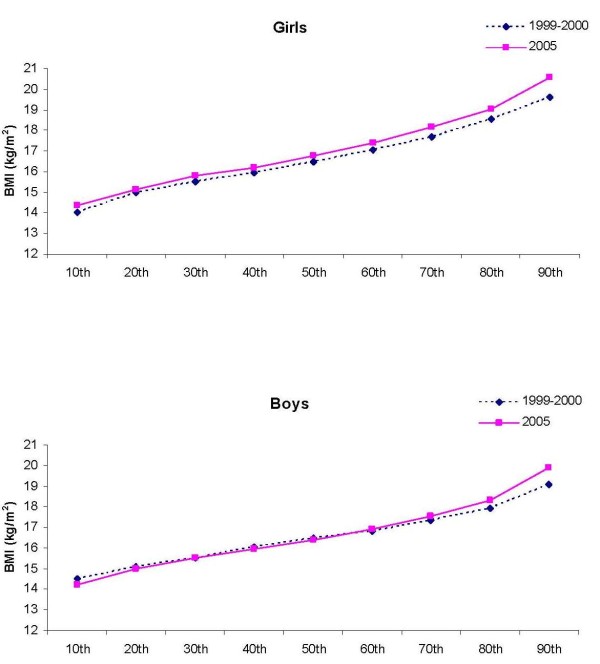
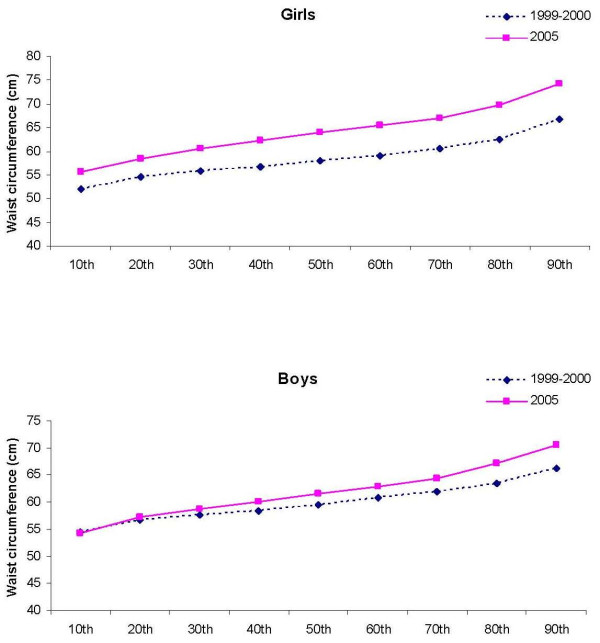
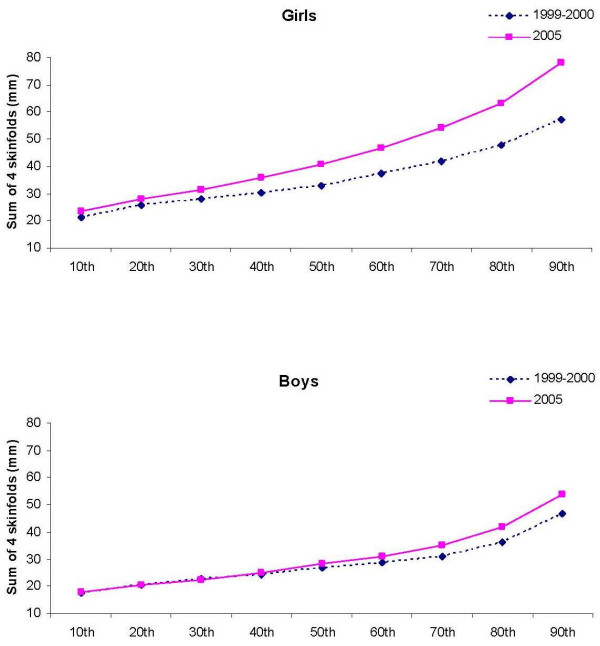
Results: The overall prevalence of overweight (including obesity) did not change over the five year period. However, a shift may have occurred as the prevalence of overweight (including obesity) increased by 6.4% in girls and 5.5% in boys over the five year period. In both study periods, logistic regression analyses revealed that children of non-Western origin had 2 times higher odds of being overweight/obese than those of Western origin. However, neither the children of Western origin nor the children of non-Western origin showed a significant increase in the prevalence of overweight over the five-year period. No changes were observed for mean BMI, while a significant increase in WC was reported for both girls and boys, and an increase in all skinfold measurements was observed in girls only. Shifts in percentile distribution were observed for BMI, WC and sum of 4 skinfold thickness, however, the shift appeared to be faster in the upper end of the population distribution (p < 0.001 for interactions).
Conclusion: From 1999-2000 to 2005, there have been increases in 9-year-olds measures of adiposity even though the BMI did not change. The results indicate the need of a large-scale monitoring of adiposity, in addition to BMI, in children.
Figures
References
-
- Australian Government - Department of Health and Aging. 2007 Australian National Children's Nutrition and Physical Activity Survey - Main Findings. 1-44. 2008. Australian Government - Department of Health and Aging; Australian Food and Grocery Council; Australian Government - Department of Agriculture, Fisheries and Forestry. Ref Type: Report.
Publication types
MeSH terms
LinkOut - more resources
Full Text Sources
Medical
