


Cooperative social clusters are not destroyed by dispersal in a ciliate
- PMID: 19828046
- PMCID: PMC2768715
- DOI: 10.1186/1471-2148-9-251
Cooperative social clusters are not destroyed by dispersal in a ciliate
Abstract
Background: The evolution of social cooperation is favored by aggregative behavior to facilitate stable social structure and proximity among kin. High dispersal rates reduce group stability and kin cohesion, so it is generally assumed that there is a fundamental trade-off between cooperation and dispersal. However, empirical tests of this relationship are rare. We tested this assumption experimentally using ten genetically isolated strains of a ciliate, Tetrahymena thermophila.
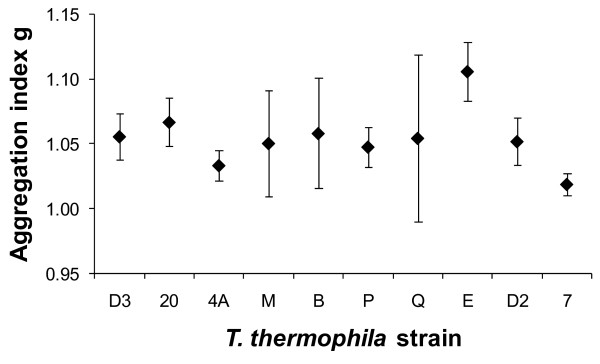
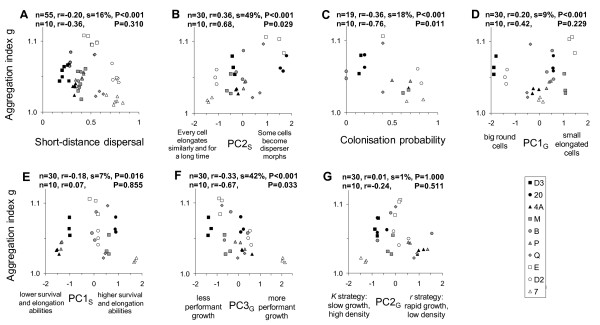
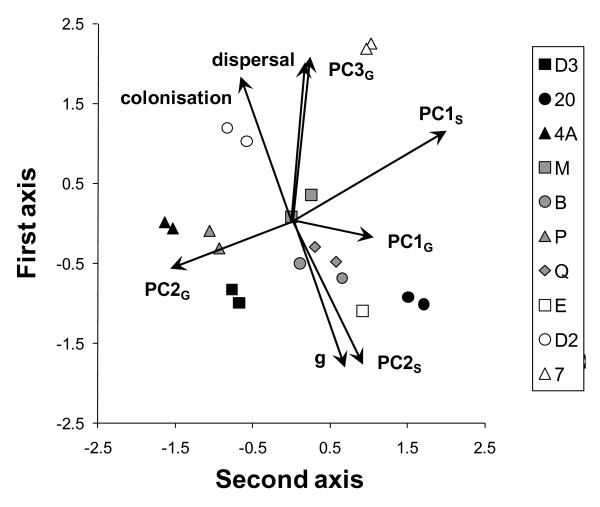
Results: The propensity for social aggregation was greater in strains with reduced cell quality and lower growth performance. While we found a trade-off between costly aggregation and local dispersal in phenotypic analyses, aggregative strains showed a dispersal polymorphism by producing either highly sedentary or long-distance dispersive cells, in contrast to less aggregative strains whose cells were monomorphic local dispersers.
Conclusion: High dispersal among aggregative strains may not destroy group stability in T. thermophila because the dispersal polymorphism allows social strains to more readily escape kin groups than less aggregative strains, yet still benefit from stable group membership among sedentary morphs. Such dispersal polymorphisms should be common in other social organisms, serving to alter the nature of the negative impact of dispersal on social evolution.
Figures
References
-
- Hamilton WD, May RM. Dispersal in stable habitats. Nature. 1977;269:578–581. doi: 10.1038/269578a0. - DOI
-
- Taylor PD. An inclusive fitness model for dispersal of offspring. J Theor Biol. 1988;130:363–378. doi: 10.1016/S0022-5193(88)80035-3. - DOI
-
- Axelrod R. The evolution of cooperation. New York: Basic Books; 1984.
Publication types
MeSH terms
LinkOut - more resources
Full Text Sources
