


Drug users' adherence to a 6-month vaccination protocol: effects of motivational incentives
- PMID: 19828264
- PMCID: PMC2815120
- DOI: 10.1016/j.drugalcdep.2009.09.006
Drug users' adherence to a 6-month vaccination protocol: effects of motivational incentives
Abstract
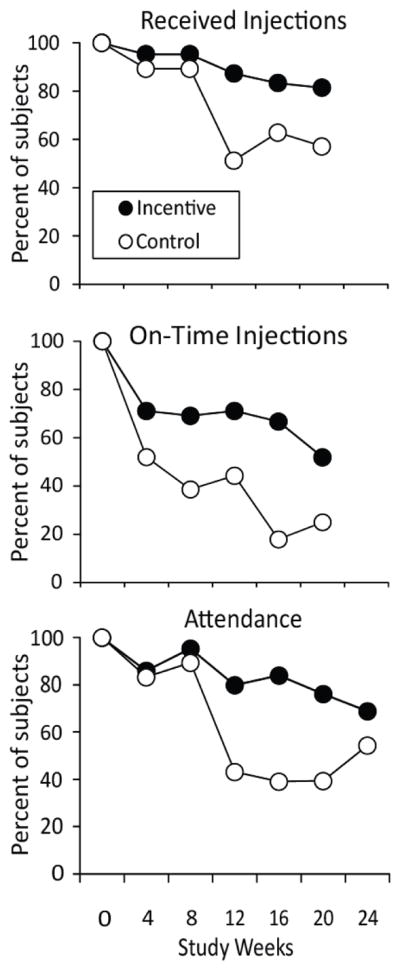
Vaccines represent a new and promising avenue of treatment for drug abuse but pose new medication adherence challenges due to prolonged and widely spaced administration schedules. This study examined effects of prize-based incentives on retention and medication adherence among 26 cocaine users involved in a 6-month hepatitis B vaccination series. Participants could meet with research staff weekly for 24 weeks and receive 7 injections containing either the Hepatitis B vaccine or a placebo. All participants received $10 at each weekly visit (maximum of $240). Those randomly assigned to the incentive program received additional monetary payments on an escalating schedule for attendance at weekly monitoring and vaccination visits with maximum possible earnings of $751. Group attendance diverged after study week 8 with attendance better sustained in the incentive than control group (group by time interaction, p=.035). Overall percent of weekly sessions attended was 82% for incentive versus 64% for control (p=.139). Receiving all scheduled injections were 77% of incentive versus 46% of control participants (p=.107). A significantly larger percentage (74% versus 51%; p=.016) of injections were received by incentive versus control participants on the originally scheduled day. Results suggest that monetary incentives can successfully motivate drug users to attend sessions regularly and to receive injected medications in a more reliable and timely manner than may be seen under usual care procedures. Thus, incentives may be useful for addressing adherence and allowing participants to reap the full benefits of newly developed medications.
Copyright (c) 2009 Elsevier Ireland Ltd. All rights reserved.
Conflict of interest statement
No authors have a conflict of interest to declare in relation to this particular study.
Figures
References
-
- Centers for Disease Control and Prevention. Hepatitis B vaccine: What you need to know. (DHHS Publication No. 42 U.S.C. § 300aa-26) Atlanta, GA: U.S. Gov. Printing Office; 2001.
-
- Comer SD, Sullivan MA, Hulse GK. Sustained-release naltrexone: Novel treatment for opioid dependence. Expert Opin Investig Drugs. 2007;16:1285–1294. - PubMed
-
- Haney M, Kosten TR. Therapeutic vaccines for substance dependence. Expert Rev Vaccines. 2004;3:11–18. - PubMed
Publication types
MeSH terms
Substances
Grants and funding
LinkOut - more resources
Full Text Sources
Medical
