


Mediterranean-style dietary pattern, reduced risk of metabolic syndrome traits, and incidence in the Framingham Offspring Cohort
- PMID: 19828705
- PMCID: PMC3152203
- DOI: 10.3945/ajcn.2009.27908
Mediterranean-style dietary pattern, reduced risk of metabolic syndrome traits, and incidence in the Framingham Offspring Cohort
Abstract
Background: The benefit of the Mediterranean-style dietary pattern in mitigating metabolic risk factors for type 2 diabetes and cardiovascular disease has not been well investigated among nondiabetic Americans.
Objective: The aim of this study was to examine the prospective association between the Mediterranean-style dietary pattern and metabolic syndrome.
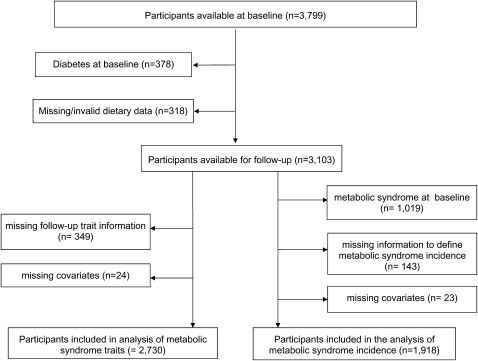
Design: The Mediterranean-style dietary pattern score (MSDPS) was used to characterize a Mediterranean-style dietary pattern in the Framingham Heart Study Offspring Cohort. We examined the longitudinal association between MSDPS and metabolic syndrome traits (including homeostasis model assessment-insulin resistance, fasting glucose, waist circumference, triglyceride, HDL cholesterol, and systolic and diastolic blood pressure) among 2730 participants of the Framingham Heart Study Offspring Cohort without type 2 diabetes (baseline median age: 54 y; 55% women), who were followed from the fifth (baseline) to the seventh study examinations (mean follow-up time: 7 y), and metabolic syndrome incidence (according to the National Cholesterol Education Program Adult Treatment Panel III definition) in 1918 participants free of the condition at baseline.
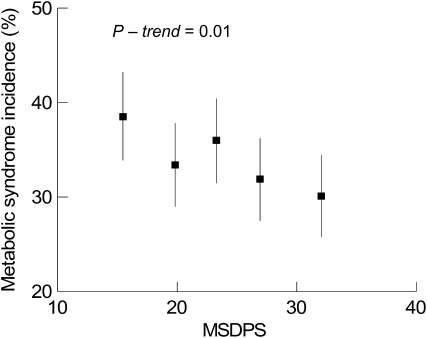
Results: A higher MSDPS was associated with lower homeostasis model assessment-insulin resistance (P = 0.02), waist circumference (P < 0.001), fasting plasma glucose (P = 0.03), and triglycerides (P < 0.001) and higher HDL cholesterol (P = 0.02) after adjustment for the corresponding baseline values and for several confounding factors associated with type 2 diabetes risk. Participants in the highest quintile category of the MSDPS had a lower incidence of metabolic syndrome than those in the lowest quintile category (38.5% compared with 30.1%; P = 0.01).
Conclusion: Our study suggests that the consumption of a diet consistent with the principles of the Mediterranean-style diet may protect against metabolic syndrome in Americans.
Figures
References
-
- Olefsky JM, Nolan JJ. Insulin resistance and non-insulin-dependent diabetes mellitus: cellular and molecular mechanisms. Am J Clin Nutr 1995;61:980S–6S - PubMed
-
- Fox CS, Coady S, Sorlie PD, et al. Increasing cardiovascular disease burden due to diabetes mellitus: the Framingham Heart Study. Circulation 2007;115:1544–50 - PubMed
-
- Rosamond W, Flegal K, Friday G, et al. Heart disease and stroke statistics—2007 update: a report from the American Heart Association Statistics Committee and Stroke Statistics Subcommittee. Circulation 2007;115:e69–171 - PubMed
-
- Bonora E, Kiechl S, Willeit J, et al. Metabolic syndrome: epidemiology and more extensive phenotypic description. Cross-sectional data from the Bruneck Study. Int J Obes Relat Metab Disord 2003;27:1283–9 - PubMed
-
- Grundy SM, Cleeman JI, Daniels SR, et al. Diagnosis and management of the metabolic syndrome: an American Heart Association/National Heart, Lung, and Blood Institute Scientific Statement. Circulation 2005;112:2735–52 - PubMed
Publication types
MeSH terms
Grants and funding
LinkOut - more resources
Full Text Sources
Medical
