


Routine work environment stress and PTSD symptoms in police officers
- PMID: 19829204
- PMCID: PMC3974929
- DOI: 10.1097/NMD.0b013e3181b975f8
Routine work environment stress and PTSD symptoms in police officers
Abstract
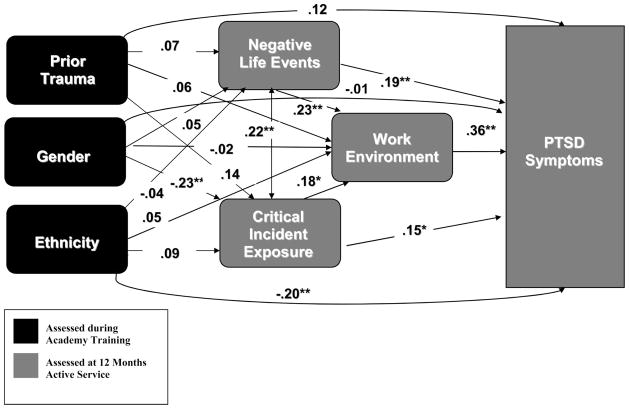
This study examined the relationship between routine work environment stress and posttraumatic stress disorder (PTSD) symptoms in a sample of police officers (N = 180) who were first assessed during academy training and reassessed 1-year later. In a model that included gender, ethnicity, traumatic exposure prior to entering the academy, current negative life events, and critical incident exposure over the last year, routine work environment stress was most strongly associated with PTSD symptoms. We also found that routine work environment stress mediated the relationship between critical incident exposure and PTSD symptoms and between current negative life events and PTSD symptoms. Ensuring that the work environment is functioning optimally protects against the effects of duty-related critical incidents and negative life events outside police service.
Figures
References
-
- Bartone PT, Adler AB, Vaitkus MA. Dimensions of psychological stress in peacekeeping operations. Mil Med. 1998;163:587–593. - PubMed
-
- Berg AM, Hem E, Lau B, Ekeberg Ø. An exploration of job stress and health in the Norwegian police service: A cross sectional study. J Occup Med Toxicol. 2006;1:26. Available at: http://www.occup-med.com/content/1/1/26. - PMC - PubMed
-
- Britt TW, Davison J, Bliese PD, Castro CA. How leaders can influence the impact that stressors have on soldiers. Mil Med. 2004;169:541–545. - PubMed
-
- Brunet A, Boyer R, Weiss DS, Marmar CR. The effects of initial trauma exposure on the symptomatic response to a subsequent trauma. Can J Behav Sci. 2001;33:97–102.
-
- Brunet A, Weiss D, Best SR, Liberman A, Fagan J, Marmar CR. Assessing recurring traumatic exposure: the Critical Incident History Questionnaire. Washington DC: International Society for Traumatic Stress Studies; 1998. p. 49.
Publication types
MeSH terms
Grants and funding
LinkOut - more resources
Full Text Sources
Medical
