. 2010 Feb;26(1):1-20.
doi: 10.1007/s10565-009-9139-5. Epub 2009 Oct 15.

Using viral vectors as gene transfer tools (Cell Biology and Toxicology Special Issue: ETCS-UK 1 day meeting on genetic manipulation of cells)

Affiliations

Using viral vectors as gene transfer tools (Cell Biology and Toxicology Special Issue: ETCS-UK 1 day meeting on genetic manipulation of cells)

Joanna L Howarth et al. Cell Biol Toxicol. 2010 Feb.

Abstract

In recent years, the development of powerful viral gene transfer techniques has greatly facilitated the study of gene function. This review summarises some of the viral delivery systems routinely used to mediate gene transfer into cell lines, primary cell cultures and in whole animal models. The systems described were originally discussed at a 1-day European Tissue Culture Society (ETCS-UK) workshop that was held at University College London on 1st April 2009. Recombinant-deficient viral vectors (viruses that are no longer able to replicate) are used to transduce dividing and post-mitotic cells, and they have been optimised to mediate regulatable, powerful, long-term and cell-specific expression. Hence, viral systems have become very widely used, especially in the field of neurobiology. This review introduces the main categories of viral vectors, focusing on their initial development and highlighting modifications and improvements made since their introduction. In particular, the use of specific promoters to restrict expression, translational enhancers and regulatory elements to boost expression from a single virion and the development of regulatable systems is described.


Figures
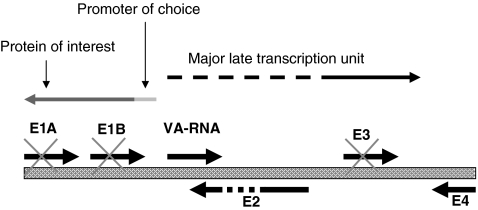
Fig. 1
Fig. 1
Production of first-generation Ad vectors from wild-type adenovirus genome. Wild-type adenoviruses have a double-stranded, linear DNA genome of approximately 36 kb in length. It is divided into early (E) and late (L) gene transcripts. Transcription of the viral genome begins with the E1 gene, producing E1a and E1b proteins. E1a proteins alter cellular metabolism and activate transcription of the other E genes, whereas the E1b protein prevents apoptosis of the host cell, promoting oncogenesis and transformation. The E2 gene products interact with a number of cellular factors to enable replication of viral DNA and transcription of the L genes. E3 gene products control various host immune responses, and the E4 gene products modulate viral gene expression and replication. In addition, wild-type adenoviruses also transcribe a set of untranslated RNAs (the VA RNAs) that combat cellular defence mechanisms by blocking activation of the interferon response and a MLTU that produces the viral capsid proteins. The creation of first-generation replication-deficient Ad vectors involved the removal of the E1 genes. In addition, E3 genes were also removed, as they are not required for viral replication in culture. This enabled up to 8-kbp foreign DNA, encoding promoters and foreign transgenes, to be incorporated into the genome. Figure adapted from Horwood et al. Arthritis Research,
Fig. 2
Fig. 2
Schematic of retrovirus. Retroviruses are RNA viruses that consist of a lipid envelope, depicted by the outer ring, which interacts with transmembrane matrix proteins and projecting receptor binding proteins. Host cell interactions are governed by these receptor binding proteins and can be altered by pseudotyping with other viral envelope proteins. The inner portion of the virion, known as the nucleocapsid, contains two identical copies of the viral genome and the viral reverse transcriptase, integrase and protease
Fig. 3
Fig. 3
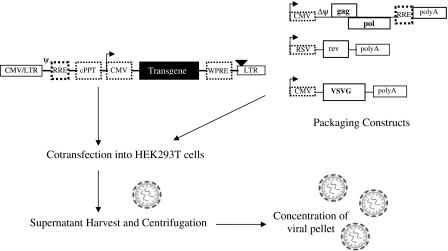
Production of lentiviral vectors. Lentiviral vectors are produced by co-transfection of packaging constructs containing viral elements needed for one round of replication, together with the shuttle vector containing the transgene into a packaging cell line, e.g. HEK293T cells. The newly formed viral particles are released into the supernatant by the budding process and can be collected (harvested) and concentrated by centrifugation. Addition of viral components such as the cPPT, RRE and WPRE can enhance the production and subsequent transgene expression
Fig. 4
Fig. 4
Non-integrating lentiviral vectors. Modification of lentiviral plasmids to contain an integrase negative helper plasmid have enabled the development of non-integrating lentiviral vectors. The viral genome does not integrate into the host genome but remains episomal. Transduction with EGFP-expressing virus demonstrates the efficiency of these vectors: a Integrating lenti-CMV-EGFP, b non-integrating CMV-EGFP and c non-integrating synapsin-EGFP
Fig. 5
Fig. 5
Neuron-specific expression using the synapsin promoter. Modification of adenoviral vectors using tissue-specific promoters to produce specific expression in embryonic rat organotypic brain cultures: a Ad-CMV-EGFP results in ubiquitous expression. b Ad-Syn-EGFP vectors, containing the human synapsin promoter, produces neuron-specific expression
Fig. 6
Fig. 6
Utilising viral vectors to create models of polyglutamine disease. a SBMA model in mouse neuroblastoma cell line. Transduction of mouse neuroblastoma cells, N2a’s, with adenoviral vectors expressing the androgen receptor construct that contains an expanded polyglutamine (CAG) repeat tract, leads to the development of protein aggregates within the cytoplasm upon testosterone addition. b Adenoviral vectors are used to create a model of polyglutamine in dissociated primary cortical neurons. These viruses express polyQ construct tagged with EGFP, driven by the synapsin promoter to enhance neuron-specific expression. c A similar model is also produced following the transduction of dissociated primary cortical neurons with adenoviral vectors expressing huntingtin with 103 PolyQ repeats fused to EGFP. d Lentiviral vectors expressing the polyQ-EGFP constructs are injected into rat striatum to create an in vivo model of polyglutamine disease

References

    1. Afione SA, Conrad CK, Kearns WG, Chunduru S, Adams R, Reynolds TC, Guggino WB, Cutting GR, Carter BJ, Flotte TR. In vivo model of adeno-associated virus vector persistence and rescue. J Virol. 1996;70:3235–3241. - PMC - PubMed
    1. Akli S, Caillaud C, Vigne E, Stratford-Perricaudet LD, Poenaru L, Perricaudet M, Kahn A, Peschanski MR. Transfer of a foreign gene into the brain using adenovirus vectors. Nat Genet. 1993;3:224–228. - PubMed
    1. Alba R, Bosch A, Chillon M. Gutless adenovirus: last-generation adenovirus for gene therapy. Gene Ther. 2005;12(Suppl 1):S18–S27. - PubMed
    1. Arnberg N. Adenovirus receptors: implications for tropism, treatment and targeting. Rev Med Virol. 2009;19:165–178. - PubMed
    1. Arnold GS, Sasser AK, Stachler MD, Bartlett JS. Metabolic biotinylation provides a unique platform for the purification and targeting of multiple AAV vector serotypes. Molec Ther. 2006;14:97–106. - PubMed

Publication types

Substances