. 2009 Dec;3(3-4):177-87.
doi: 10.1007/s12079-009-0074-2. Epub 2009 Oct 16.

The interaction of Thrombospondins with extracellular matrix proteins

The interaction of Thrombospondins with extracellular matrix proteins

Kemin Tan et al. J Cell Commun Signal. 2009 Dec.

Abstract

The thrombospondins (TSPs) are a family of five matricellular proteins that appear to function as adapter molecules to guide extracellular matrix synthesis and tissue remodeling in a variety of normal and disease settings. Various TSPs have been shown to bind to fibronectin, laminin, matrilins, collagens and other extracellular matrix (ECM) proteins. The importance of TSP-1 in this context is underscored by the fact that it is rapidly deposited at the sites of tissue damage by platelets. An association of TSPs with collagens has been known for over 25 years. The observation that the disruption of the TSP-2 gene in mice leads to collagen fibril abnormalities provided important in vivo evidence that these interactions are physiologically important. Recent biochemical studies have shown that TSP-5 promotes collagen fibril assembly and structural studies suggest that TSPs may interact with collagens through a highly conserved potential metal ion dependent adhesion site (MIDAS). These interactions are critical for normal tissue homeostasis, tumor progression and the etiology of skeletal dysplasias.


Figures
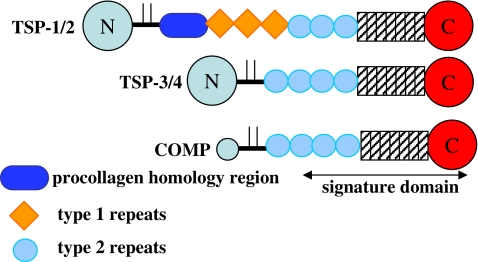
Fig. 1
Fig. 1
Schematic representation of the members of the TSP gene family. TSP-1 and -2 (Subgroup A) have equivalent domain structures and are trimeric. TSP-3, -4 and -5 (Subgroup B) assemble into pentamers. The vertical lines represent the disulfide bonds that connect the subunits
Fig. 2
Fig. 2
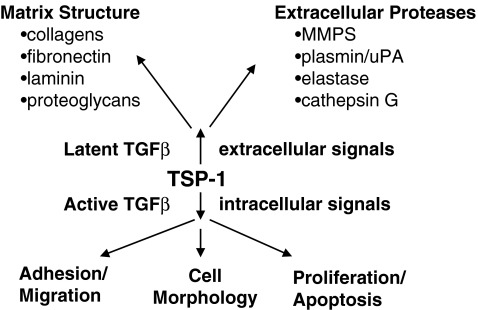
The matricellular functions of TSP-1
Fig. 3
Fig. 3
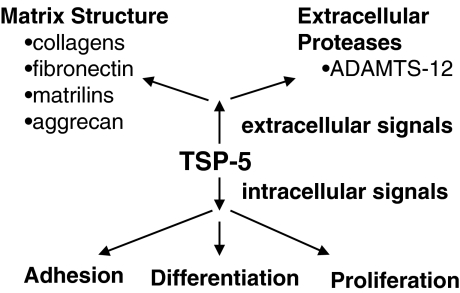
The matricellular functions of TSP-5
Fig. 4
Fig. 4
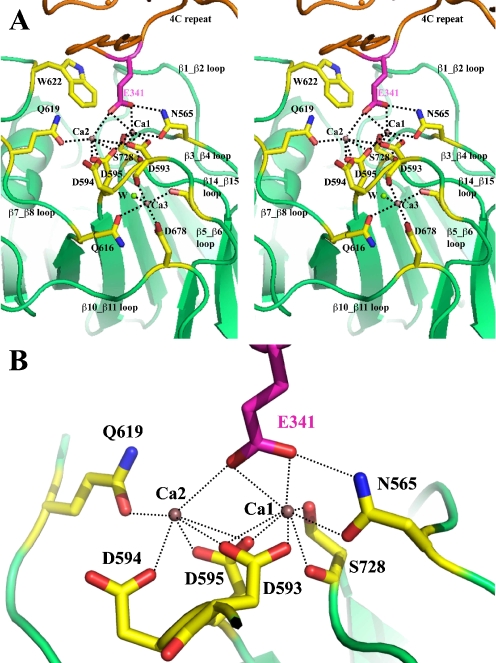
The binding of a mimetic ligand to the MIDAS-like motif of TSP-5. a Stereo ribbon drawing of the MIDAS-like motif of TSP-5 and its interaction with a mimetic ligand (E341) from type 3 repeat 4C of a neighboring molecule in the crystal structure. The MIDAS-like motif is on the top of C-terminal domain and includes an extended Ca2+ (purple spheres) binding site involving Ca1 and Ca2 of C-terminal domain. The Ca3 binding site is next to the extended Ca site, sharing an aspartic acid residue, D593. The adjacent Ca site may form an ADMIDAS-like motif as discussed in the text. A water molecule is shown as a green sphere and marked with a W. There are two other water molecules that are required to complete Ca2 and Ca3 coordinates and are not resolved in the TSP-5 structure due to low-resolution limit. b A zoom in view of MIDAS-like motif and the interacting glutamic acid. For clarity, the view is slightly different from that in Fig. 4a. The figure was prepared using the program PyMOL (http://www.PyMOL.org)

References

    1. Adams JC, Lawler J. Cell-type specific adhesive interactions of skeletal myoblasts with thrombospondin-1. Mol Biol Cell. 1994;5:423–437. - PMC - PubMed
    1. Adams JC, Bentley AA, Kvansakul M, Hatherley D, Hohenester E. Extracellular matrix retention of thrombospondin 1 is controlled by its conserved C-terminal region. J Cell Sci. 2008;121:784–795. doi: 10.1242/jcs.021006. - DOI - PubMed
    1. Agah A, Kyriakides TR, Lawler J, Bornstein P. The lack of thrombospondin-1 (TSP1) dictates the course of wound healing in double-TSP1/TSP2-null mice. Am J Pathol. 2002;161:831–839. - PMC - PubMed
    1. Anonick PK, Yoo JK, Webb DJ, Gonias SL. Characterization of the antiplasmin activity of human thrombospondin-1 in solution. Biochem J. 1993;289(Pt 3):903–909. - PMC - PubMed
    1. Arber S, Caroni P. Thrombospondin-4, an extracellular matrix protein expressed in the developing and adult nervous system promotes neurite outgrowth. J Cell Biol. 1995;131:1083–1094. doi: 10.1083/jcb.131.4.1083. - DOI - PMC - PubMed