Continuum modeling of biological tissue growth by cell division, and alteration of intracellular osmolytes and extracellular fixed charge density
- PMID: 19831471
- PMCID: PMC2860886
- DOI: 10.1115/1.3192138
Continuum modeling of biological tissue growth by cell division, and alteration of intracellular osmolytes and extracellular fixed charge density
Abstract
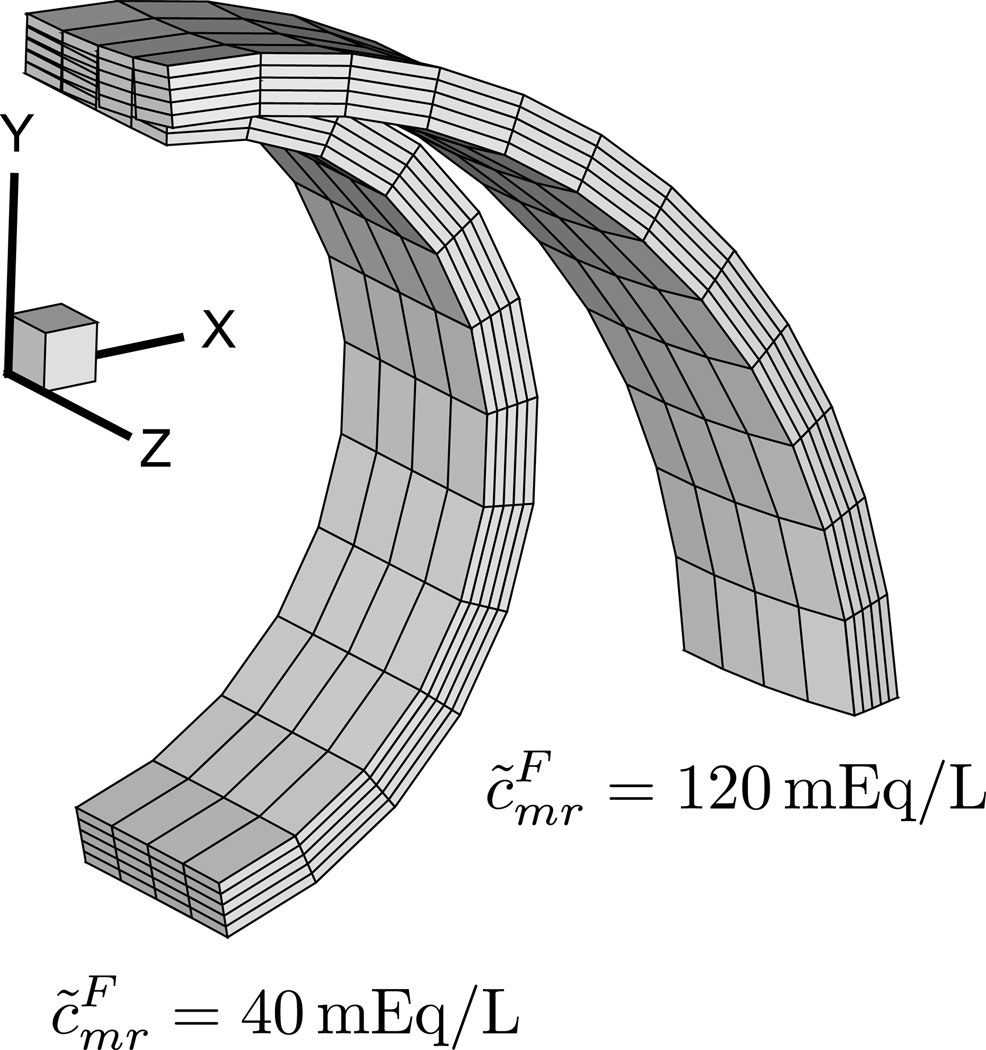
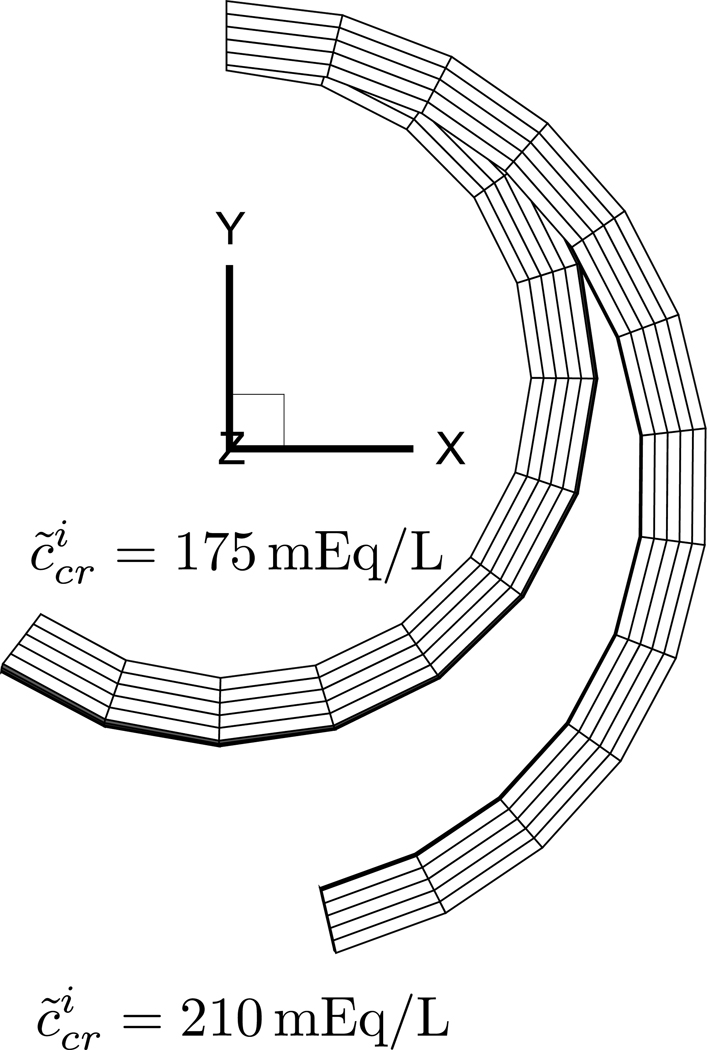
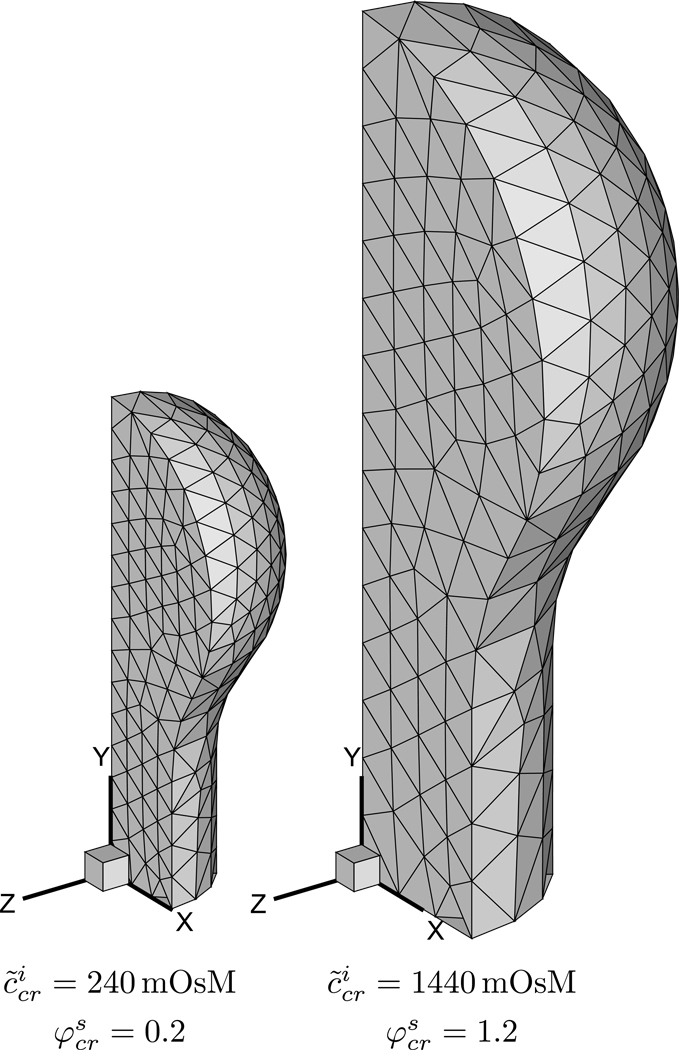
A framework is formulated within the theory of mixtures for continuum modeling of biological tissue growth that explicitly addresses cell division, using a homogenized representation of cells and their extracellular matrix (ECM). The model relies on the description of the cell as containing a solution of water and osmolytes, and having a porous solid matrix. The division of a cell into two nearly identical daughter cells is modeled as the doubling of the cell solid matrix and osmolyte content, producing an increase in water uptake via osmotic effects. This framework is also generalized to account for the growth of ECM-bound molecular species that impart a fixed charge density (FCD) to the tissue, such as proteoglycans. This FCD similarly induces osmotic effects, resulting in extracellular water uptake and osmotic pressurization of the ECM interstitial fluid, with concomitant swelling of its solid matrix. Applications of this growth model are illustrated in several examples.
Figures
References
-
- Hsu FH. The influences of mechanical loads on the form of a growing elastic body. J Biomech. 1968;1(4):303–311. - PubMed
-
- Cowin SC, Hegedus DH. Bone remodeling - 1. theory of adaptive elasticity. J Elasticity. 1976;6(3):313–326.
-
- Skalak R, Dasgupta G, Moss M, Otten E, Dullumeijer P, Vilmann H. Analytical description of growth. J Theor Biol. 1982;94(3):555–577. - PubMed
-
- Rodriguez EK, Hoger A, McCulloch AD. Stress-dependent finite growth in soft elastic tissues. J Biomech. 1994;27(4):455–467. - PubMed
-
- Epstein M, Maugin GA. Thermomechanics of volumetric growth in uniform bodies. Int J Plasticity. 2000;16(7–8):951–978.
Publication types
MeSH terms
Substances
Grants and funding
LinkOut - more resources
Full Text Sources