


Vitamin D and non-Hodgkin lymphoma risk in adults: a review
- PMID: 19832043
- PMCID: PMC2893413
- DOI: 10.3109/07357900902849632
Vitamin D and non-Hodgkin lymphoma risk in adults: a review
Abstract
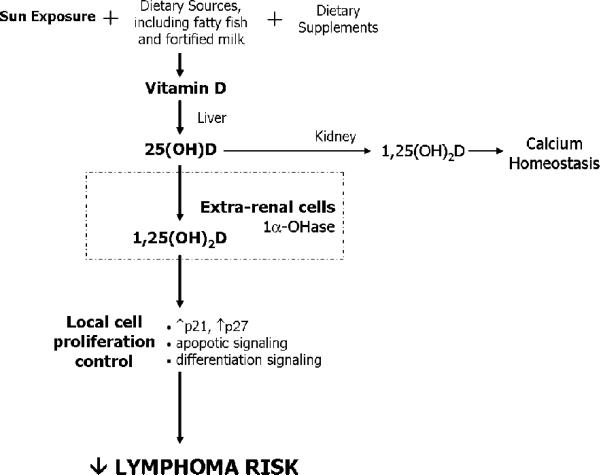
Animal and human studies support a protective effect of vitamin D sufficiency related to malignancy by uncovering paracrine and autocrine effects of extra-renal 25-hydroxyvitamin D (25(OH)D) activation including regulation of cell cycle proliferation, apoptosis induction, and increased cell differentiation signaling. Recent epidemiologic studies demonstrate a reduction in non-Hodgkin lymphoma (NHL) risk with increased sunlight exposure. As sunlight is a major vitamin D source, it has been suggested that vitamin D status may mediate this observed association. This review provides a comprehensive discussion of the current epidemiologic evidence with regard to the investigation of an association between vitamin D status and NHL risk.
Figures
References
-
- Ries L, et al., editors. SEER Cancer Statistics Review, 1975–2004. National Cancer Institute; Bethesda, MD: 2005. http://seer.cancer.gov/csr/1973_2004/. Vol. based on November 2006 SEER data submission, posted to the SEER website, 2007.
-
- Fisher SG, Fisher RI. The epidemiology of non-Hodgkin's lymphoma. Oncogene. 2004;23(38):6524–34. - PubMed
-
- Grulich AE, Vajdic CM, Cozen W. Altered immunity as a risk factor for non-Hodgkin lymphoma. Cancer Epidemiol Biomarkers Prev. 2007;16(3):405–8. - PubMed
-
- Engels EA, Goedert JJ. Human immunodeficiency virus/acquired immunodeficiency syndrome and cancer: past, present, and future. J Natl Cancer Inst. 2005;97(6):407–9. - PubMed
-
- Baris D, Zahm SH. Epidemiology of lymphomas. Curr Opin Oncol. 2000;12(5):383–94. - PubMed
Publication types
MeSH terms
Substances
Grants and funding
LinkOut - more resources
Full Text Sources
Medical
