Comment
doi: 10.1101/gad.1861709.
Developmental trajectories in early hematopoiesis
Affiliations
- PMID: 19833763
- PMCID: PMC2764501
- DOI: 10.1101/gad.1861709
Item in Clipboard
Comment
Developmental trajectories in early hematopoiesis
Genes Dev.
.
Abstract
The paths that hematopoietic stem cells take to develop from multipotent, self-renewing cells into committed lymphocytes has been a topic of debate for some time. During early hematopoiesis, multiple branchpoints have been described in which progeny cells segregate into cell lineages with distinct developmental potentials. In this issue of Genes & Development, Inlay and colleagues (pp. 2376-2381) identify novel intermediate stages through which hematopoietic progenitor cells travel.
Figures
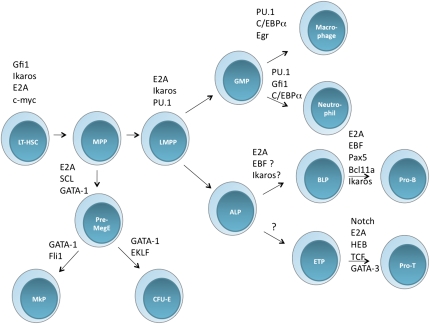
Development of hematopoietic progenitors from the LT-HSC. The diagram shows the road map of early hematopoiesis. The revised map shows the newly defined and characterized ALP and BLP compartments. Transcription factors that act at distinct stages or transition during early hematopoiesis are indicated. (MkP) megakaryocytic progenitor; (CFU-E) colony-forming unit erythroid progenitor. Note that the CLP population is segregated into two distinct stages, named the ALP and the BLP compartments.
Comment on
-
Ly6d marks the earliest stage of B-cell specification and identifies the branchpoint between B-cell and T-cell development.Genes Dev. 2009 Oct 15;23(20):2376-81. doi: 10.1101/gad.1836009. Genes Dev. 2009. PMID: 19833765 Free PMC article.
References
-
- Adolfsson J, Mansson R, Buza-Vidas N, Hultquist A, Liuba K, Jensen CT, Bryder D, Yang L, Borge OJ, Thoren LA, et al. Identification of Flt3+ lympho-myeloid stem cells lacking erythro-megakaryocytic potential a revised road map for adult blood lineage commitment. Cell. 2005;121:295–306. - PubMed
-
- Agata Y, Tamaki N, Sakamoto S, Ikawa T, Masuda K, Kawamoto H, Murre C. Regulation of T cell receptor b gene rearrangements and allelic exclusion. Immunity. 2007;27:871–884. - PubMed
-
- Akashi K, Traver D, Miyamoto T, Weissman IL. A clonogenic common myeloid progenitor that gives rise to all myeloid lineages. Nature. 2000;404:193–197. - PubMed
-
- Bain G, Robanus Maandag EC, te Riele HP, Feeney AJ, Sheehy A, Schlissel M, Shinton SA, Hardy RR, Murre C. Both E12 and E47 allow commitment to the B cell lineage. Immunity. 1997b;6:145–154. - PubMed
Publication types
MeSH terms
Substances
LinkOut - more resources
Full Text Sources
Miscellaneous