. 2009 Nov 3;106(44):18686-91.
doi: 10.1073/pnas.0909464106. Epub 2009 Oct 15.

Methionine oxidation contributes to bacterial killing by the myeloperoxidase system of neutrophils

Affiliations

Methionine oxidation contributes to bacterial killing by the myeloperoxidase system of neutrophils

Henry Rosen et al. Proc Natl Acad Sci U S A. .

Abstract

Reactive oxygen intermediates generated by neutrophils kill bacteria and are implicated in inflammatory tissue injury, but precise molecular targets are undefined. We demonstrate that neutrophils use myeloperoxidase (MPO) to convert methionine residues of ingested Escherichia coli to methionine sulfoxide in high yield. Neutrophils deficient in individual components of the MPO system (MPO, H(2)O(2), chloride) exhibited impaired bactericidal activity and impaired capacity to oxidize methionine. HOCl, the principal physiologic product of the MPO system, is a highly efficient oxidant for methionine, and its microbicidal effects were found to correspond linearly with oxidation of methionine residues in bacterial cytosolic and inner membrane proteins. In contrast, outer envelope proteins were initially oxidized without associated microbicidal effect. Disruption of bacterial methionine sulfoxide repair systems rendered E. coli more susceptible to killing by HOCl, whereas over-expression of a repair enzyme, methionine sulfoxide reductase A, rendered them resistant, suggesting a direct role for methionine oxidation in bactericidal activity. Prominent among oxidized bacterial proteins were those engaged in synthesis and translocation of peptides to the cell envelope, an essential physiological function. Moreover, HOCl impaired protein translocation early in the course of bacterial killing. Together, our findings indicate that MPO-mediated methionine oxidation contributes to bacterial killing by neutrophils. The findings further suggest that protein translocation to the cell envelope is one important pathway targeted for damage.


Conflict of interest statement

The authors declare no conflict of interest.

Figures
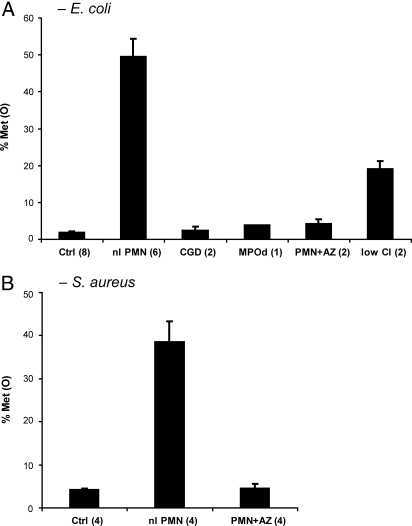
Fig. 1.
Fig. 1.
Neutrophil-mediated oxidation of bacterial methionines. Bacteria were incubated with neutrophils for 1 h, recovered, and analyzed by LC-ESI-MS/MS. The fraction of bacterial methionine residues in peptides recovered as sulfoxides was monitored as M + 16. Abbreviations: Ctrl, PMN—nonphagocytic conditions (serum and divalent cations omitted [all PMN donors combined]); nl PMN, normal donor PMN—phagocytic conditions (serum and divalent cations present); CGD, neutrophils defective in H2O2 production (isolated from an individual with chronic granulomatous disease, deficient in NADPH oxidase); MPOd, PMN lacking MPO (from an individual with complete hereditary MPO deficiency); PMN+AZ, normal PMN supplemented with, 10−4 M sodium azide, an MPO inhibitor; low Cl, normal PMN, chloride salts in suspension medium replaced with gluconates. Legend parentheses indicate replicates for each condition. (A) Escherichia coli, strain ATCC11775. (B) Staphylococcus aureus, strain 502A.
Fig. 2.
Fig. 2.
Bactericidal activity and protein methionine oxidation by HOCl and an MPO, H2O2, chloride system. The E. coli strain was CFT073. For HOCl (A), the reaction was in PBS, pH 7.4. An equal volume of oxidant, at twice the indicated final concentration, was rapidly mixed with 4 × 10⁹ bacterial cells, and after 2–5 s the reaction was quenched with 33 mM methionine. For the MPO system (B), the reaction was in 40 mM sodium phosphate pH 7.0 containing 10 mM glucose and 0.1 M NaCl. MPO, at concentrations of 0–34 nM, was preincubated with bacteria for 3–5 min. The reaction was started by addition of glucose oxidase sufficient to generate H2O2 at an initial rate of 40 μM/min, and the reaction was incubated for 15 min with vigorous agitation, before quenching with 33 mM methionine. HOCl formation by MPO (x axis, B) was estimated as taurine chlorination (μM/15 min). Bacterial viability (diamonds, % viability) and protein methionine and methionine sulfoxide [circles, Met(O)%] were estimated by LC-ESI-MS/MS and spectral counting.
Fig. 3.
Fig. 3.
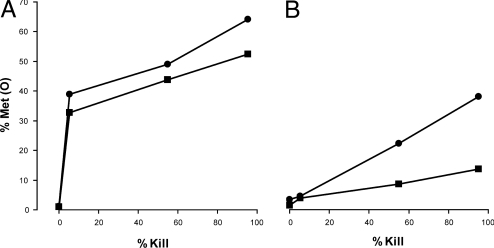
Protein location affects susceptibility to oxidation by HOCl and an MPO system. Methionine oxidation plotted against extent of bacterial killing for HOCl (circles) and an MPO system (squares). (A) Cell envelope proteins: outer membrane and periplasm. (B) All other proteins (inner membrane, cytoplasm, and location not specified). Data are from experiments described in Fig. 2. Proteins were assigned to cellular locations as described in Materials and Methods.
Fig. 4.
Fig. 4.
Increased susceptibility of E. coli deficient in methionine sulfoxide reductases A and B (msrA msrB) to microbicidal effects of HOCl. HOCl in PBS, at twice the concentration indicated in the figure, was rapidly injected into an equal volume of E. coli in PBS, pH 7.4. Residual microbial viability was determined by plating dilutions on Mueller Hinton agar. The E. coli strains were wild type, CFT073 (closed circles), an msrA msrB double mutant (closed squares), and the mutant complemented with an msrA-expressing plasmid (open squares). Results are the geometric mean of six independent experiments. Error bars reflect the SEM of log-transformed data.
Fig. 5.
Fig. 5.
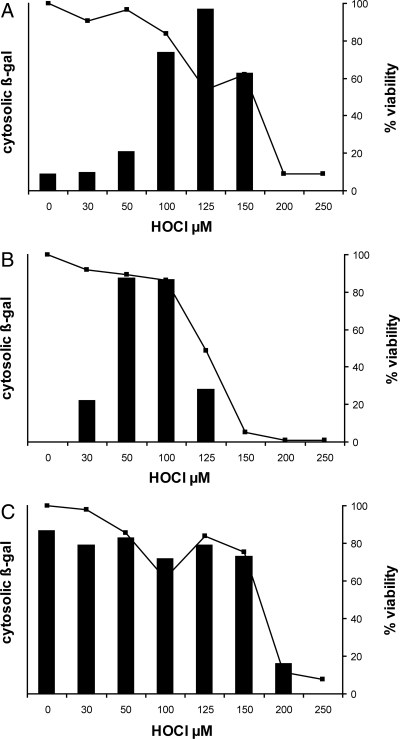
HOCl effects on protein translocation from cytoplasm to cell envelope. (A) E. coli strain EC626 (MC4100 Φ(lamB-lacZ) Hyb 42–1), which synthesizes a fusion protein that is translocated through the secA pathway, was exposed to HOCl at the indicated concentrations and then induced to synthesize its normally translocated β-gal fusion protein as described in Materials and Methods. Failure to translocate the protein resulted in accumulation of cytoplasmic β-galactosidase activity (bars). Bacterial viability at each HOCl concentration is shown as a line graph (squares, right y axis). (B) Oxidation conditions as for (A) except that the E. coli strain was EC628 (MC4100 Φ(H*lamB‘-’lacZ), H*lamB [diploid]), which synthesizes a fusion protein that is translocated through the signal recognition particle pathway. Induction and β-gal assay conditions were modified to detect the lower overall fusion protein levels in this strain (see Materials and Methods). (C) Oxidation conditions as for (A) except that the E. coli strain was EC627 (MC4100 Φ(lamBΔ60-lacZ) Hyb 42–1), which synthesizes a fusion protein that is predominantly cytosolic (not translocated) under all conditions. This strain serves as an indicator of bacterial capacity, upon HOCl oxidation, to sense an inducing stimulus and respond with new protein synthesis. Each panel reflects a representative experiment from at least three replicates. Maximal ONPG hydrolysis in (A–C) (A420-1.75*A550; see Materials and Methods), was 0.097, 0.210, and 0.083 units, respectively.

References

    1. Nauseef WM. How human neutrophils kill and degrade microbes: An integrated view. Immunol Rev. 2007;219:88–102. - PubMed
    1. Klebanoff SJ. Myeloperoxidase: Friend and foe. J Leukoc Biol. 2005;77:598–625. - PubMed
    1. Klebanoff SJ, Clark RA. The Neutrophil. Amsterdam: North-Holland Publishing; 1978.
    1. Harrison JE, Schultz J. Studies on the chlorinating activity of myeloperoxidase. J Biol Chem. 1976;251:1371–1374. - PubMed
    1. Chapman AL, Hampton MB, Senthilmohan R, Winterbourn CC, Kettle AJ. Chlorination of bacterial and neutrophil proteins during phagocytosis and killing of Staphylococcus aureus. J Biol Chem. 2002;277:9757–9762. - PubMed

Publication types

MeSH terms