. 2009 Dec 2;28(23):3706-16.
doi: 10.1038/emboj.2009.305. Epub 2009 Oct 15.

Schlank, a member of the ceramide synthase family controls growth and body fat in Drosophila

Affiliations

Schlank, a member of the ceramide synthase family controls growth and body fat in Drosophila

Reinhard Bauer et al. EMBO J. .

Abstract

Ceramide synthases are highly conserved transmembrane proteins involved in the biosynthesis of sphingolipids, which are essential structural components of eukaryotic membranes and can act as second messengers regulating tissue homeostasis. However, the role of these enzymes in development is poorly understood due to the lack of animal models. We identified schlank as a new Drosophila member of the ceramide synthase family. We demonstrate that schlank is involved in the de novo synthesis of a broad range of ceramides, the key metabolites of sphingolipid biosynthesis. Unexpectedly, schlank mutants also show reduction of storage fat, which is deposited as triacylglyerols in the fat body. We found that schlank can positively regulate fatty acid synthesis by promoting the expression of sterol-responsive element-binding protein (SREBP) and SREBP-target genes. It further prevents lipolysis by downregulating the expression of triacylglycerol lipase. Our results identify schlank as a new regulator of the balance between lipogenesis and lipolysis in Drosophila. Furthermore, our studies of schlank and the mammalian Lass2 family member suggest a novel role for ceramide synthases in regulating body fat metabolism.


Conflict of interest statement

The authors declare that they have no conflict of interest.

Figures
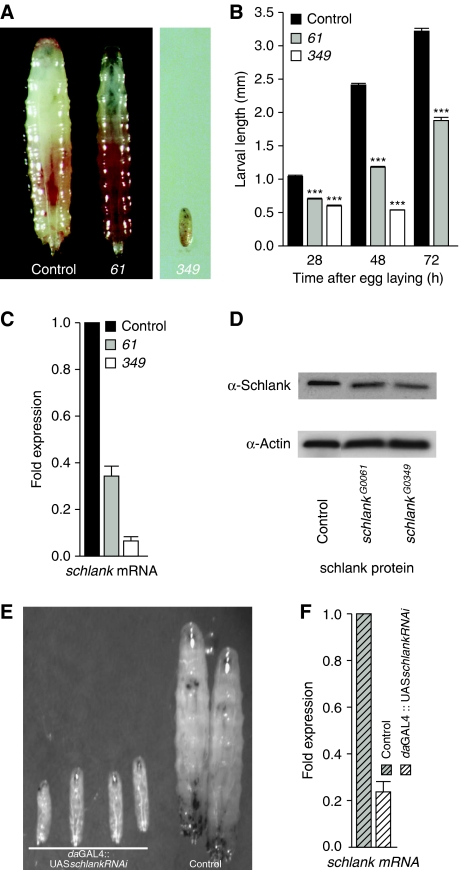
Figure 1
Figure 1
Schlank is essential for larval growth. (A) Larval growth of schlankG0061 (61) mutants compared with wild-type w1118 larvae (control) at late L3 stage. schlankG0349 (349) hatch as first instar larvae and die after about 3 days as morphological first instar larvae. Food intake in mutants was controlled by feeding red-coloured yeast. (B) Average length of control [w1118] (n=123, n=81, n=48), schlankG0061 (n=54, n=187, n=63) and schlankG0349 (n=14, n=106) larvae after 24–25, 48–49 and 72–73 h after egg laying. (C) Reduced schlank mRNA expression in schlank mutants as compared with that in w1118 controls. (D) Determination of residual schlank protein (predicted size of about 46 kDa) in schlank mutants; reduction to 80% in schlankG0061 and 60% in schlankG349 mutants as compared with that in wild-type controls (100%; w1118) using schlank antibody (Supplementary Figure S4). An actin antibody was used to determine the loading control. (E,F) schlank knockdown using schlank RNAi (UASschlankRNAi) in combination with the daughterless-GAL4 (daGAL4) driver line phenocopies the schlank larval growth phenotype (E). Quantification of mRNA levels by qRT–PCR in panel F. Control: daGAL4∷w1118. Asterisks in panel B indicate significant differences to the wild type (P<0.001). (BG) Error bars indicate s.e.m.
Figure 2
Figure 2
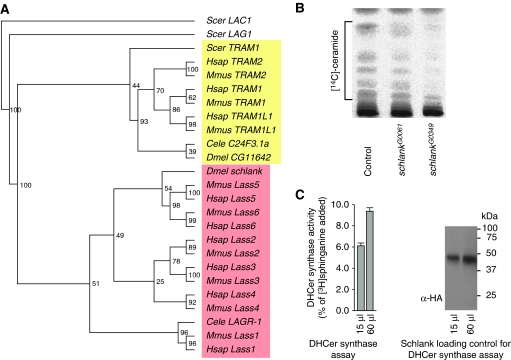
Schlank is involved in de novo ceramide synthesis. (A) Phylogenetic tree of Lass family members and TRAM proteins. Protein sequences were derived from the Ensembl database. If more than one protein variant existed, the version with all domain features was used (for accession numbers see Supplementary Table SI). Sequences were aligned using EMBL-EBI ClustalW2 online service using standard settings. The alignment file was used to generate 100 bootstrapped data sets with seqboot (PHYLIP 3.68 package; see also Felsenstein, 1989). The output was analysed using maximum likelihood (proml, PHYLIP package). An unrooted consensus tree was generated with consense (PHYLIP package). Bootstrap values are marked above each branch. The ceramide synthase family is highlighted in red and the TRAM family in yellow. Note that schlank falls into the Lass family and CG11642 into the TRAM family. (B) Biosynthesis of ceramides is significantly reduced in first instar schlankG0061 and schlankG0349 larvae as compared with that in w1118 wild-type controls. Sphingolipids were labelled by feeding larvae with radiolabelled L-[3-14C]-serine for 12 h. After lipid extraction equal amounts of radioactivity were applied to TLC plates, developed with chloroform/ methanol/ glacial acetic acid (190:9:1) and quantified. The total ceramide content in schlankG0061- and in schlankG0349-mutant larvae was reduced to 89 and 60%, respectively, as compared with that in the wild-type (100%). (C) The dose-dependent increase in the expression of immunoreactive schlankHA product correlates with an increase in ceramide synthase activity. Different amounts of eluted fractions after binding to a HA affinity matrix were used for immunoblotting with an HA antibody or determination of ceramide synthase activity (see also Supplementary data).
Figure 3
Figure 3
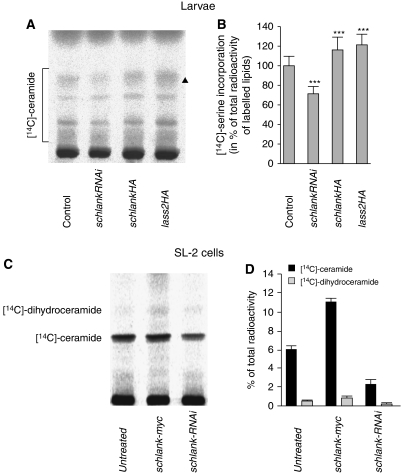
Modulation of schlank activity correlates with the rate of ceramide de novo synthesis (A, B) Larvae carrying hsGAL4 and either UASschlankRNAi (schankRNAi), UASschlankHA (schlankHA) or UASlass2HA (lass2HA) were heat shocked for 1 h and subsequently fed L-[3-14C]-serine. Its incorporation of L-[3-14C]-serine into de novo ceramide was analysed in larvae 12 h after heat shock by TLC with chloroform/methanol/glacial acetic acid (190:9:1) (A) and quantified (B). Asterisks in panel B indicate significant differences to wild-type controls [hsGAL4∷w1118] (P<0.001). (C, D) Treatment of SL-2 cells in the presence of [14C]serine with schlank dsRNA or schlank overexpression after transfection of SL-2 cells shows significant downregulation or upregulation of (dihydro)ceramide, respectively. Ceramides and dihydroceramides were separated on TLC plates impregnated with borate with chloroform/methanol 9:1. The main (dihydro)ceramide bands depicted in panel C correspond to the main ceramide marked with an asterisk in panel A (see also Supplementary Figure S2A). Error bars indicate s.d.
Figure 4
Figure 4
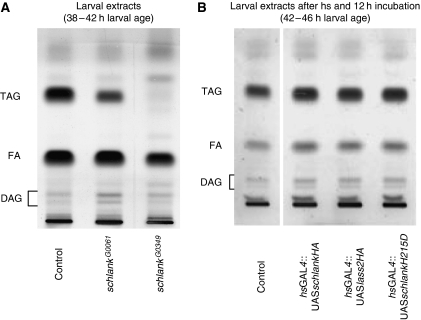
A role for schlank in TAG regulation. (A) Comparison of in vivo TAG levels in 38- to 42-h-old schlankG0061- and schlankG0349-mutant animals of the same age with w1118 controls. In both mutants TAG and FA levels were reduced to a different extent correlating well with the severity of the mutant schlank alleles. (B) TAG and FAs are elevated in 42- to 46-h-old larvae upon overexpression of either schlankHA (hsGAL4∷UASschlankHA), murine lass2HA (hsGAL4∷UASlass2HA) or schlankH215D (hsGAL4∷UASschlankH215D), which cannot upregulate ceramide synthesis (see Supplementary Figure S3B). Triacylglycerol (TAG), diacylglycerol (DAG), fatty acids (FA). For photodensitometric quantification, see Table I.
Figure 5
Figure 5
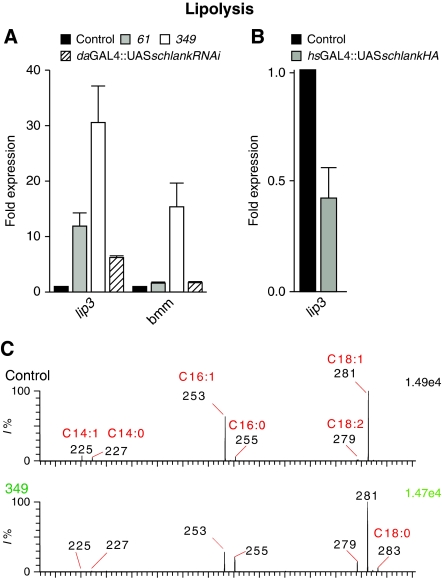
Schlank affects lipolysis. (A) Transcript levels of lip3 and bmm lipases are upregulated in first instar schlankG0061 and schlankG0349 mutants and upon schlank knockdown using a daGAL4 driver line, as quantified by qRT–PCR. schlank mutants were compared with wild-type w1118 larvae, and schlankRNAi was compared with daGAL4∷w1118) (B) Overexpression of UASschlankHA using a heat shock-GAL4 (hsGAL4) driver line decreases lip3 transcript levels (hsGAL4∷w1118 were used as control). (C) Analysis and quantification of FAs in 38- to 42-h-old w1118 control and schlankG0349 mutants. Quantification of FAs was performed by ESI-MS using an internal standard (Table I and Supplementary data). Error bars indicate s.e.m.
Figure 6
Figure 6
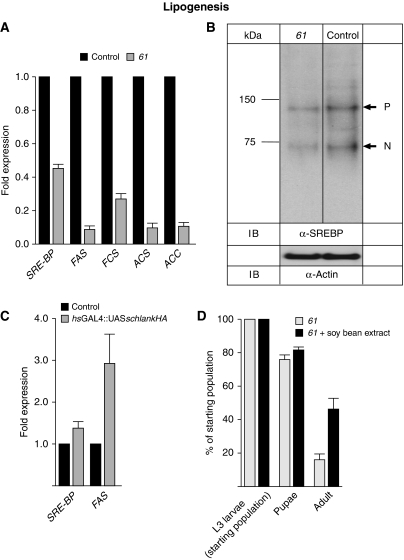
Schlank is a positive regulator of lipogenesis. (A) Reduced mRNA expression of SREBP, FAS, FCS, ACS as well as ACC in schlankG0061 as compared with w1118 control. Quantification by qRT–PCR. (B) Immunoblot analysis of schlankG0061 (61) and w1118 (control) whole-fly lysates (60 μg/lane) shows reduction in SREBP protein levels in schlankG0061 mutants. The blot was probed with monoclonal antibody against the NH2-terminal fragment of dSREBP (IgG-3B2; Seegmiller et al, 2002). The membrane was then stripped and reprobed with anti-actin antibody used as loading control (lower panel). (C) Increased dSREBP and FAS transcript levels in larvae overexpressing UASschlankHA in combination with an hsGAL4 driver line after 1 h of heat shock. (D) Soy lipid extract can rescue schlankG0061-mutant animals to adulthood while the percentage of larvae and pupae is not altered. Error bars indicate s.e.m.

References

    1. Acharya U, Acharya JK (2005) Enzymes of sphingolipid metabolism in Drosophila melanogaster. Cell Mol Life Sci 62: 128–142 - PMC - PubMed
    1. Adachi-Yamada T, Gotoh T, Sugimura I, Tateno M, Nishida Y, Onuki T, Date H (1999) De novo synthesis of sphingolipids is required for cell survival by down-regulating c-Jun N-terminal kinase in Drosophila imaginable discs. Mol Cell Biol 19: 7276–7286 - PMC - PubMed
    1. Aguila JR, Suszko J, Gibbs AG, Hoshizaki DK (2007) The role of larval fat cells in adult Drosophila melanogaster. J Exp Biol 210: 956–963 - PubMed
    1. Arrese EL, Wells MA (1997) Adipokinetic hormone induced lipolysis in the fat body of an insect, Manduca sexta: synthesis of sn-1,2-diacylglycerols. J Lipid Res 38: 68–76 - PubMed
    1. Batheja AD, Uhlinger DJ, Carton JM, Ho G, D'Andrea MR (2003) Characterization of serine palmitoyltransferase in normal human tissues. J Histochem Cytochem 51: 687–696 - PubMed

Publication types

MeSH terms

LinkOut - more resources