


doi: 10.1186/jbiol185.
Molecular machines or pleiomorphic ensembles: signaling complexes revisited
Affiliations
- PMID: 19835637
- PMCID: PMC2776906
- DOI: 10.1186/jbiol185
Item in Clipboard
Molecular machines or pleiomorphic ensembles: signaling complexes revisited
J Biol.
.
Abstract
Signaling complexes typically consist of highly dynamic molecular ensembles that are challenging to study and to describe accurately. Conventional mechanical descriptions misrepresent this reality and can be actively counterproductive by misdirecting us away from investigating critical issues.
Figures

Different classes of molecular assemblies.

Signaling by the platelet-derived growth factor (PDGF) receptor. The unliganded receptor is monomeric and its tyrosine kinase catalytic activity is low (left). On binding to dimeric PDGF, the receptor dimerizes, its catalytic activity increases, and receptors transphosphorylate each other on a number of different sites, represented by pink circles (center). These phosphorylated sites (with one exception) serve to recruit cytosolic effector proteins (gray) that contain phosphotyrosine-specific modular binding domains (right). The exception is the activating phosphorylation, located on the catalytic domain of the receptor adjacent to the active site (red circle). Representative effectors depicted are: Src, Src-family non-receptor tyrosine kinases; PI3K, regulatory subunit of phosphatidylinositol 3-kinase; GAP, RasGAP, a GTPase-activating factor for Ras; PLC, phosphatidylinositol-specific phospholipase C-γ; Shp2, SH2-containing tyrosine phosphatase; Grb2, adaptor protein that recruits the Ras guanine-nucleotide exchange factor Sos.

Averaging leads to loss of information. In the panel on the right, each pixel is the average of the properties of all the individual pixels in the panel on the left. By averaging, all information on the range of properties of individual pixels, and their spatial distribution, is lost. Most biochemical methods used to probe signaling complexes, such as immunoprecipitation followed by immunoblotting or mass spectrometry, average the properties of complexes over the entire population.
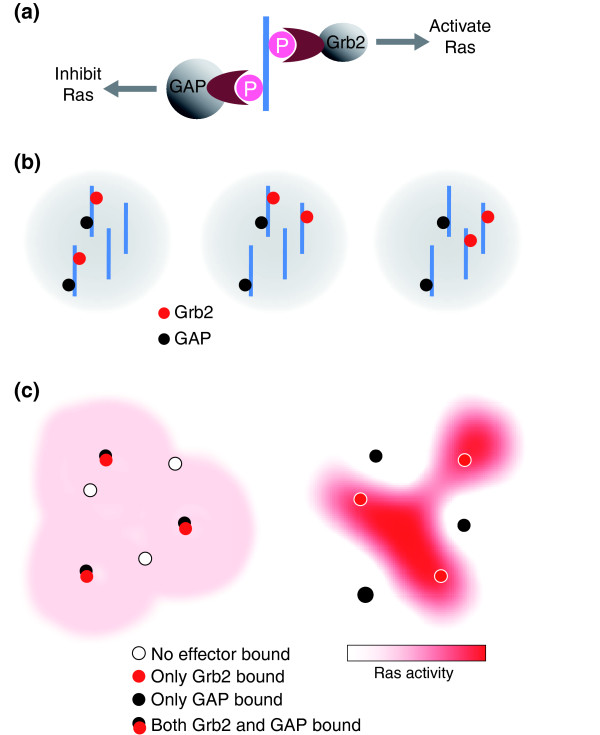
Individual receptor states can influence signal output. (a) Grb2 and RasGAP (GAP) bind to distinct sites on the PDGF receptor (blue line). For clarity, only one receptor molecule is shown; the actual activated form of the receptor is a dimer. The consequence of Grb2 binding is Ras activation, through the Ras guanine-nucleotide exchange factor Sos. The consequence of GAP binding is Ras inactivation (by stimulating its intrinsic GTPase activity). Thus, these two effectors have opposing effects on Ras activity. (b) Three different possible distributions of GAP and Grb2 on receptors are depicted; in all cases, an average of 0.5 molecule of Grb2 and 0.5 molecule of GAP are bound per receptor. Left, binding of Grb2 and GAP are positively correlated; middle, binding of Grb2 and GAP are independent; right, binding of Grb2 and GAP are negatively correlated. (c) Effects of different distribution of effectors on Ras activity are depicted. Left, where binding of GAP and Grb2 are positively correlated, Ras activity will be relatively low and uniform. Right, where binding of Grb2 and GAP are negatively correlated, areas of high Ras activity and low Ras activity will be interspersed.
References
-
- Heldin CH, Westermark B. Mechanism of action and in vivo role of platelet-derived growth factor. Physiol Rev. 1999;79:1283–1316. - PubMed
Publication types
MeSH terms
Substances
Grants and funding
LinkOut - more resources
Full Text Sources
