


Objective quantification of physical activity in bariatric surgery candidates and normal-weight controls
- PMID: 19837009
- PMCID: PMC2818132
- DOI: 10.1016/j.soard.2009.08.012
Objective quantification of physical activity in bariatric surgery candidates and normal-weight controls
Abstract
Background: Physical activity (PA) is an important component of weight loss programs and should be encouraged for severely obese patients undergoing bariatric surgery. However, few studies have determined the amount and intensity of activities undertaken preoperatively by bariatric surgery patients using objective measures.
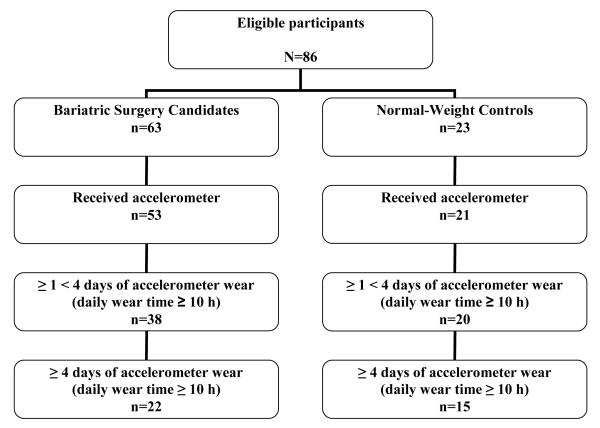
Methods: Using RT3 tri-axial accelerometers, the present study compared 38 bariatric surgery candidates and 20 normal weight controls on activity counts/hr; the number of minutes daily spent in moderate-to-vigorous intensity PA (MVPA) and vigorous intensity PA; and the level of compliance with national recommendations to accumulate 150 min/wk of MVPA in bouts of > or = 10 minutes.
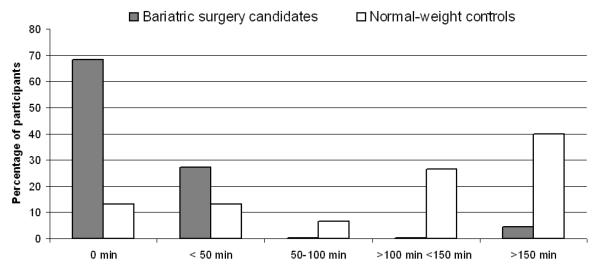
Results: Surgery candidates, compared with controls, recorded significantly (P <.01) fewer activity counts/hr (13,799 +/- 3758 counts/hr versus 19,462 +/- 4259 counts/hr) and spent fewer minutes per day engaged in MVPA (26.4 +/- 23.0 min/d versus 52.4 +/- 24.7 min/d) and vigorous PA (1.2 +/- 3.4 min/d vs 11.8 +/- 9.0 min/d). More than two thirds (68%) of the surgery candidates versus 13% of the normal weight controls did not accumulate any MVPA in bouts of > or = 10 minutes and only 4.5% of obese patients met the weekly MVPA recommendation versus 40% of the controls.
Conclusion: The results of our study have shown that bariatric surgery candidates have low PA levels and rarely engage in PA bouts of sufficient duration and intensity to maintain and improve health. Additional research is needed to determine how best to increase PA in bariatric surgery candidates.
2010 American Society for Metabolic and Bariatric Surgery. Published by Elsevier Inc. All rights reserved.
Figures

References
-
- Buchwald H, Estok R, Fahrbach K, et al. Weight and types 2 diabetes after bariatric surgery: systematic review and meta-analysis. Am J Med. 2009;122:248–65. - PubMed
-
- Snyder B, Nguyen A, Scarbourough T, Yu S, Wilson E. Comparison of those who succeed in losing significant excessive weight after bariatric surgery and those who fail. Surg Endosc. 2009 doi: 10.1007/s00464-008-3221-1. - PubMed
-
- Bond DS, Phelan S, Wolfe LG, et al. Becoming physically active after bariatric surgery is associated with improved weight loss and health-related quality of life. Obesity. 2009;17:78–83. - PubMed
-
- Lightman SW, Pirsarska K, Bermann ER, et al. Discrepancy between self-reported and actual caloric intake and exercise in obese subjects. New Engl J Med. 1992;327:1893–8. - PubMed
Publication types
MeSH terms
Grants and funding
LinkOut - more resources
Full Text Sources
Medical
Miscellaneous
