. 2010 Jan;207(4):645-59.
doi: 10.1007/s00213-009-1697-y. Epub 2009 Oct 20.

Impulsive choice and response in dopamine agonist-related impulse control behaviors

Affiliations

Impulsive choice and response in dopamine agonist-related impulse control behaviors

Valerie Voon et al. Psychopharmacology (Berl). 2010 Jan.

Abstract

Rationale: Dopaminergic medication-related impulse control disorders (ICDs) such as pathological gambling and compulsive shopping have been reported in Parkinson's disease (PD).

Hypothesis: We hypothesized that dopamine agonists (DAs) would be associated with greater impulsive choice or greater discounting of delayed rewards in PD patients with ICDs (PDI).

Methods: Fourteen PDI patients, 14 PD controls without ICDs, and 16 medication-free matched normal controls were tested on the Experiential Discounting Task (EDT), a feedback-based intertemporal choice task, spatial working memory, and attentional set shifting. The EDT was used to assess choice impulsivity (hyperbolic K value), reaction time (RT), and decision conflict RT (the RT difference between high conflict and low conflict choices). PDI patients and PD controls were tested on and off DA.

Results: On the EDT, there was a group by medication interaction effect [F(1,26) = 5.62; p = 0.03] with pairwise analyses demonstrating that DA status was associated with increased impulsive choice in PDI patients (p = 0.02) but not in PD controls (p = 0.37). PDI patients also had faster RT compared to PD controls [F(1,26) = 7.51, p = 0.01]. DA status was associated with shorter RT [F(3,24) = 8.39, p = 0.001] and decision conflict RT [F(1,26) = 6.16, p = 0.02] in PDI patients but not in PD controls. There were no correlations between different measures of impulsivity. PDI patients on DA had greater spatial working memory impairments compared to PD controls on DA (t = 2.13, df = 26, p = 0.04).

Conclusion: Greater impulsive choice, faster RT, faster decision conflict RT, and executive dysfunction may contribute to ICDs in PD.


Figures

Figure 1
Figure 1
Experiential Discounting Task (EDT). (A) EDT Task. The task is described extensively in the text. (B) The bar graph represents impulsivity scores as measured using the hyperbolic discount constant K. Patients with Parkinson disease (PD) and problem gambling/shopping (PDI) were compared with PD controls and tested on and off dopamine agonists (DA) (repeated measures ANOVA). Medication free normal volunteers (NV) are represented by the dashed line. Error bars represent standard deviation. (*Group by medication interaction effect p=0.03).
Figure 2
Figure 2
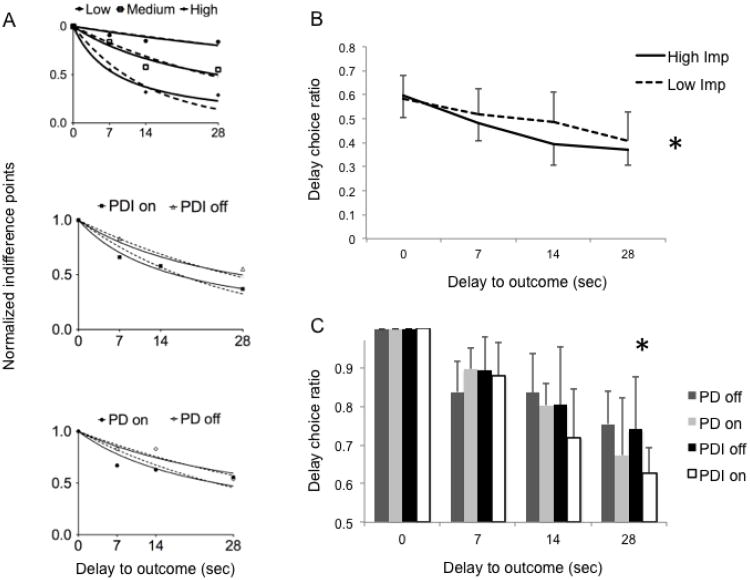
Indifference plots, fitted hyperbolic and exponential curves and delay choice ratios of the Experiential Discounting Task. (A) For illustration purposes, the indifference points at the four delay intervals are plotted for sample subjects with low, medium and high impulsivity (Hyperbolic K = 0.008, 0.35, 0.12 respectively) (top graph). The fitted hyperbolic curve (solid line) and exponential curve (dashed line) are shown. Similarly, sample subjects of patients with Parkinson disease (PD) and problem gambling/shopping (PDI) on and off dopamine agonists (DAs) (middle graph) and PD controls on and off DAs (bottom graph) are shown. (B) The line graphs represent the delayed choice ratios (delay choices/total choices) for the four delay intervals for all PDI and PD subjects dichotomized into non-impulsive (below median K) and impulsive subjects (above median K). [* The area under curve for the delay choice ratio curve is greater for the non-impulsive compared to the impulsive (df=54 t=2.53 p=0.02)]. (C) The bar graph represents the normalized delay choice ratios (delay choice ratio at each delay interval divided by ratio at t=0) for the PDI and PD subjects on and off DAs. [** F(3,52)=6.40 p=0.0009 for delay interval 28 seconds]. All error bars represent standard deviation.
Figure 3
Figure 3
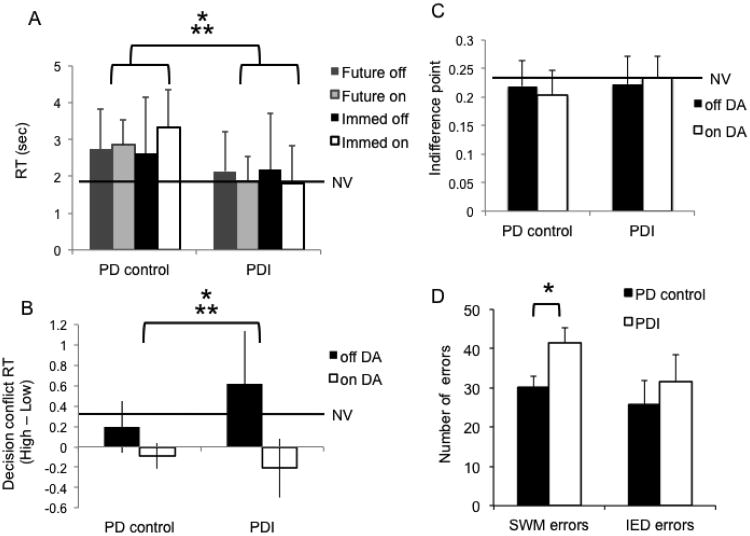
Reaction time (RT), decision conflict, probability and executive function. The graphs show the comparison between Parkinson disease (PD) patients with problem gambling/shopping (PDI) compared to PD controls on and off dopamine agonists (DAs). (NV = normal volunteers) (A) RT. The bar graph shows the mean RT [*group effect: F(1,26)=7.51, p=0.01; **group by medication interaction effect: F(3.24)=8.39, p=0.001]. (B) Decision conflict RT. The bar graph shows the difference between RTs during a high conflict choice near the indifference point and a low conflict choice earlier in the trial. A positive score indicates a longer decision time to choose between higher conflict choices compared to lower conflict choices. [*medication effect: F(1,26)=26.39, p<0.0001; **group by medication interaction effect: F(1,26)=6.16, p=0.02]. (C) Risk estimation. The bar graph shows the indifference point during the no delay choice (e.g. choice between an adjusting deterministic amount and a fixed probabilistic amount p=0.35). Higher scores indicate a higher subjective value associated with the risky choice (i.e. overestimation of risk). There was a trend toward a group by medication interaction [F(1,26)=3.84, p=0.06]. (C) Executive function. The bar graph represents the number of errors made in the spatial working memory task (SWM) and intra- and extra-dimensional set shifting (IED) tasks from the Cambridge Automated Neuropsychological Test Battery (*t=2.13, df=26, p=0.04). The tasks compared PDI patients and PD controls on DAs only. Normal volunteers were not assessed.

References

    1. Diagnostic and Statistical Manual of Mental Disorders. 4th. American Psychiatric Association; 1994.
    1. Belin D, Mar AC, Dalley JW, Robbins TW, Everitt BJ. High impulsivity predicts the switch to compulsive cocaine-taking. Science. 2008;320:1352–5. - PMC - PubMed
    1. Bickel WK, Marsch LA. Toward a behavioral economic understanding of drug dependence: delay discounting processes. Addiction. 2001;96:73–86. - PubMed
    1. Blokland A, Sik A, Lieben C. Evaluation of DOI, 8-OH-DPAT, eticlopride and amphetamine on impulsive responding in a reaction time task in rats. Behav Pharmacol. 2005;16:93–100. - PubMed
    1. Bordet R, Ridray S, Carboni S, Diaz J, Sokoloff P, Schwartz JC. Induction of dopamine D3 receptor expression as a mechanism of behavioral sensitization to levodopa. Proc Natl Acad Sci U S A. 1997;94:3363–7. - PMC - PubMed

Publication types

MeSH terms

Substances