Review
. 2010 Jan;61(1):14-26.
doi: 10.1016/j.phrs.2009.10.002. Epub 2009 Oct 17.

Viral vectors for neurotrophic factor delivery: a gene therapy approach for neurodegenerative diseases of the CNS

Affiliations
Review

Viral vectors for neurotrophic factor delivery: a gene therapy approach for neurodegenerative diseases of the CNS

Seung T Lim et al. Pharmacol Res. 2010 Jan.

Abstract

The clinical manifestation of most diseases of the central nervous system results from neuronal dysfunction or loss. Diseases such as stroke, epilepsy and neurodegeneration (e.g. Alzheimer's disease and Parkinson's disease) share common cellular and molecular mechanisms (e.g. oxidative stress, endoplasmic reticulum stress, mitochondrial dysfunction) that contribute to the loss of neuronal function. Neurotrophic factors (NTFs) are secreted proteins that regulate multiple aspects of neuronal development including neuronal maintenance, survival, axonal growth and synaptic plasticity. These properties of NTFs make them likely candidates for preventing neurodegeneration and promoting neuroregeneration. One approach to delivering NTFs to diseased cells is through viral vector-mediated gene delivery. Viral vectors are now routinely used as tools for studying gene function as well as developing gene-based therapies for a variety of diseases. Currently, many clinical trials using viral vectors in the nervous system are underway or completed, and seven of these trials involve NTFs for neurodegeneration. In this review, we discuss viral vector-mediated gene transfer of NTFs to treat neurodegenerative diseases of the central nervous system.


Figures

Figure 1
Figure 1. Models of neurotrophic factors secretion and site of action
Neurotrophic factors were initially identified for their ability to promote neurite outgrowth. NGF was the first neurotrophic factor identified (82, 190) and subsequent studies led to the “neurotrophic hypothesis” which states that developing neurons compete with each other for a limited supply of NTF provided by the target cell. (A) The innervating cell stimulates release of a NTF from the target cell and reinforces the interaction of the innervating neurite and the target cell. (B) Additional proteins with neurotrophic activity have subsequently identified to be secreted in both target-derived and non-target derived fashion to have autocrine or paracrine effects. Both neurons and glia can produce NTFs and the expression of specific NTF receptors determines a cell’s response to the NTFs present in the extracellular environment.
Figure 2
Figure 2. Neurotrophic factors act on receptor kinases to exert effects
Neurotrophic factors released into the extracellular environment bind to their cognate receptor or family of receptors with differing affinity. A) The NTF/receptor interaction can activate intracellular signaling via A) phosphorylation by a transmembrane coreceptor (e.g. GDNF) or B) phosphorylation by receptor dimerization (e.g. NGF). Receptor phosphorylation leads to the activation of various signaling pathways that have multiple effects on the cell including transcriptional activation, altered cellular metabolism and synaptic plasticity. For more details on TGF-beta receptors and neurotrophin receptor signaling see reviews (–194).
Figure 3
Figure 3. Directing neurotrophic factors to the region of diseased neurons
The tissue location of NTF production by a viral vector is determined by NTF receptor expression on diseased neurons (cell body versus processes) and tropism of the viral vector being used. Vectors can be delivered to the cell body (A-left) or neuritic processes (A-right) of the diseased neurons. (B) Viral vector targeting to the region of the neuron body can directly transduce the diseased neuron, glia or other neurons for secretion of the therapeutic NTF. (C) Viral vector placed in the region of the neuritic processes of the target neuron can lead to retrograde delivery of the vector genome to the nucleus of the target neuron (dashed line) or transduce glia or cells innervated by the diseased neuron to secrete the therapeutic NTF.
Figure 4
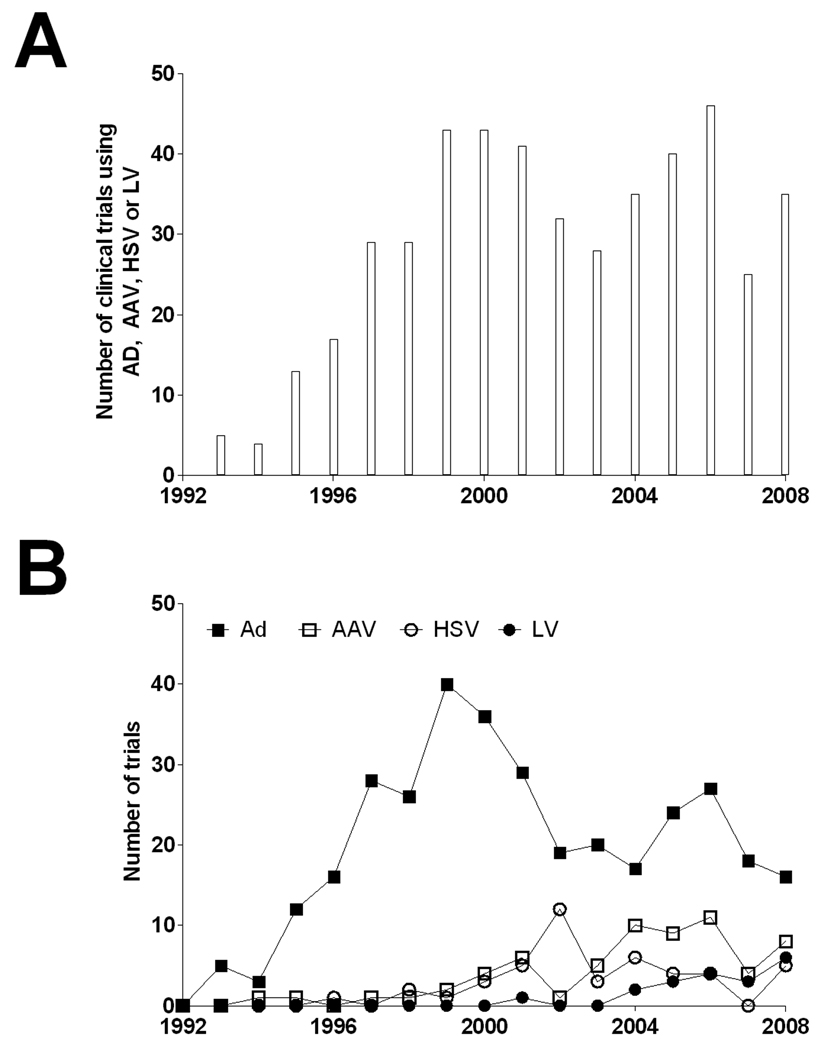
Figure 4. Worldwide clinical trials involving Ad, AAV, HSV or LV
(A) Total clinical trials for Ad, AAV, HSV and LV by year. (B) Total clinical trials for each vector by year. Trial numbers represent proposed, open, completed or discontinued trials listed at http://www.wiley.co.uk/genmed/clinical/ as of October 2009.

References

    1. Levi-Montalcini R. The nerve growth factor 35 years later. Science. 1987;237:1154–1162. - PubMed
    1. Yuen EC, Howe CL, Li Y, Holtzman DM, Mobley WC. Nerve growth factor and the neurotrophic factor hypothesis. Brain Dev. 1996;18:362–368. - PubMed
    1. Suhonen J, Ray J, Blomer U, Gage FH, Kaspar B. Ex vivo and in vivo gene delivery to the brain. Chapter 13. Curr Protoc Hum Genet. 2006 Unit 13 13. - PubMed
    1. Tuszynski MH, Thal L, Pay M, Salmon DP, U HS, Bakay R, Patel P, Blesch A, Vahlsing HL, Ho G, Tong G, Potkin SG, Fallon J, Hansen L, Mufson EJ, Kordower JH, Gall C, Conner J. A phase 1 clinical trial of nerve growth factor gene therapy for Alzheimer disease. Nat Med. 2005;11:551–555. - PubMed
    1. Majhenand D, Ambriovic-Ristov A. Adenoviral vectors--how to use them in cancer gene therapy? Virus Res. 2006;119:121–133. - PubMed

Publication types

MeSH terms

Substances