. 2009 Dec 14;425(1):159-68.
doi: 10.1042/BJ20090884.

Role of phosphoinositides in STIM1 dynamics and store-operated calcium entry

Affiliations

Role of phosphoinositides in STIM1 dynamics and store-operated calcium entry

Ciara M Walsh et al. Biochem J. .

Abstract

Ca2+ entry through store-operated Ca2+ channels involves the interaction at ER-PM (endoplasmic reticulum-plasma membrane) junctions of STIM (stromal interaction molecule) and Orai. STIM proteins are sensors of the luminal ER Ca2+ concentration and, following depletion of ER Ca2+, they oligomerize and translocate to ER-PM junctions where they form STIM puncta. Direct binding to Orai proteins activates their Ca2+ channel function. It has been suggested that an additional interaction of the C-terminal polybasic domain of STIM1 with PM phosphoinositides could contribute to STIM1 puncta formation prior to binding to Orai. In the present study, we investigated the role of phosphoinositides in the formation of STIM1 puncta and SOCE (store-operated Ca2+ entry) in response to store depletion. Treatment of HeLa cells with inhibitors of PI3K (phosphatidylinositol 3-kinase) and PI4K (phosphatidylinositol 4-kinase) (wortmannin and LY294002) partially inhibited formation of STIM1 puncta. Additional rapid depletion of PtdIns(4,5)P2 resulted in more substantial inhibition of the translocation of STIM1-EYFP (enhanced yellow fluorescent protein) into puncta. The inhibition was extensive at a concentration of LY294002 (50 microM) that should primarily inhibit PI3K, consistent with a major role for PtdIns(4,5)P2 and PtdIns(3,4,5)P3 in puncta formation. Depletion of phosphoinositides also inhibited SOCE based on measurement of the rise in intracellular Ca2+ concentration after store depletion. Overexpression of Orai1 resulted in a recovery of translocation of STMI1 into puncta following phosphoinositide depletion and, under these conditions, SOCE was increased to above control levels. These observations support the idea that phosphoinositides are not essential but contribute to STIM1 accumulation at ER-PM junctions with a second translocation mechanism involving direct STIM1-Orai interactions.


Figures
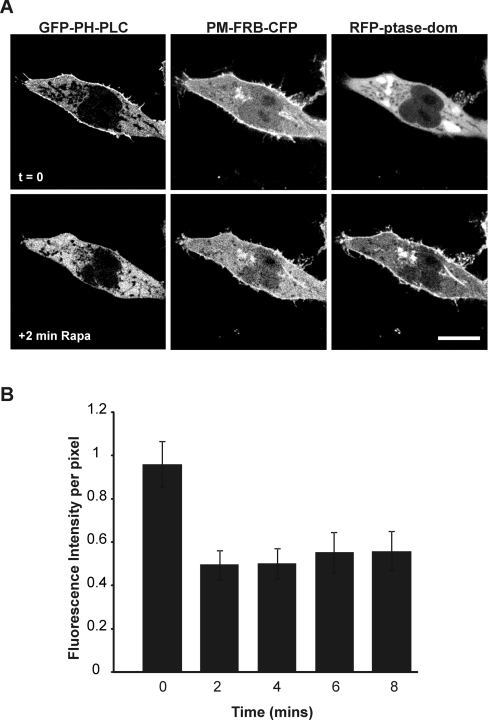
Figure 1
Figure 1. Activation of the inducible phosphatase results in rapid and efficient depletion of PtdIns(4,5)P2
HeLa cells were co-transfected with the GFP-PH-PLC, PM-FRB-CFP and RFP-ptase-dom constructs. At 24 h post-transfection, cells were treated with rapamycin (1 μM; Rapa). Rapamycin rapidly depleted PtdIns(4,5)P2 as shown by the removal of GFP–PH-PLC from the PM to the cytosol (A). Quantification of fluorescence at the PM reveals that depletion is complete within 2 min (B). Scale bar, 10 μm.
Figure 2
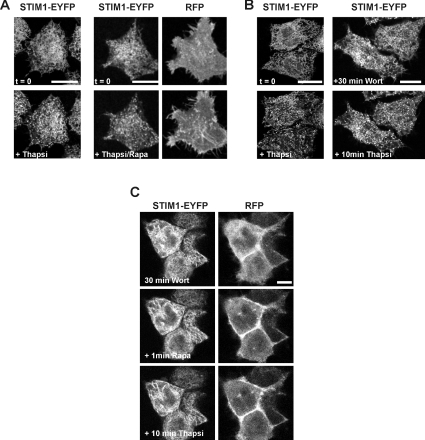
Figure 2. STIM1–EYFP translocation occurs in cells following depletion of either PtdIns(4,5)P2 or PtdIns4P/PtdIns(3,4,5)P3, but is inhibited by the depletion of multiple phosphoinositides
HeLa cells were transfected with either STIM1-EYFP alone or co-transfected with the STIM1-EYFP, PM-FRB-RFP and RFP-ptase-dom constructs. (A) Control cells treated only with thapsigargin are shown on the left. In cells which overexpress all three proteins, depletion of PtdIns(4,5)P2 by the rapamycin-inducible phosphatase did not prevent the translocation of STIM1–EYFP stimulated by thapsigargin. (B) Control cells treated only with thapsigargin are shown on the left. Inhibition of PI3K and PI4K by wortmannin (20 μM) pre-treatment did not prevent thapsigargin-induced STIM1 translocation in cells expressing STIM1–EYFP alone. (C) Cells were co-transfected with the STIM1-EYFP, PM-FRB-RFP and RFP-ptase-dom constructs and perfused with 20 μM wortmannin for 30 min followed by addition of rapamycin. Addition of thapsigargin had little or no effect on the distribution of STIM1. Scale bars, 10 μm. Rapa, rapamycin; Thapsi, thapsigargin; Wort, wortmannin.
Figure 3
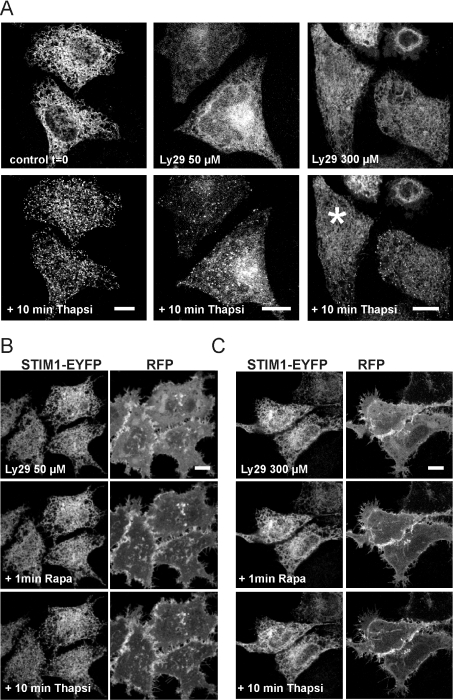
Figure 3. Translocation of STIM1–EYFP is inhibited by the depletion of multiple phosphoinositides in cells treated with LY294002
HeLa cells were co-transfected with the STIM1-EYFP, PM-FRB-RFP and RFP-ptase-dom constructs. (A) Cells were perfused with no additions (controls), or 50 or 300 μM LY294002 for 30 min followed by addition of thapsigargin, which resulted in some STIM1 translocation into puncta under all conditions. Note that after treatment with 300 μM LY294002, few ST1M1 puncta formed in some cells (e.g. the cell marked by an asterisk). (B) Cells were perfused with 50 μM LY294002 for 30 min followed by addition of rapamycin. Treatment with thapsigargin had little effect on the distribution of STIM1. (C) Cells were perfused with 300 μM LY294002 for 30 min followed by addition of rapamycin. Treatment with thapsigargin had little effect on the distribution of STIM1. Scale bar, 10 μm. Ly29, LY294002; Rapa, rapamycin; Thapsi, thapsigargin.
Figure 4
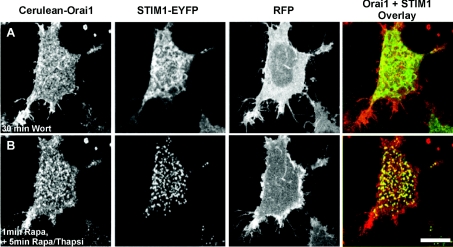
Figure 4. Overexpression of Orai1 rescues STIM1 puncta formation following depletion of phosphoinositides
HeLa cells were co-transfected with STIM1-EYFP, PM-FRB-RFP and RFP-ptase-dom constructs and Cerulean-Orai1. The cells were treated with 20 μM wortmannin (A) followed by addition of rapamycin to deplete PtdIns(4,5)P2. Overexpression of Orai1 rescued thapsigargin-stimulated translocation of STIM1 (B). Scale bar, 10 μm. Rapa, rapamycin, Thapsi, thapsigargin; Wort, wortmannin.
Figure 5
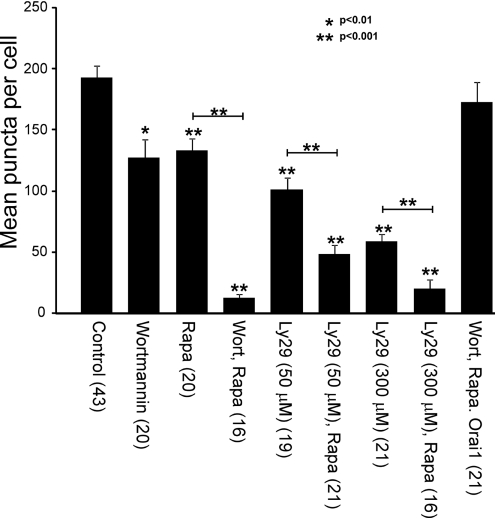
Figure 5. Quantification of puncta formed in response to thapsigargin treatment and the effect of depletion of PtdIns(4,5)P2 and inhibition of lipid kinases
Cells from the various treatments used in the study were analysed and the number of puncta formed following thapsigargin treatment counted and expressed as mean per cell±S.E.M. based on the number of cells indicated in parentheses. The statistical significance of values for all conditions are compared with control thapsigargin-treated cells, and indicated pairwise comparisons were determined using a two-tailed Student's t test. Statistically significant differences are indicated. Ly29, LY294002; Rapa, rapamycin, Thapsi, thapsigargin; Wort, wortmannin.
Figure 6
Figure 6. Phosphoinositide depletion reduces store-operated Ca2+ influx but this is reversed by the overexpression of Orai1
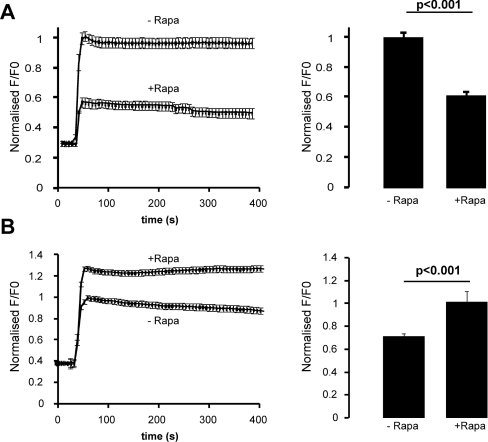
(A) HeLa cells were transfected with the STIM1-EYFP, PM-FRB-RFP and RFP-ptase-dom constructs. At 48 h post-transfection, cells were loaded with fluo-4/AM (5 μM) and incubated in wortmannin (20 μM) for 30 min. Intracellular stores were depleted with thapsigargin (2 μM). Re-addition of Ca2+ to the external solution 420 s later allowed the measurement of Ca2+ influx in cells which had been treated with or without rapamycin (Rapa). Rapamycin treatment resulted in the inhibition of Ca2+ influx when compared with cells which had been incubated in the absence of rapamycin, as shown in the averaged traces. Quantification of the average peak values of Ca2+ influx from these traces revealed a significant decrease in peak [Ca2+]i values in rapamycin-treated cells. (B) In a similar experiment but with HeLa cells also overexpressing Orai from pcDNA3, Ca2+ influx was restored in rapamycin-treated cells to levels greater than that of cells which had not been treated with rapamycin, as shown in the averaged traces and the peak [Ca2+ ]i values.
Figure 7
Figure 7. Phosphoinositide depletion reduces store-operated Ca2+ influx due to endogenous STIM1
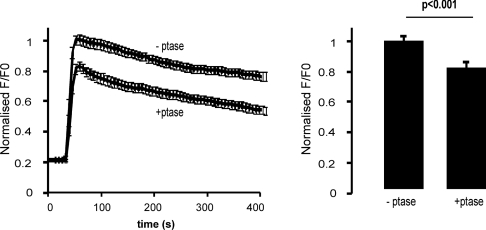
Cells were transfected with the PM-FRB-RFP and RFP-ptase-dom constructs. At 48 h post-transfection, cells were loaded with fluo-4/AM (5 μM) and incubated with wortmannin (20 μM) for 30 min and treated with rapamycin (1 μM) before thapsigargin treatment and re-addition of Ca2+ to the external solution after 620 s. In this experiment, [Ca2+]i was monitored in transfected (+ptase; n=22) and non-transfected cells (−ptase; n=18) in the same microscope fields and directly compared so that all cells had been treated with rapamycin.

References

    1. Parekh A. B., Putney J. W., Jr Store-operated calcium channels. Physiol. Rev. 2005;85:757–810. - PubMed
    1. Putney J. W., Jr A model for receptor-regulated calcium entry. Cell Calcium. 1986;7:1–12. - PubMed
    1. Roos J., DiGregorio P. J., Yeromin A. V., Ohlsen K., Lioudyno M., Zhang S., Safrina O., Kozak J. A., Wagner S. L., Cahalan M. D., et al. STIM1, an essential and conserved component of store-operated Ca2+ channel function. J. Cell Biol. 2005;169:435–445. - PMC - PubMed
    1. Liou J., Kim M. L., Heo W. D., Jones J. T., Myers J. W., Ferrell J. E., Jr, Meyer T. STIM is a Ca2+ sensor essential for Ca2+-store-depletion-triggered Ca2+ influx. Curr. Biol. 2005;15:1235–1241. - PMC - PubMed
    1. Feske S., Gwack Y., Prakriya M., Srikanth S., Puppel S. H., Tanasa B., Hogan P. G., Lewis R. S., Daly M., Rao A. A mutation in Orai1 causes immune deficiency by abrogating CRAC channel function. Nature. 2006;441:179–185. - PubMed

Publication types

MeSH terms

Substances